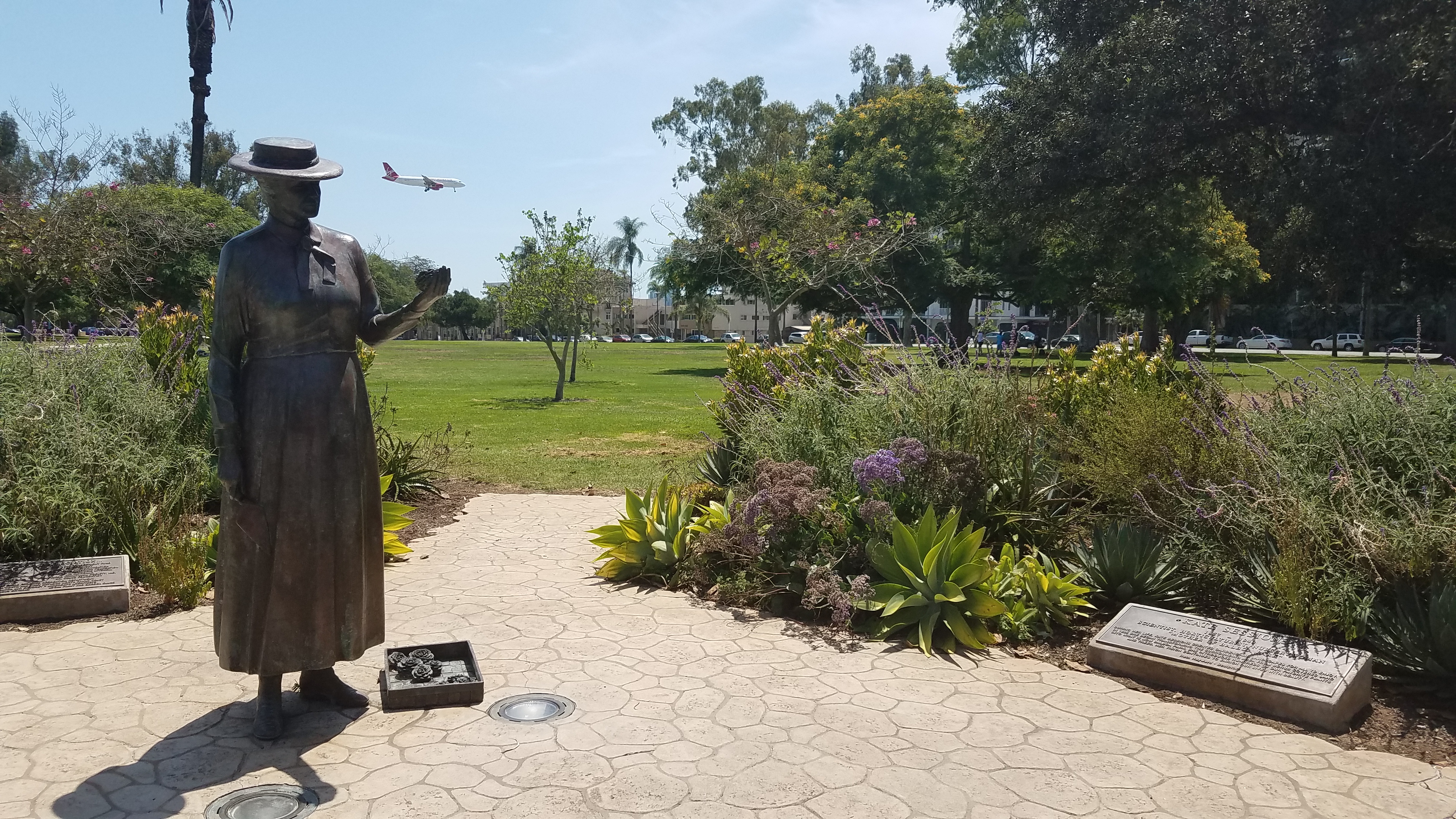
Kate Sessions
Katherine Olivia Sessions spent sixty years working twelve-to-fourteen-hour days as a botanist, horticulturalist, and landscape architect in San Diego — importing plants from around the world, planting trees in Balboa Park in exchange for a nursery lease, and transforming the look of an entire city.
A Bargain With the City
In 1892, Katherine Sessions went to the City of San Diego with a proposal. She wanted to lease 30 acres of land in the undeveloped park that the city had set aside on a mesa above downtown. In exchange for the right to operate her nursery there, she would plant 100 trees a year inside the park and donate 300 more for planting throughout San Diego.
The city agreed. The bargain would prove to be one of the most consequential real estate transactions in San Diego's history — not because of the money involved, which was modest, but because of what Sessions did with it.
Sessions was born in San Francisco on November 8, 1857. She earned a degree in science from the University of California in 1881, one of the early women to graduate from the institution. She came to San Diego in 1884 and spent the rest of her life there, working in plants and soil until her death on March 24, 1940.
What She Planted
The Balboa Park of today — with its towering eucalyptus trees, its palms, its flowering coral trees and jacarandas, its layered mix of California natives and imported species — is largely Sessions's creation. She brought in plants from Australia, South America, South Africa, and across California, testing what would grow in San Diego's climate and selecting the species that would thrive.
Sessions understood plant ecology in a practical, scientific way that was unusual for the era. She knew which species would anchor hillsides against erosion, which would provide shade on the park's exposed mesa, which would attract birds and create habitat. Her choices were not purely aesthetic — they were informed by knowledge of how plants functioned in relationship to each other and to the land.
She also founded Mission Hills Nursery in 1910, extending her work beyond Balboa Park into the residential neighborhoods of San Diego. The plants she supplied and the advice she offered shaped gardens and streetscapes across the city.
Sixty Years of Work
Sessions worked at a pace that was, by contemporary accounts, extraordinary. Twelve-to-fourteen-hour days were routine. She took only two vacations in her career. The work was physical — nursery work and landscape work require constant labor — as well as intellectual, requiring continuous learning about new species, new growing conditions, and new applications.
She was also a communicator. Sessions wrote for newspapers and horticultural journals, spreading knowledge about California plants to gardeners who might otherwise have defaulted to the lawn-and-formal-garden conventions that immigrants brought from the East Coast and from Europe. She argued for plants that suited the California climate, for native and near-native species, for gardens that worked with the land rather than against it.
In 1939, a year before her death, she became the first woman to receive the Frank N. Meyer Medal, the highest honor given by the American Genetic Association for plant collecting and introduction — recognition, near the end of a long career, that her contributions to American horticulture had been exceptional.
The Mother of Balboa Park
The title 'Mother of Balboa Park' was given to Sessions by the people who knew her work and understood what she had done. It is not an exaggeration. The park's character — its vegetation, its shade, its layered botanical richness — reflects six decades of Sessions's choices, applied at a scale that transformed 1,200 acres of bare California mesa into one of the most beautiful urban parks in the country.
A park in Pacific Beach is named after her. Her portrait hangs in the San Diego Hall of Champions. The street trees she planted still shade neighborhoods across the city.
But the most enduring monument to Kate Sessions is Balboa Park itself. Every jacaranda blooming purple in the spring, every eucalyptus providing shade over a picnic, every coral tree flowering red against the California sky — these are her work, still growing.
From the Air
Kate Sessions's most famous work is Balboa Park, which is clearly visible on approach to KSAN (San Diego International Airport) — the green expanse of the park on the mesa northeast of downtown, with the distinctive architecture of the 1915 Panama-California Exposition buildings at its heart. Kate O. Sessions Memorial Park is located in Pacific Beach, approximately 6 miles northwest of the airport. Her nursery work extended across the entire city and is visible in the tree canopy of San Diego's residential neighborhoods.