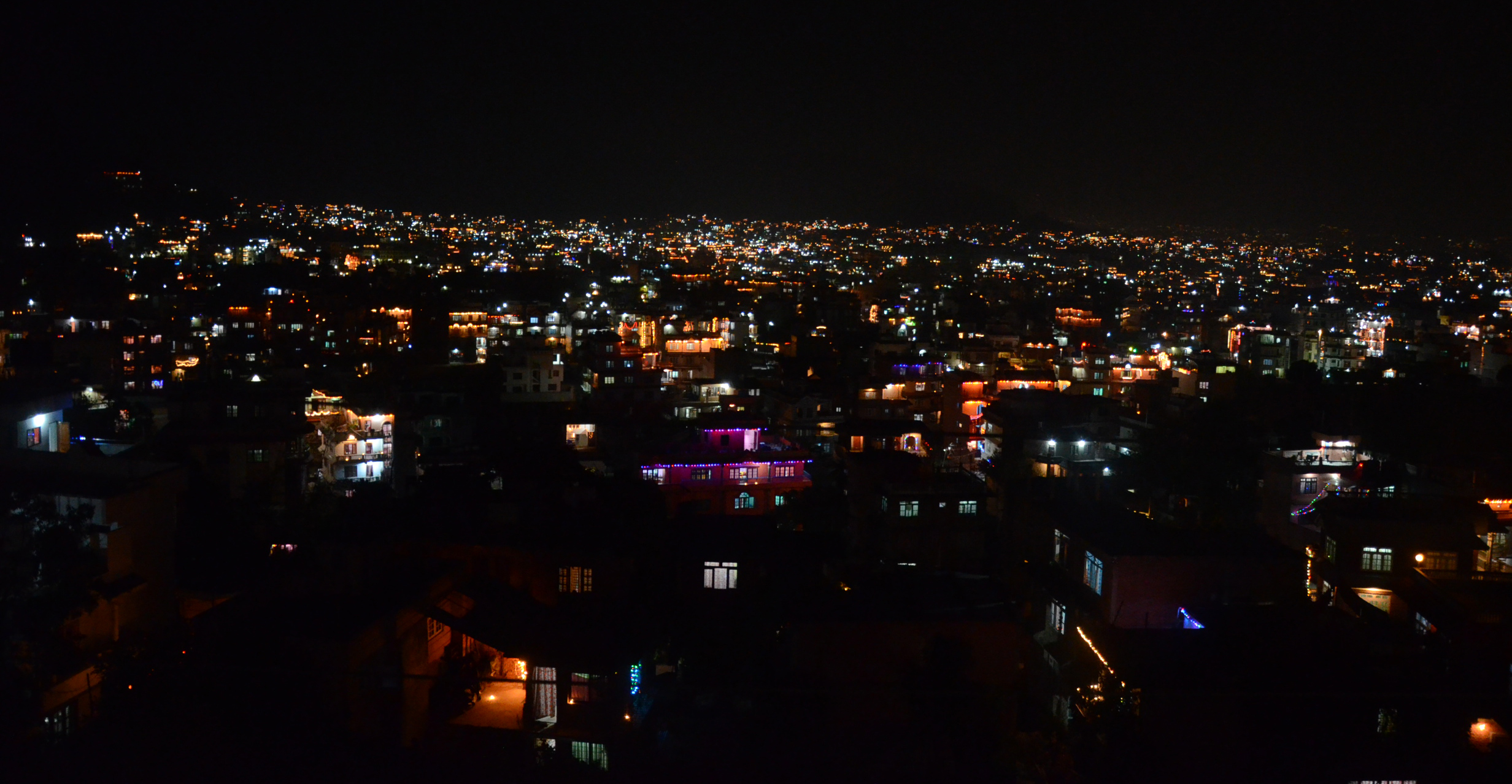
Kathmandu
Kathmandu sits in a bowl-shaped valley at 1,400 meters, surrounded by hills that block the Himalayan peaks from view until you climb above them. The valley held three kingdoms - Kathmandu, Patan, and Bhaktapur - that competed in temple-building until Nepal's unification in 1768. The architecture that competition produced, the pagodas and stupas and palace squares, earned the valley seven UNESCO World Heritage Sites. The 2015 earthquake, magnitude 7.8, killed nearly 9,000 people and damaged or destroyed monuments that had stood for centuries. Reconstruction continues, the valley rebuilding what nature destroyed. Kathmandu holds 1.5 million people in the city, over 5 million in the valley, a population that has grown as Nepal has modernized and migration from rural areas has accelerated. The city is chaos - traffic without rules, pollution without limits, construction without plan - and also the gateway through which everyone who climbs Everest must pass.
Durbar Square
Kathmandu's Durbar Square held the royal palace of the Malla kings who ruled until 1768 and the Shah kings who ruled until 2008 when Nepal became a republic. The square's temples - Taleju, Jagannath, the Kumari House where the living goddess lives - represent centuries of competitive construction, each king adding monuments to surpass predecessors. The Hanuman Dhoka palace complex sprawls behind, its courtyards and towers a museum of Nepalese history.
The 2015 earthquake collapsed several temples in the square, their centuries-old brick and wood construction unable to withstand the shaking. Restoration has been slow, complicated by debates about whether to rebuild authentically or strengthen against future earthquakes. The scaffolding and cranes that fill the square today mark progress, but the work will take decades. What remains standing shows what was lost - architecture so distinctive that UNESCO created special categories to protect it.
The Stupas
Boudhanath stupa, one of the largest in the world, sits northeast of central Kathmandu, its whitewashed dome and all-seeing eyes watching over a Tibetan Buddhist community that settled after China invaded Tibet in 1950. The stupa predates the invasion by over a millennium - legend dates it to the 5th century - but the Tibetan refugees who built monasteries around it gave it new significance. The prayer wheels that pilgrims spin, the butter lamps that light the shrine rooms, the maroon-robed monks who circumambulate at dawn belong to a Tibetan culture that survives in exile.
Swayambhunath, older and smaller, sits on a hill west of the city, its gold-topped stupa visible from across the valley. The monkeys that inhabit the temple complex give it the tourist name 'Monkey Temple,' though the Buddhist and Hindu shrines that share the hilltop have nothing to do with primates. Both stupas suffered earthquake damage; both have been restored; both remain spiritual centers where belief persists despite tourism.
Pashupatinath
Pashupatinath temple, on the banks of the Bagmati River, is Nepal's most sacred Hindu site - dedicated to Shiva in his form as lord of animals, closed to non-Hindus, its gold-roofed pagoda visible only from outside the walls. The ghats along the river serve for cremation, the bodies burned on stepped platforms as families watch and priests attend. Tourists photograph from the opposite bank, the death rituals of others becoming spectacle.
The temple complex extends beyond the main shrine - hundreds of smaller temples and shrines, many housing ascetic sadhus whose ash-covered bodies and matted hair mark their renunciation of ordinary life. The Shivaratri festival brings hundreds of thousands of pilgrims, the grounds filling with devotees who have walked for days to reach the god. Pashupatinath survived the earthquake with minor damage, its stone construction more resilient than the brick temples elsewhere.
The Gateway to Everest
Every Everest climber passes through Kathmandu - obtaining permits at the Ministry of Tourism, buying gear in Thamel's outdoor shops, flying to Lukla for the trek to base camp. The mountaineering industry that began with Hillary and Tenzing in 1953 has become major business: over 800 people summit Everest in busy years, each paying tens of thousands of dollars for permits, guides, and equipment. Kathmandu captures a share of every dollar.
Thamel, the tourist district, caters to this trade - shops selling North Face knockoffs and genuine gear side by side, restaurants serving every cuisine climbers might crave, hotels ranging from backpacker hostels to luxury establishments. The contrast between climbers' budgets and local incomes creates the peculiar economy of adventure tourism, where spending in days what Nepalis earn in months is normal. Kathmandu has always been a gateway - to Tibet, to India, to the mountains - and commerce has always followed.
The Valley Air
Kathmandu's air pollution ranks among the worst in the world, the valley's bowl shape trapping emissions from vehicles, brick kilns, and cooking fires. The black clouds that hang over the city on still days obscure the surrounding hills; the respiratory illnesses that affect residents are endemic. The government has tried solutions - banning older vehicles, moving brick kilns outside the valley - but enforcement is inconsistent and growth is constant.
The pollution is worst in winter when temperature inversions trap cold air in the valley floor. On bad days, residents wear masks and schools close; the tourists who come for mountain views see only haze. Climate change worsens the problem - reduced winter rainfall means less washing of the air. Kathmandu's population continues to grow regardless, the economic opportunities in the capital outweighing the health costs that statistics cannot fully capture.
From the Air
Kathmandu (27.70N, 85.32E) sits in a valley at 1,400m elevation surrounded by hills. Tribhuvan International Airport (VNKT/KTM) is located 6km east of the city center with one runway 02/20 (3,050m). The airport is challenging - surrounded by hills requiring specific approach procedures. The Himalayan range is visible to the north on clear days. Boudhanath and Swayambhunath stupas are visible landmarks. The valley is densely populated. Weather is subtropical highland - warm wet monsoon (June-Sept), cool dry winter. Visibility often poor due to pollution and haze. Mountain flying in the region requires specialized training and conditions.