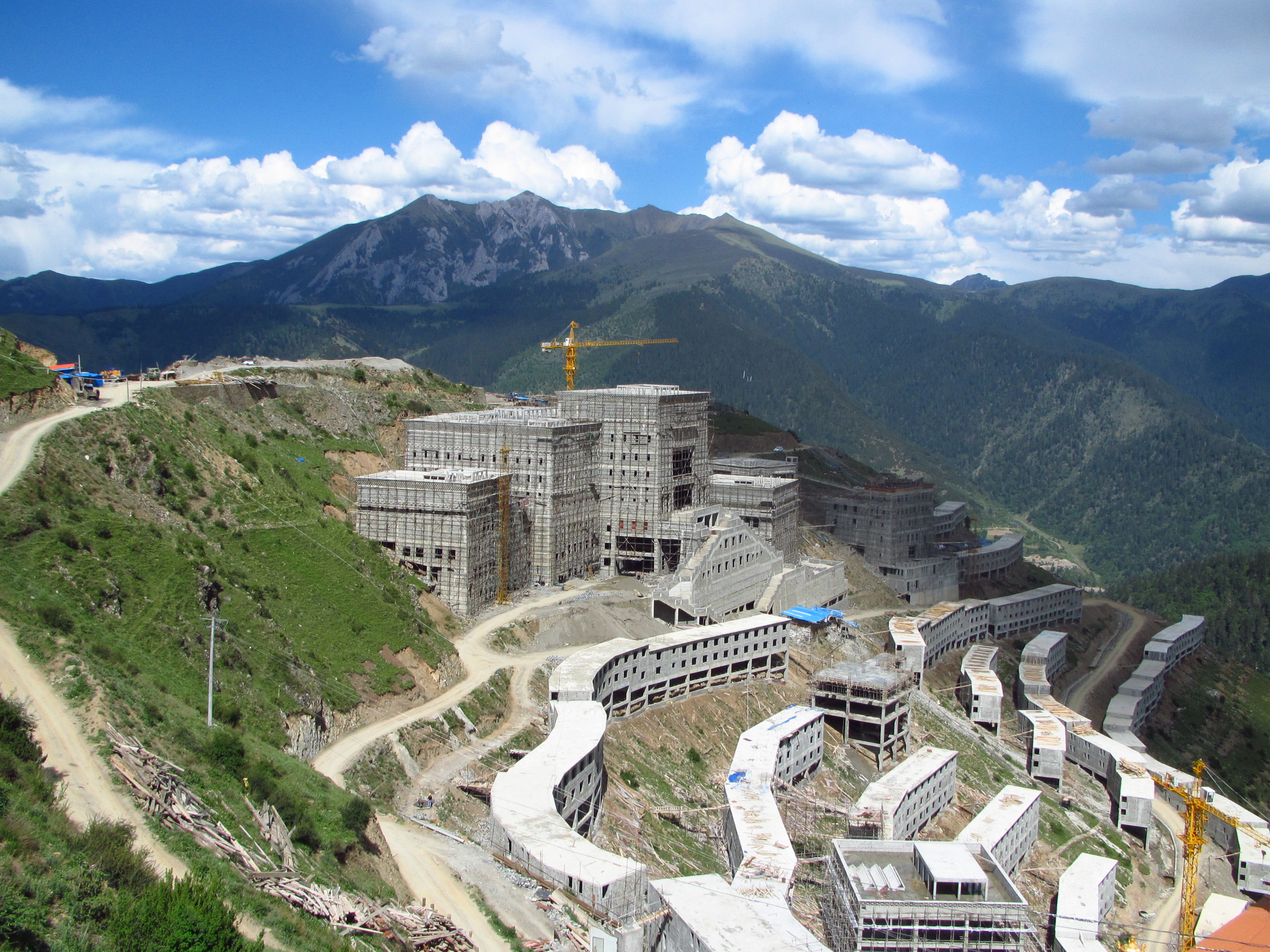
Kathok Monastery
Eighteen hairpin turns on a dirt road. That is what separates the valley floor from Kathok Monastery, one of the oldest and most revered Nyingma Buddhist institutions in Tibet. Founded in 1159 in the Kingdom of Derge -- present-day Baiyu County, Sichuan -- Kathok is one of the Six Mother Monasteries of the Nyingma school, the oldest lineage of Tibetan Buddhism. Before the monastery existed, Padmasambhava himself is said to have spent 25 days at this site, sitting on a rock marked with a double vajra and a sacred syllable. The monastery was built on that rock, and its name means "on top of the ka" -- a reference to the syllable Guru Rinpoche left behind. It is counted among his 25 sacred sites in the Do Kham region.
The Prophecy of a Hundred Thousand Rainbow Bodies
Kathok was founded by Kathok Kadampa Deshek, a younger brother of the influential master Phagmo Drupa Dorje Gyalpo. According to tradition, Guru Rinpoche prophesied that Deshek would be an emanation of Yeshe Tsogyal, the legendary female consort of Padmasambhava, and that 100,000 people would achieve rainbow body at Kathok -- the highest form of spiritual realization in Dzogchen practice, in which the physical body dissolves into light at the moment of death. The prophecy is said to have been fulfilled. Whether one takes such claims literally or metaphorically, they speak to the extraordinary spiritual reputation Kathok cultivated over centuries. By the time of Tibet's annexation in 1951, about 800 monks lived at the monastery, and numerous branch institutions had spread across the Do Kham region and beyond.
Guardians of the Oral Lineage
Kathok distinguished itself as a center of the Kama lineages -- the oral transmission teachings of the Nyingma school, as opposed to the Terma or hidden treasure traditions. This specialization gave Kathok a particular scholarly gravity. The monastery's third abbot, Jampa Bum, whose 26-year tenure ended in 1252, is said to have ordained thousands of monks from across Tibet, drawing students from the Kham regions of Minyak, Jang, and Gyemorong. In 1999, disciples of Kenpo Munsel and Kenpo Jamyang compiled a Kathok edition of the oral lineages running to 120 volumes -- twice the size of the Dudjom edition, containing rare Nyingma treatises on Mahayoga, Anuyoga, and Atiyoga that had never been seen outside Tibet. Kathok also became the last bastion of the Anuyoga tradition when other Nyingma institutions let it decline.
Destruction, Prison, and Rebuilding
The original monastery fell into disrepair and was rebuilt on the same site in 1656, driven by the energy of two treasure-revealers: Duddül Dorje and Rigdzin Longsal Nyingpo. Under Longsel Nyingpo's influence, Kathok evolved its dual emphasis on both Kama and Terma traditions. Then came 1966. During the Cultural Revolution, the monastery was destroyed and its lamas imprisoned. The rebuilding that followed was led by Moktsa Tulku, who began the work after his release from prison, aided by Khenpo Ngakchung Tulku. The human cost extended beyond the monastery walls. Katok Situ Chokyi Nyima, one of Kathok's lauded scholars, died of starvation in Gothang Gyalgo prison camp in 1962. These losses make the monastery's survival not merely an architectural achievement but an act of cultural resilience carried forward by individuals who paid dearly for their commitment.
The Yogi Who Split a Cliff
Among the more colorful figures in Kathok's history is Chopa Lugu, the 1st Chonyi Gyatso, who lived sometime between the seventeenth and mid-eighteenth centuries. He earned the title "The Chod Yogi Who Split a Cliff in China" and was remembered for his nightly bellowing of bone-trumpet and shouting of phet during pilgrimage -- much to the irritation of the business traveler who accompanied him. The contrast between Chopa Lugu's ecstatic practice and his companion's annoyance captures something essential about Kathok's character: this was never a place of quiet, decorous religion alone. Dzongsar Khyentse Chokyi Lodro, one of the twentieth century's most important Tibetan Buddhist masters, was educated here. The 4th Kathok Getse Rinpoche, known for his mastery of Dzogchen, served as the 7th head of the entire Nyingma school in 2018, the year he died in an accident. Scholarship, eccentricity, devotion, and loss -- Kathok's story holds all of them.
From the Air
Located at 31.31°N, 98.94°E in Baiyu County, Garze Tibetan Autonomous Prefecture, Sichuan. The monastery sits high on the eastern flanks of a mountain range, accessed by a dirt road with 18 hairpin turns. The nearest town is Horpo, 17 km to the north. Nearest significant airport is Kangding Airport (ZUKD), approximately 350 km to the southeast, or Qamdo Bamda Airport (ZUBD) roughly 300 km to the west. Extremely mountainous terrain with deep valleys. The monastery complex above the valley floor would be difficult to spot from altitude, but the hairpin road may be visible.