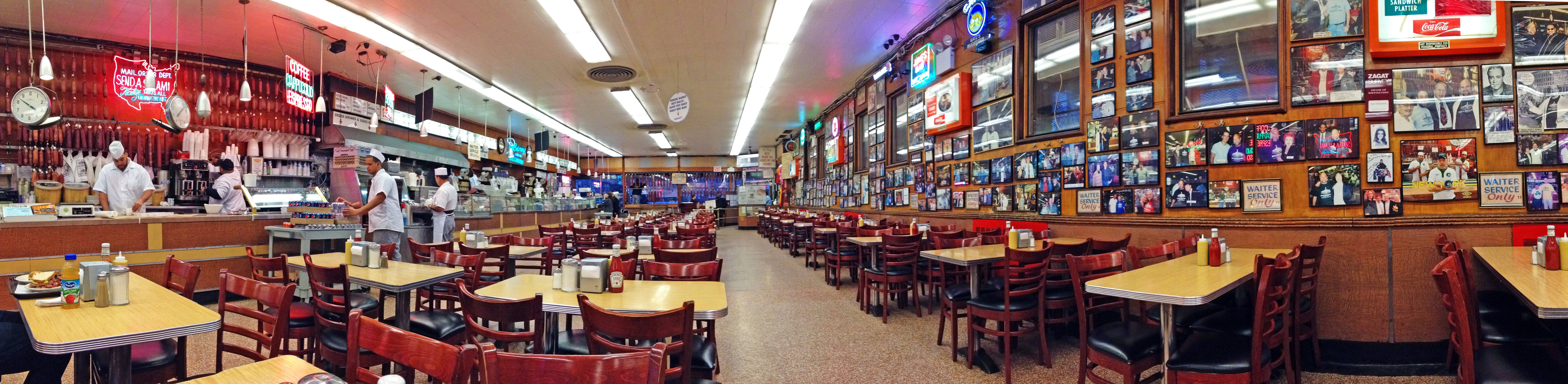
Katz's Delicatessen
You do not simply walk into Katz's Delicatessen. A door attendant hands you a numbered ticket as you enter, and from that moment forward, every sandwich, every hot dog, every fountain drink is tallied on that slip of paper. Lose the ticket and you owe fifty dollars -- a house rule that tells you something about the place: Katz's does not bend, not for you, not for anyone, not since 1888. At 205 East Houston Street, on the corner of Ludlow, the fluorescent-lit dining hall is a time capsule of formica tables, hanging salamis, and hand-carved pastrami that Zagat ranked as the best in New York City. Each week, the countermen work through 15,000 pounds of pastrami, thousands of pounds of corned beef and salami, and 4,000 hot dogs. The slogan painted on the side of the building reads, "Send A Salami To Your Boy In The Army" -- a family tradition from World War II that became a permanent fixture when nobody had the heart to take the sign down.
A Deli That Predates the Subway
The original delicatessen dates to 1888, though food writer Robert F. Moss has challenged some of the founding mythology, noting that Ellis Island records show the Iceland brothers -- Morris and Hyman -- did not immigrate until 1902, and their delicatessen appears in records only by 1911. Whatever the precise origins, the business eventually passed through the Katz and Tarowsky families, who ran it for decades. When subway construction for the Houston Street Line in the 1930s forced the deli to move across the street, barrels of meat and pickles occupied the vacant Houston Street lot until a proper storefront facade was added between 1946 and 1949. The entrance stayed on Ludlow Street, preserving the deli's orientation toward the old tenement neighborhood rather than the busier thoroughfare.
Family Business, No Heirs Required
Ownership of Katz's has passed through hands that were not always blood relations, a pattern that has kept the deli alive when family succession failed. After Willy Katz died, his son Lenny took over. When both Benny Katz and Harry Tarowsky died in 1980, the business passed to Benny's son-in-law Artie Makstein and Harry's son Izzy. In 1988, on the centennial, Lenny, Izzy, and Arthur -- none of whom had children to inherit the business -- sold to restaurateur Martin Dell, his chef son Alan, and Martin's son-in-law Fred Austin. Alan's son Jake joined in 2009 and now runs major operations. The pattern is almost genetic: every generation that has touched Katz's has found someone willing to stand behind the counter and keep carving. In 2017, the family opened a satellite location in Downtown Brooklyn's DeKalb Market Hall and launched worldwide mail-order shipping.
I'll Have What She's Having
Katz's cultural footprint extends far beyond its pastrami. The deli's most famous moment occurred in Rob Reiner's 1989 film When Harry Met Sally, when Meg Ryan demonstrated a fake orgasm at a table while Billy Crystal looked on in bewilderment. Estelle Reiner, the director's mother, delivered the line that made the scene immortal: "I'll have what she's having." In February 2025, Ryan and Crystal returned to the deli for a Hellmann's mayonnaise commercial that aired during Super Bowl LIX, with Crystal quipping, "I can't believe they let us back in here!" This time, Sydney Sweeney delivered the famous line. Katz's has also appeared in Donnie Brasco, Across the Universe, We Own the Night, Enchanted, and the documentary Deli Man. The dining room has served as a set for Law & Order, Impractical Jokers, and Man v. Food. For filmmakers, the appeal is the same as for diners: the place looks exactly like what it is.
Catchphrases and Lost Tickets
The signage at Katz's reads like found poetry. "Send A Salami To Your Boy In The Army" originated during World War II, when the owners' sons -- Lenny Katz and Izzy Tarowsky -- were both serving overseas, and the family tradition of mailing food became the company's enduring slogan. The other catchphrase, "Katz's, that's all!" exists because of a miscommunication: when a signmaker asked Harry Tarowsky what to put on the deli's sign, Harry replied "Katz's, that's all" -- meaning he was done talking. The signmaker painted it verbatim. Both phrases remain on the building today, weathered but legible, as much a part of the Lower East Side streetscape as the fire escapes above them. Inside, the ticket system persists as a relic of a pre-digital economy, enforced with the fifty-dollar lost-ticket penalty that ensures nobody tries to swap a large tab for a smaller one.
From the Air
Located at 40.7223N, 73.9874W on Manhattan's Lower East Side, at the southwest corner of Houston and Ludlow Streets. The deli occupies a corner storefront in the dense tenement grid below Houston Street. From altitude, look for the intersection of Houston Street (a major east-west artery) and Ludlow Street, with the distinctive signage visible at low altitude. Nearby landmarks include the Williamsburg Bridge to the east and Sara D. Roosevelt Park to the west. Closest airports: KJFK (John F. Kennedy International, 13 nm SE), KLGA (LaGuardia, 8 nm NE), KEWR (Newark Liberty, 10 nm W). Best viewed at 1,500-2,000 ft AGL for neighborhood context.