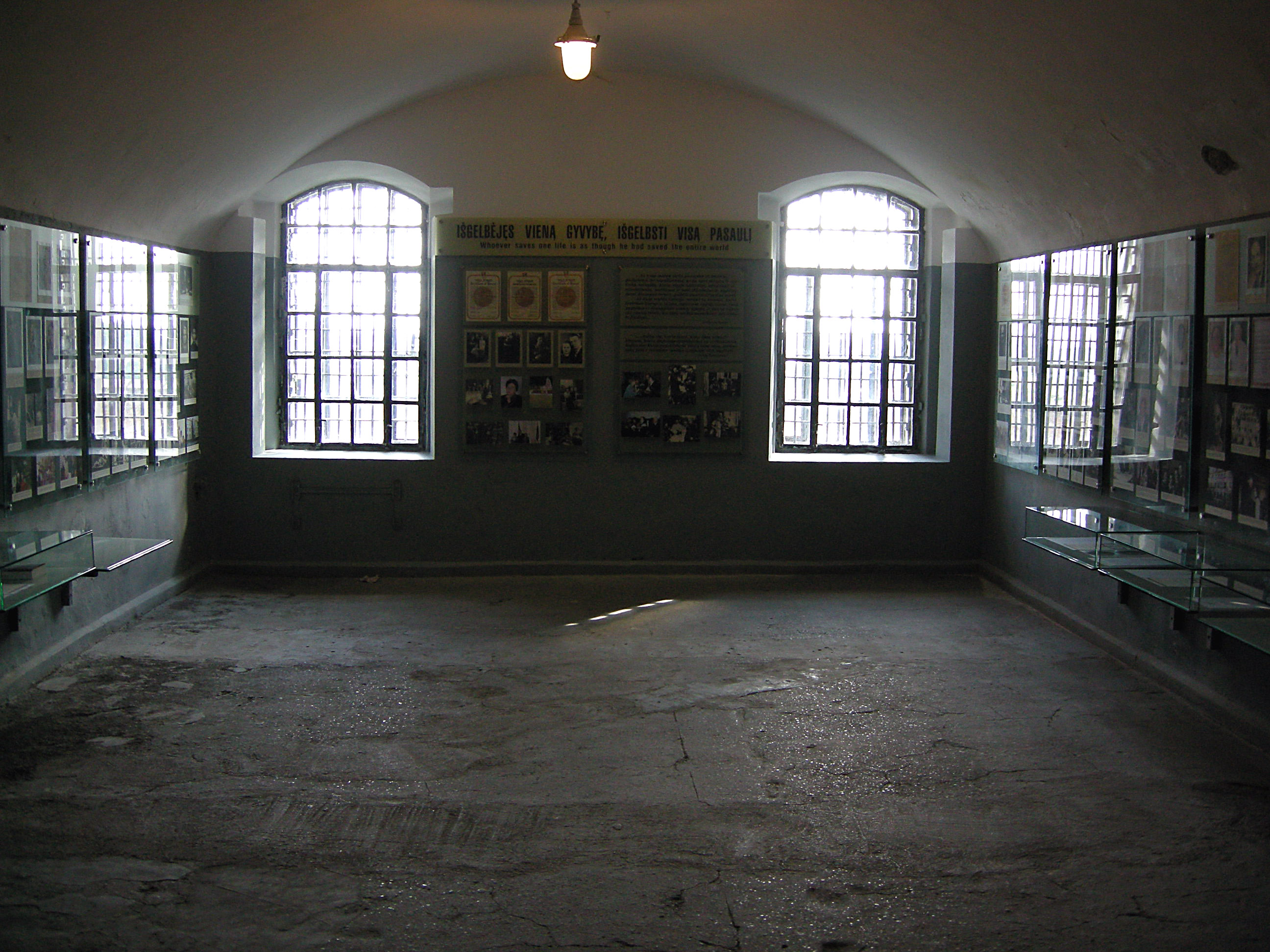
Kaunas Fortress
In 1812, Napoleon's Grande Armée crossed the Nemunas near Kaunas on its way to Moscow without serious resistance, and the Russian Empire never forgot it. By the 1870s a more dangerous Germany was unifying to the west, and Tsar Alexander II decided that the road to Vilnius and Riga would not be left open a second time. On July 7, 1879, he ordered the construction of a first-class fortress at Kaunas. Sixty-five square kilometers of Lithuanian land would be ringed with seven brick forts and nine artillery batteries arranged in concentric loops, eventually expanded to eight forts and then to a Ninth Fort that introduced reinforced concrete, electricity, and armored watchtowers to a fortress system designed for the artillery duels of the next century. By the time it was complete in 1915, it was the largest defensive complex in the Russian Empire. Decades later, the same Ninth Fort would become a place where roughly fifty thousand people were murdered.
The Empire's Western Wall
Construction began in 1882. About four thousand workers built the first generation of forts: brick faces, thick earth ramparts incorporated into the natural relief, the whole complex deliberately hard to see and harder to breach. Generals Nikolay Obruchev, Konstantin Zverev, and Ivan Volberg oversaw the original design. By 1887 the fortress was officially designated first-class, the highest tier in the Russian system, and Otto Klem became its first commandant. In 1890, work on the Eighth Fort introduced the new technology of reinforced concrete to Russian military engineering. The Ninth Fort, begun in 1903, was the first of its kind in the empire—a trapezoid with one infantry rampart, two armored watchtowers, electricity, ventilation, and cannon casemates lined with cork to muffle the noise of firing.
What the Fortress Was For—and What It Could Not Stop
Russia spent more than three decades building Kaunas Fortress to repel an invasion from the west. When the invasion came in 1915, the fortress fell quickly. The German Tenth Army under Paul von Hindenburg captured Kaunas after a brief siege; the legendary defensive complex had been outpaced by the artillery and tactics of the First World War. After 1918, the new independent Lithuania inherited the forts. Some became civil institutions—the Sixth and Ninth held prisoners, the Seventh housed the Central Archive—and others were used as army barracks. The military logic that had built them was already obsolete. Their next use would have nothing to do with defense at all.
1941: The Great Action
The 1939 Molotov-Ribbentrop Pact assigned Lithuania to the Soviet sphere; the USSR occupied the country in June 1940 and immediately turned the fortress into a prison and interrogation site for political prisoners. When Germany broke the pact and invaded the Soviet Union on June 22, 1941, Kaunas fell to the Wehrmacht two days later. Kaunas's Jewish population numbered between thirty-five thousand and forty thousand. What happened next would, by 1944, leave almost none of them alive. On July 6, 1941, Lithuanian auxiliary police acting under SS orders shot nearly three thousand Jewish people at the Seventh Fort. On August 18, in what came to be called the 'intellectuals action,' over eighteen hundred Jewish men—doctors, lawyers, teachers, rabbis—were murdered at the Fourth Fort. On October 28, the SS summoned the residents of the newly established Kaunas Ghetto for what survivors remember as a sorting on a frozen field. More than nine thousand men, women, and children selected at that sorting were marched to the Ninth Fort and executed in a single day. This was the 'Great Action.'
The Sixty Who Got Out
Over the following years the killing at the Ninth Fort continued. More than five thousand Jewish people deported from Germany, Austria, and Czechoslovakia were murdered here, far from the cities they had been told they were being relocated to. By 1943 the Nazis began Aktion 1005, the program to hide the evidence of mass murder by exhuming and burning the bodies. They forced sixty-four prisoners—mostly Jewish, some Soviet POWs—to do the work at the Ninth Fort. On Christmas Eve 1943, after months of planning, sixty of those prisoners escaped. Thirteen of them survived the war and gave testimony documenting what they had been forced to do, evidence the Nazis had killed them precisely to hide. The total number of those murdered at the Ninth Fort came to roughly fifty thousand, including more than thirty thousand Jewish victims of the Holocaust.
What Remains, What Was Lost
Since 1959 the Ninth Fort has been a memorial. Its first exhibition opened that year; today it draws roughly one hundred thousand visitors annually and hosts Holocaust education seminars. A thirty-two-meter sculptural memorial rises above the field where so many were killed. The Seventh Fort, sold in 2007, has been opened as a fortification and military museum since 2009 and is currently the only brick fort in Kaunas safe for visitors. The complex still contains unexploded ordnance from both World Wars; a 1995 project removed about 1.9 tonnes of explosives, and more remains. Despite a century of damage, neglect, and the worst uses any military structure can be put to, Kaunas Fortress is the most complete surviving example of a Russian Imperial fortress anywhere. It is also a place that asks every visitor to hold two facts at once: the engineering ambition of an empire trying to defend itself, and the vastly worse use that the same stone and concrete were eventually put to by people who built none of it.
From the Air
Kaunas Fortress occupies roughly 65 square kilometers around the city of Kaunas. The Ninth Fort, the most-visited memorial, sits at approximately 54.93°N, 23.85°E, north of the city center near the A1 highway to Klaipėda. The Seventh Fort lies northeast of the Old Town. From the air the eight outer forts ring the city in a recognizable concentric pattern. Kaunas International Airport (EYKA) is about 12 km north; Vilnius (EYVI) is roughly 100 km east-southeast.