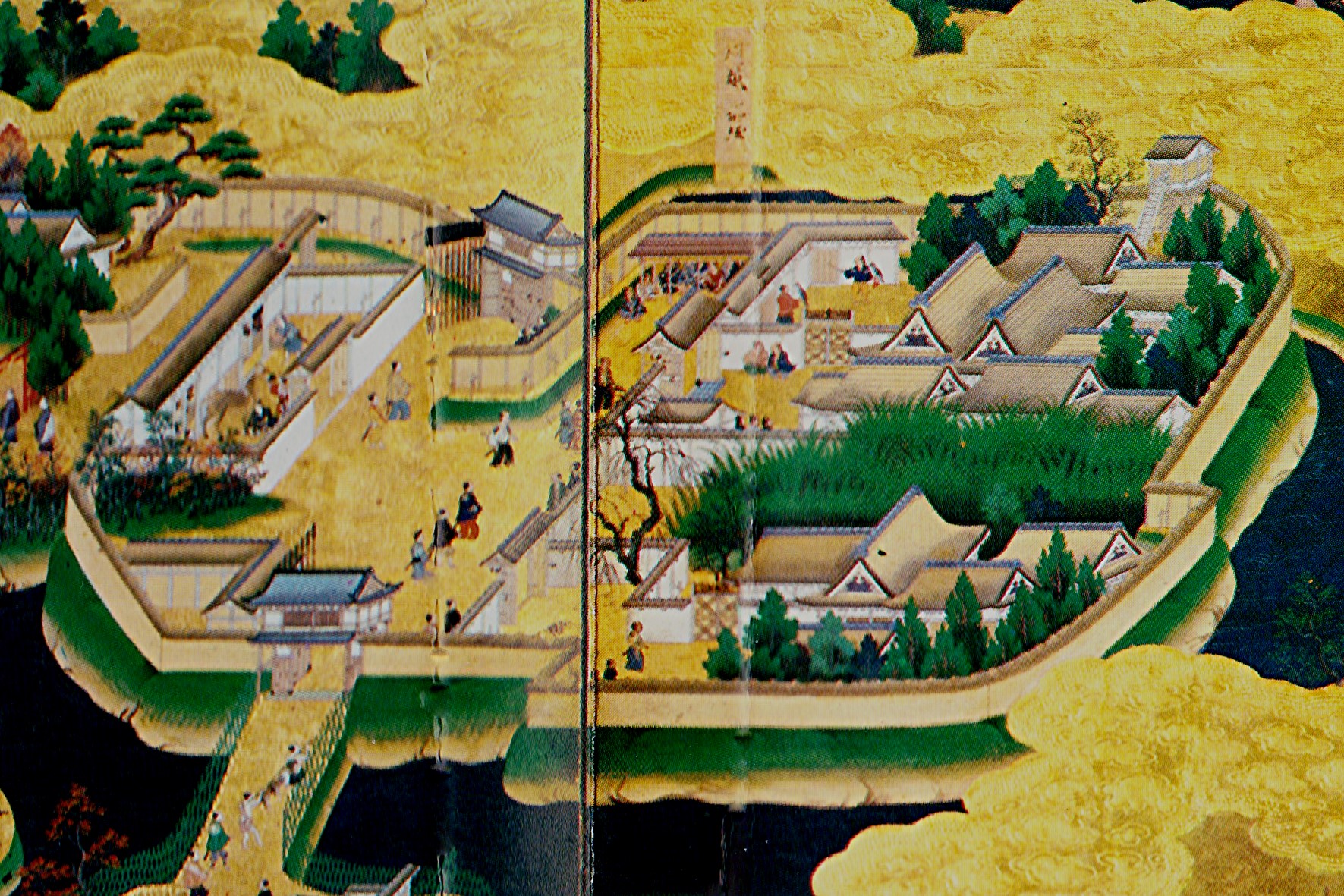
Kawagoe Castle: Three Thousand Against Eighty Thousand
In the spring of 1546, three thousand men inside Kawagoe Castle looked out at an army of eighty thousand surrounding their walls. The Uesugi clan had come to take back what the Hojo had seized nine years earlier, and the math was impossible -- nearly twenty-seven attackers for every defender. What followed became one of the most celebrated night raids in Japanese military history. The Hojo garrison held until a relief force arrived, then launched a coordinated assault in darkness that shattered the siege and effectively ended Uesugi dominance in the Kanto region. That single battle, fought over a flatland fortress in what is now suburban Saitama Prefecture, redrew the political map of eastern Japan. Today, of the sprawling castle complex that anchored these events, only one building remains standing.
A Father-Son Fortress
Kawagoe Castle was built in 1457 by Ota Doshin and his son Ota Dokan, under orders from the Uesugi lord Mochitomo. Dokan would go on to build Edo Castle the same year -- the fortress that would eventually become the Imperial Palace in Tokyo. But Kawagoe came first. Positioned on the Kanto plain with the Arakawa River to the east and access roads running west toward Echigo Province, the castle commanded a strategic corridor. It was a flatland castle, a hirajiro, built not on high ground but amid the rivers and wetlands of the Musashi plain, relying on water barriers rather than mountain slopes for defense. For the Uesugi clan, Kawagoe was a shield for Edo. For whoever held it, the castle controlled the northern approaches to what would one day become Tokyo.
The Siege That Changed Everything
The Hojo clan seized Kawagoe in 1537 after Hojo Ujitsuna had taken Edo Castle in 1524. The Uesugi were not willing to accept the loss. In 1545, Uesugi Tomosada assembled a massive coalition -- estimates put the combined force at eighty thousand troops -- and laid siege to the castle. The Hojo garrison numbered roughly three thousand under Hojo Tsunashige. The siege dragged through winter into the spring of 1546, when Hojo Ujiyasu arrived with reinforcements and executed a devastating night attack. The besieging army, overconfident and spread thin around the perimeter, collapsed. Uesugi Tomosada was killed. The Yamanouchi branch of the Uesugi clan never recovered. In a single night, the balance of power in the Kanto shifted permanently to the Hojo, who would dominate eastern Japan until Toyotomi Hideyoshi's campaign against them in 1590.
Centuries as a Castle Town
After the Hojo consolidated control, Kawagoe served for forty-five years as a satellite fortress protecting Edo and the clan's central stronghold at Odawara. When the Hojo fell to Toyotomi Hideyoshi in 1590, Tokugawa Ieyasu took control of the Kanto and Kawagoe became the seat of the Kawagoe Domain under the new Tokugawa order. For nearly three centuries, successive lords governed from the castle, and the town around it grew into a prosperous merchant center. Kawagoe's proximity to Edo -- close enough for commerce, far enough for strategic depth -- made it one of the most important domain seats in the region. The castle town's warehouse district, with its distinctive clay-walled kurazukuri buildings, still survives and earns Kawagoe the nickname 'Little Edo.'
What Remains on the Mound
Dismantlement began in 1870 as the Meiji government abolished feudal domains. Buildings were relocated around Kawagoe and to nearby cities. Today, only the Honmaru Goten -- the main palace of the innermost enclosure -- survives on the original site, though not quite in its original position. Built in 1848 by the lord of Kawagoe Domain just twenty years before the feudal system ended, the Honmaru Goten is an elegant wooden structure of sliding screens, tatami rooms, and covered corridors that once served as the lord's residence and administrative headquarters. A mound where the yagura tower once stood is the only other visible remnant of the castle's former scale. The Saitama Prefectural Government designated the Honmaru Goten as a Tangible Cultural Property in 1967, and the relocated structure received the same designation when it was returned to the enclosure in 1991. It is the closest castle to Tokyo that visitors can actually enter, since Edo Castle is now the Imperial Palace and largely inaccessible to the public.
From the Air
Located at 35.925°N, 139.492°E in the city of Kawagoe, Saitama Prefecture, approximately 30 kilometers northwest of central Tokyo. The castle grounds sit in the northern part of Kawagoe's historic district, near the Shingashi River. The Honmaru Goten building and surrounding park area are visible from 3,000-5,000 feet AGL as a green space amid dense urban development. The nearby kurazukuri warehouse district to the south provides a visual landmark with its distinctive dark clay buildings. Iruma Air Base (RJTJ) lies approximately 8 kilometers to the northwest. Honda Airport, a private airfield near Okegawa, is about 10 kilometers northeast. Tokyo Haneda Airport (RJTT) is roughly 50 kilometers to the south-southeast.