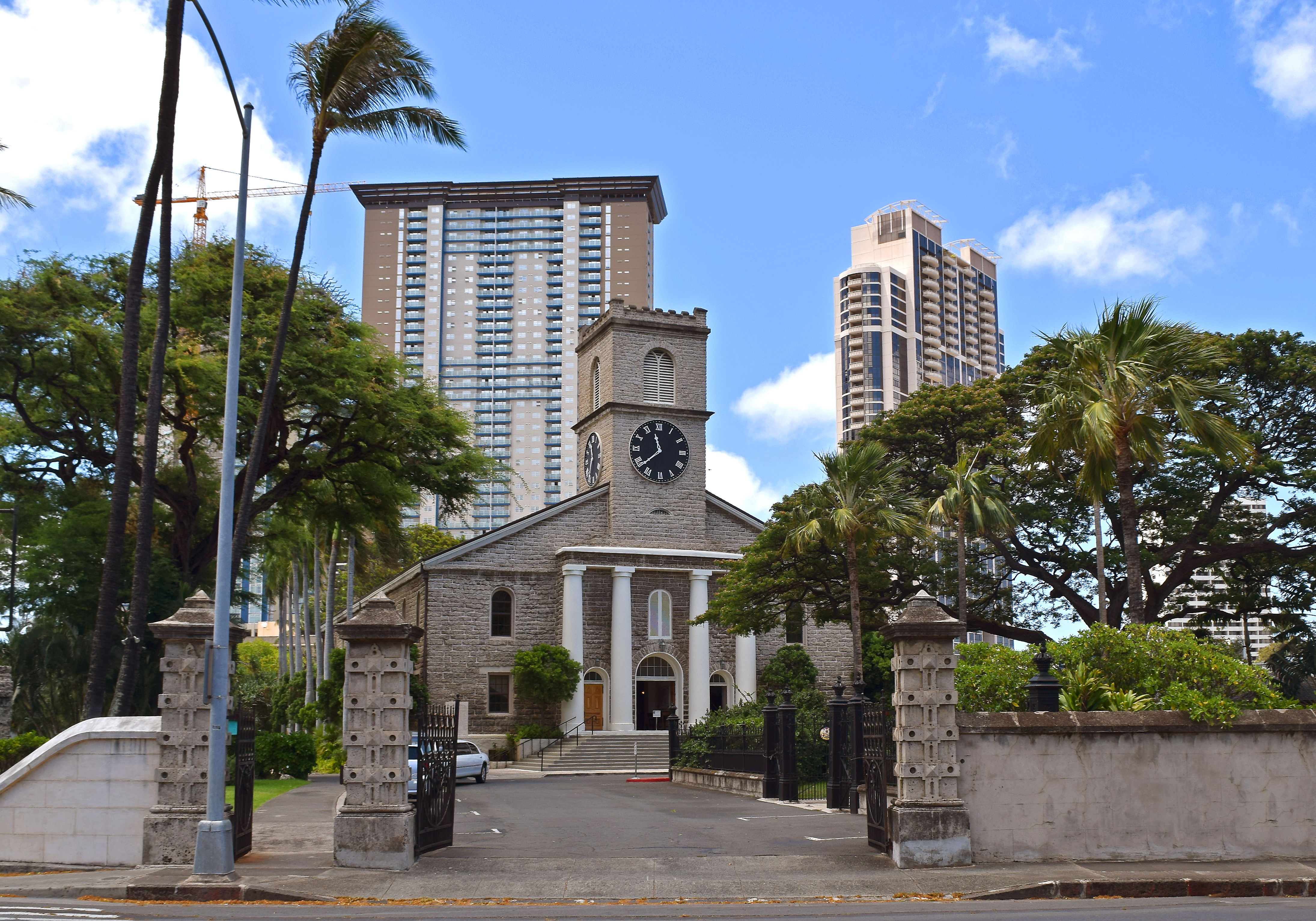
Kawaiahaʻo Church
Hawaiian divers pried the building from the sea. Between 1836 and 1842, they dove three to six meters below the surface off Oʻahu's southern coast, chiseling thousand-pound slabs of coral rock from an offshore reef with hand tools. They cut roughly 14,000 blocks this way, hauled them ashore, and stacked them into the walls of Kawaiahaʻo Church. The result was a New England-style meetinghouse built from the Pacific Ocean itself — a physical fusion of the missionary tradition that designed it and the Hawaiian labor and landscape that made it real. It still stands in downtown Honolulu, the oldest church on Oʻahu, holding services partly in the Hawaiian language more than 180 years later.
Coral Walls and Competing Cathedrals
The Kawaiahaʻo mission began in 1820, one of the earliest Protestant footholds in the Hawaiian Islands. Four thatched churches preceded the coral structure, each outgrown or worn out in turn. The stone church was commissioned by the regency of Kaʻahumanu and designed by Reverend Hiram Bingham in the severe New England Congregational style the American missionaries had brought with them across the Pacific. Its construction coincided with a rival project: the Cathedral of Our Lady of Peace, built by the Roman Catholic Apostolic Vicariate of the Hawaiian Islands. That cathedral broke ground in 1840 and was substantially completed in 1843, just one year after Kawaiahaʻo's dedication. The two churches rose within blocks of each other, a stone-and-coral proxy for the denominational competition that shaped nineteenth-century Hawaiian Christianity.
Where Kings Took Their Oaths
Kawaiahaʻo Church became the spiritual heart of the Hawaiian monarchy. Kamehameha III, Kamehameha IV, Kamehameha V, and Kalākaua all took their constitutional oaths of office within its walls. State funerals and royal baptisms were held here, and the aliʻi — the Hawaiian ruling class — claimed the church as their own, earning it the nickname "the Aliʻi Church." Today, twenty portraits of Hawaiian royalty line the upper gallery of the sanctuary. King Lunalilo, who specifically requested burial in a church cemetery rather than the Royal Mausoleum, rests in a crypt near the front courtyard alongside his father. The church was so central to Hawaiian governance that losing it felt like losing a piece of the kingdom itself.
A Queen's Last Farewell
The relationship between Kawaiahaʻo and the monarchy was complicated by faith itself. Kamehameha IV and his wife Queen Emma were drawn to the Anglican tradition and established the Church of Hawaiʻi, commissioning the Cathedral Church of Saint Andrew as a new center of royal worship. Later monarchs — Kamehameha V, Kalākaua, and eventually Liliʻuokalani — preferred the Anglican cathedral. Yet Kawaiahaʻo never lost its hold on Hawaiian national identity. Princess Liliʻuokalani had directed the church choir before ascending to the throne. When she died in 1917, her body lay in state at Kawaiahaʻo Church for a full week before the funeral was held at ʻIolani Palace. Even after the monarchy was gone, the church remained the place where Hawaiʻi said goodbye to its last queen.
Living Heritage in Coral and Song
Kawaiahaʻo Church was designated a U.S. National Historic Landmark in 1962, along with the adjacent Mission Houses, as the Hawaiian Mission Houses Historic Site. But the building's significance is not frozen in museum status. Services continue every Sunday, and the Hawaiian language threads through the liturgy and hymns — a practice that connects the congregation to the church's founding era, when Hawaiian was the language of governance, worship, and daily life across the islands. Among the notable figures buried or memorialized on the grounds is Henry Berger, the Prussian-born bandmaster of the Royal Hawaiian Band, and Abraham Akaka, whose pastorate from 1957 to 1984 is remembered for his role in the American civil rights movement. The church is part of the United Church of Christ, denominationally far removed from the Congregational missionaries who built it, yet carrying their legacy in every coral block.
From the Air
Kawaiahaʻo Church is located at 21.305°N, 157.859°W in downtown Honolulu on Oʻahu. The coral-block church sits adjacent to the Mission Houses and within a block of ʻIolani Palace and Aliʻiōlani Hale. Its distinctive New England-style architecture and steeple make it identifiable from low altitude. Best viewed at 1,500–2,000 ft AGL. Nearest airport: Daniel K. Inouye International (PHNL), approximately 5 nm northwest. Morning hours offer best visibility before afternoon trade-wind clouds develop.