Kawara-dera
Scholars have argued about this temple for centuries, and nobody has won. Kawara-dera was counted among the four great temples of Asuka alongside Asuka-dera, Yakushi-ji, and Daikan-daiji, yet its founding is absent from the Nihon Shoki, Japan's oldest official chronicle. The silence earned it a fitting nickname: the "mysterious great temple." When the imperial capital shifted from Asuka to Heijo-kyo in 710, the other three temples were dutifully relocated. Kawara-dera, for reasons that remain unexplained, was left behind in the village where it was born.
A Palace Becomes a Prayer Hall
The prevailing theory places Kawara-dera's founding in the mid-7th century, during the reign of Emperor Tenchi. The story begins with fire. In 655, Asuka Itabuki Palace burned down, and Empress Saimei took up temporary residence at Kawara-miya Palace. When she moved on to Okamoto Palace the following year, the site was apparently converted into a Buddhist temple. The Nihon Shoki's first confirmed mention of Kawara-dera comes from 673, when Emperor Tenmu gathered scribes there to copy the entire Buddhist canon for the first time in Japanese history. The temple appears in the record suddenly, fully formed, with no origin story -- as though it had always been there. An earlier chronicle entry from 653 mentions the temple by name, but even the Nihon Shoki's own editor added a note questioning whether the passage actually referred to Yamada-dera instead.
Two Halls and a Five-Story Pagoda
Excavations conducted between 1957 and 1959 revealed a temple layout unlike anything else in Asuka. Where most temples of the period centered on a single main hall, Kawara-dera had two -- the Central Main Hall, or Chukondo, on the northern side of a square cloister, and a Western Main Hall, or Saikondo, facing east toward a five-story pagoda. The arrangement echoed the Western Temple complex at Horyu-ji, but with a twist: at Horyu-ji the main hall faces south, while at Kawara-dera the Saikondo faced east, directly confronting the pagoda. More surprising still, the Saikondo was an open-air building with no walls, its eaves open on all four sides. The foundation stones of the Chukondo turned out to be marble -- the only known use of marble as temple foundation material in ancient Japan. Temple tradition long claimed the stones were agate, but archaeological analysis proved otherwise.
The Most Beautiful Tiles in Japan
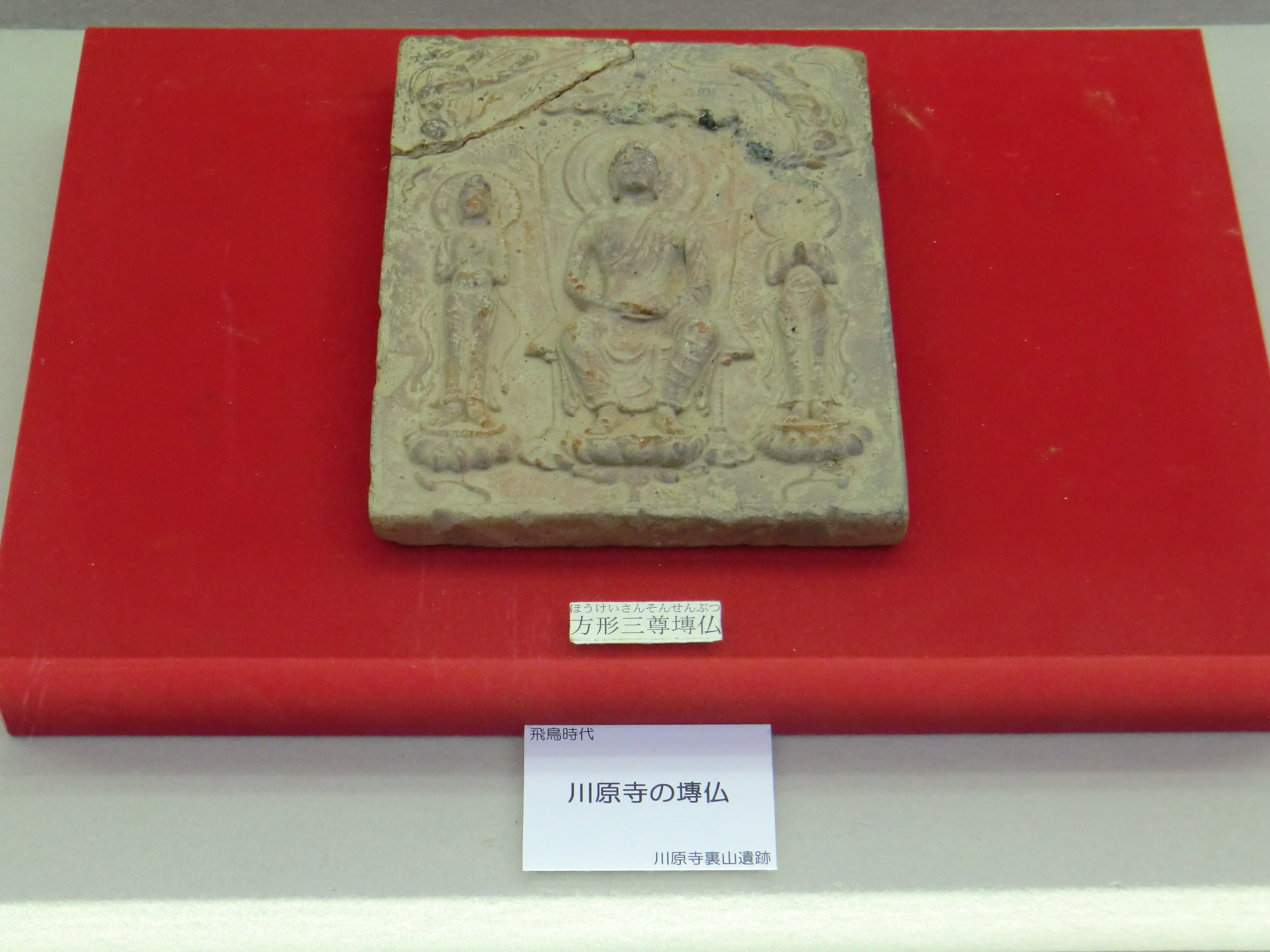
Among the most celebrated artifacts from Kawara-dera are its founding-era roof tiles, described by scholars as being "among the most beautiful ever made in Japan." These are compound lotus pattern tiles, each of the eight petals subdivided into two, creating an intricate double-layered design of remarkable precision. The pattern proved so influential that it became the mainstream tile design for Buddhist temples across Japan in subsequent centuries. In 1974, an even more unusual find emerged from Itafuchi Shrine on the hillside behind the temple ruins. Archaeologists unearthed several hundred clay statues and embossed Buddha bricks, each measuring roughly 20 centimeters square and bearing a relief of a Buddhist triad. No other site in Japan has yielded such a large quantity of embossed Buddha bricks from a single location. Their exact purpose remains debated, but the leading theory holds that they once filled the walls of a Buddhist hall, creating an interior surface dense with sacred images.
Fire, Lightning, and Renewal
Kawara-dera burned repeatedly. A document from 1070 records the loss of property records in a temple fire. According to the diary of the nobleman Kujo Kanezane, the temple burned again in 1191. It was rebuilt during the Kamakura period but never recovered its former stature. The final blow came at the end of the Muromachi period, when lightning struck and the temple was abandoned for good. In the mid-Edo period, a smaller temple called Gufuku-ji was built on the footprint of the old Chukondo. It stands there today, a quiet successor to its vanished predecessor. Gufuku-ji preserves two wooden standing statues from the early Heian period -- one of Jikoku-ten and one of Tamon-ten -- both designated National Important Cultural Properties. The surrounding archaeological site has been developed so that visitors can trace the outlines of the Great South Gate, the Middle Gate, and the cloister corridors, walking the ghost plan of a temple that once rivaled anything in Japan.
From the Air
Located at 34.473N, 135.818E in the village of Asuka, Nara Prefecture, on the Asuka plain south of Nara city. The temple ruins sit in flat terrain amid rice paddies and low hills. Nearest major airport: Kansai International Airport (RJBB), approximately 40nm to the west. Osaka Itami (RJOO) is roughly 30nm to the northwest. The Asuka plain is dotted with archaeological sites visible as cleared rectangles among green fields. Mount Miwa rises to the northeast. Best viewed at 3,000-5,000 feet AGL for context of the broader Asuka archaeological landscape.