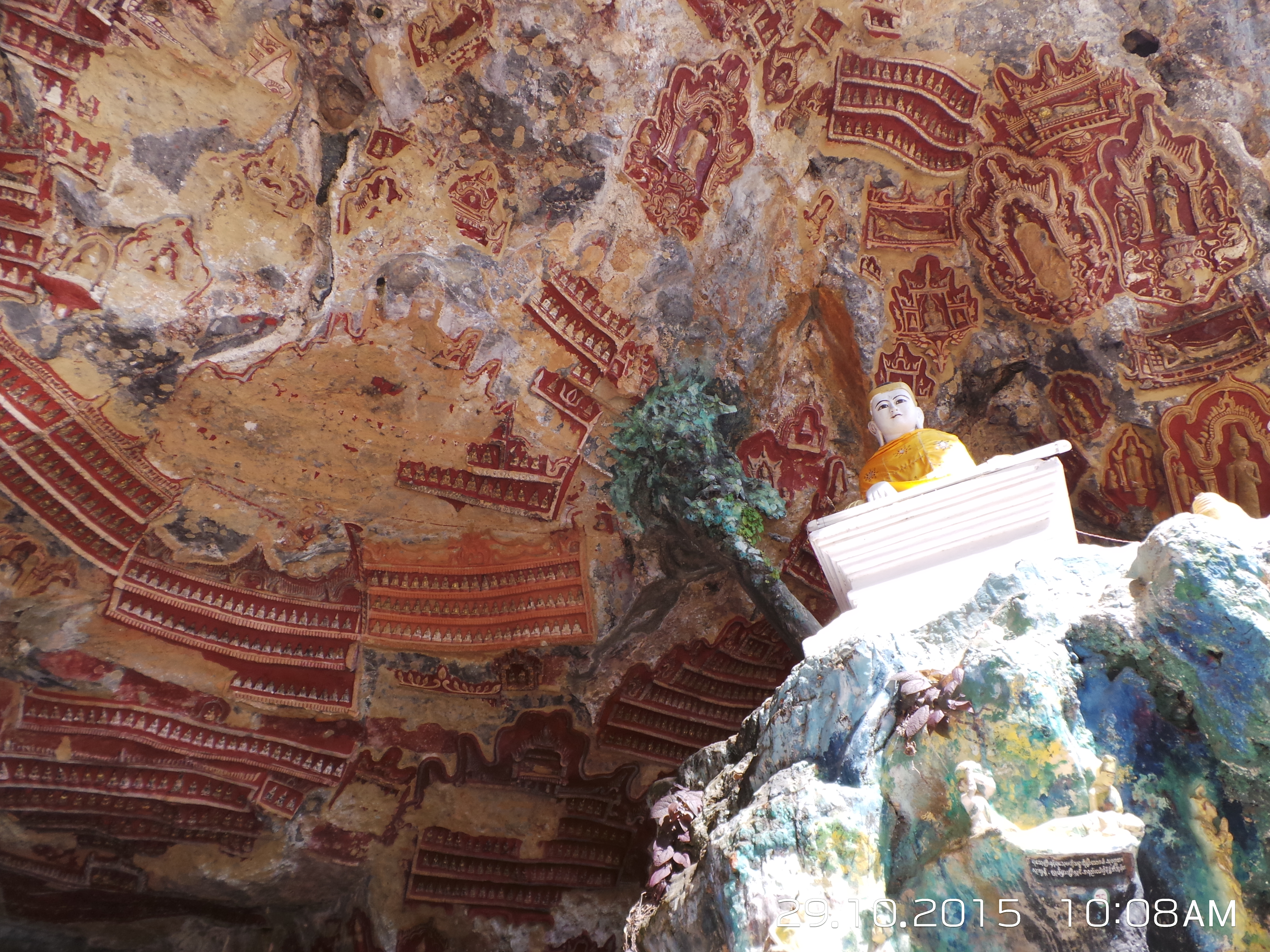
Kawgun Cave
Thousands of small Buddha figures cover the walls, floor to ceiling, pressed into the limestone like prayers made permanent. Some are clay, some stone, some gilded, all silent. The Kawgun Cave sits at the foot of its namesake mountain, eight miles from Hpa-an in Kayin State, and entering it feels less like visiting a temple than stepping inside someone's act of devotion that simply never stopped. The cave is 130 feet long, 70 feet wide, and 25 feet high -- modest dimensions that make the density of its contents all the more overwhelming. When the British diplomat John Crawfurd became the first known Western visitor in January 1827, he found what centuries of worshippers had left behind: a cave transformed into a gallery of faith, its walls inscribed in ancient Mon script with the names of donors and the Buddha images they had given.
A Queen's Refuge
The most compelling story embedded in these walls concerns a queen who ran. According to stone inscriptions written in ancient Mon script, some of the Buddha statues were donated by a queen consort of Martaban -- the old port city now called Mottama. When King Anawrahta of the Pagan Kingdom conquered the Thaton Kingdom in the 11th century, he captured King Manuha and took him north to Pagan. The queen consort of Martaban escaped. Legend holds that she fled to the Kawgun Cave and, in hiding, donated Buddha statues to the temple. Whether the story is precisely true matters less than what the inscriptions preserve: evidence that this cave has served as a sanctuary -- both spiritual and physical -- for over a thousand years. The 23 lines of ancient Mon script carved into the robe of one Buddhist relief represent some of the oldest Mon-language inscriptions in the region, a link to a civilization that predates the Burmese kingdoms that eventually absorbed it.
Where Buddhism Met Hinduism
Three stone reliefs found in the cave complicate the simple Buddhist narrative. Two are Buddhist in subject, but the third depicts Hindu deities: Brahma, Vishnu, Shiva, and an image of Ganesh. This overlap is not unusual in Southeast Asian religious history -- the region's spiritual landscape was never as neatly divided as modern categories suggest -- but it is rare to find it preserved so clearly in a single cave. The Buddhist reliefs carry those 23 lines of Mon inscription on the left side of one statue's robe, though the right side has broken away and only three lines survive. The ink inscriptions throughout the cave record a more personal kind of history: donors' names, their wishes, and the number of Buddha images they contributed. Each entry is an individual act of generosity made legible across centuries, a ledger of devotion written on stone walls in a language most visitors can no longer read.
Layers of Time in Limestone
The origins of the Kawgun Cave temple remain uncertain, which is part of what makes it fascinating. The site is believed to date from around the 7th century, though historian Nai Maung Toe has suggested, based on the inscriptions, that it could be older -- perhaps the 6th century. The limestone itself is far more ancient, shaped by geological processes that carved a natural chamber into the mountainside long before any human entered it. What visitors see today is the accumulation of centuries: each generation adding its own Buddha figures to the walls, layering devotion upon devotion until the cave became something no single architect planned. The rear of the cave opens to a row of floating restaurants on Ruby Lake, a jarring but somehow fitting transition from the sacred to the everyday. The Ministry of Culture now maintains the site with modern conservation technology, protected by law -- a bureaucratic expression of the same impulse that drove a fleeing queen to press clay Buddhas into stone more than a millennium ago.
From the Air
Located at 16.82°N, 97.59°E at the foot of Mt. Kawgun, eight miles from Hpa-an and 28 miles from Mawlamyine in Kayin State. The cave entrance is two miles from the west bank of the Thanlwin River. Recommended viewing altitude 2,000-4,000 feet for context of the limestone karst landscape. Nearest airports: Hpa-an Airport (limited service) and Mawlamyine Airport (VYMM). The surrounding karst mountains and the Thanlwin River provide prominent visual landmarks. Ruby Lake is visible at the rear of the mountain.