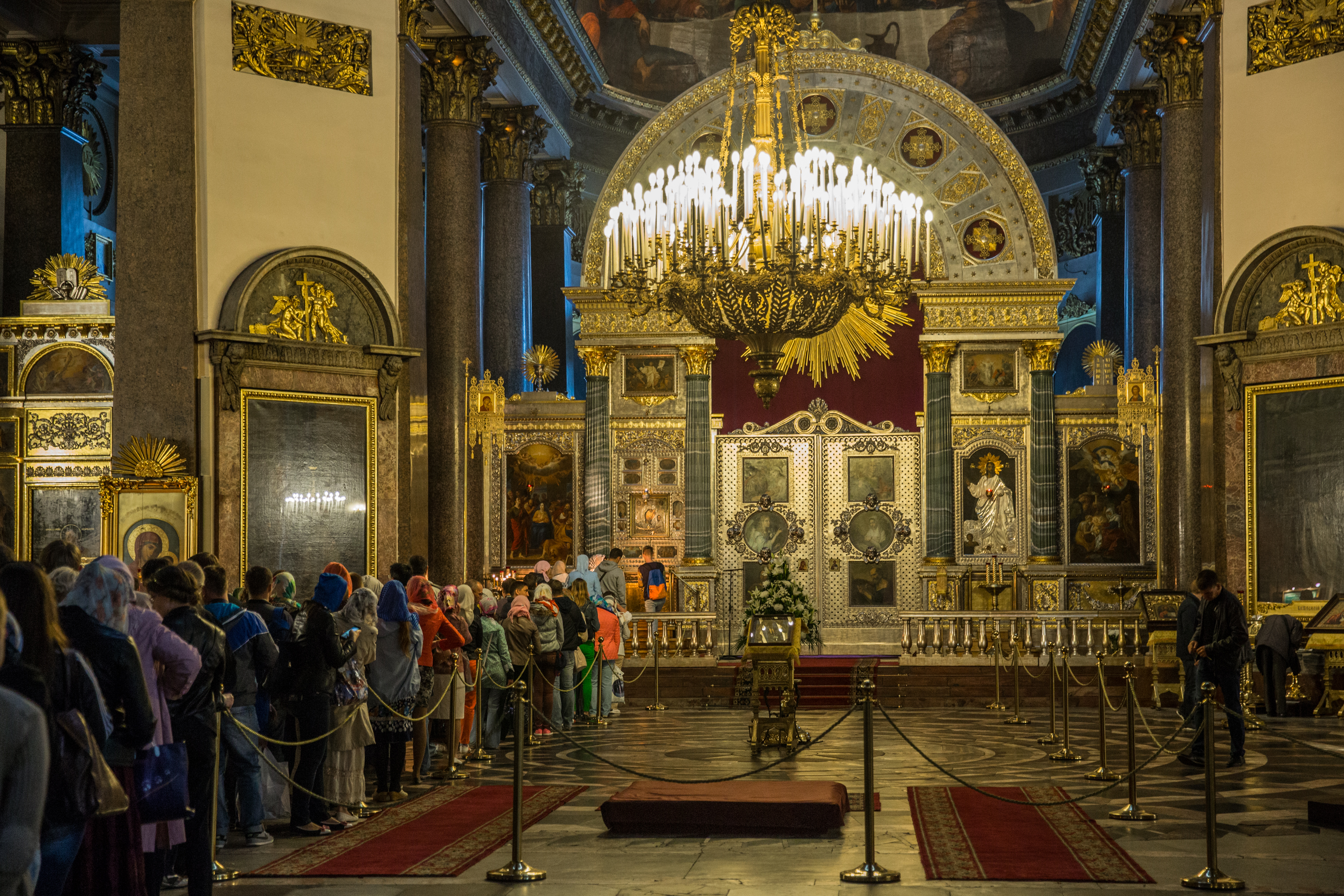
Kazan Cathedral, Saint Petersburg
Andrey Voronikhin had a problem. The new emperor wanted a cathedral on Nevsky Prospekt to house Russia's most venerated icon, and he wanted it to look like St Peter's in Rome. The Russian Orthodox Church found the idea offensive: a Catholic basilica, copied in the heart of the Orthodox capital? Voronikhin solved it the way Russian architects often solved such problems, by building exactly what the emperor wanted while letting the church save face. He swept a colonnade of 96 Corinthian columns into a wide arc on Nevsky Prospekt, a fragment of Bernini's piazza dropped onto the boulevard, and tucked the actual cathedral behind it at a right angle. From the street it reads as Roman. Step inside and the iconostasis tells you exactly whose church this is.
Built for an Icon
Construction began in 1801 under the supervision of Alexander Sergeyevich Stroganov, the wealthy nobleman whose family palace stood just down the street. Voronikhin had been a serf in the Stroganov household before being freed and trained as an architect, and the cathedral that took ten years to rise was his first major public commission. It replaced an earlier Church of the Nativity of the Theotokos, dismantled when the new building was consecrated in 1811. The whole project was built around a single object: the icon known as Our Lady of Kazan, said to have been discovered miraculously in the city of Kazan in 1579. By 1811 it had become the most venerated image in Russian Orthodoxy, and the cathedral was designed to be its setting.
Kutuzov Comes to Pray
The cathedral's meaning shifted in 1812. When Napoleon crossed the Niemen and pushed into Russia, the commander-in-chief Mikhail Kutuzov came to Kazan Cathedral and prayed before Our Lady of Kazan for help. The icon, the cathedral, the general and the war became fused in Russian memory. After Napoleon's catastrophic retreat from Moscow, the building was reframed as a memorial to Russia's victory in what Russians still call the Patriotic War. Kutuzov died in 1813 during the campaign that pushed the French back across Europe, and his tomb was placed inside the cathedral he had prayed in. Captured French standards and keys to surrendered cities filled the side chapels. A church built to house an icon had become a war memorial without losing its sacred function.
Museum of Atheism
After the Russian Revolution, the new Soviet authorities closed the cathedral in January 1932 and reopened it ten months later as the Museum of the History of Religion and Atheism, billed as Leningrad's largest antireligious museum. Spanish Inquisition waxworks went up where the iconostasis had been. The building was preserved precisely because it was useful as a kind of negative example, and that preservation, ironic as it is, kept the structure intact through decades when other Russian churches were demolished or left to rot. Services resumed in 1992, and four years later the cathedral was returned to the Russian Orthodox Church. The museum moved out, the iconostasis was restored, and Kazan Cathedral now functions as the mother cathedral of the metropolis of Saint Petersburg.
The Building Itself
The interior runs 69 meters in length and reaches 62 meters in height under the dome. Rows of pink granite columns turn the nave into something that feels less like a church and more like a palace hall, the colonnade outside repeated and intensified inside. Vladimir Borovikovsky painted the royal doors of the central iconostasis, six panels showing Saints Luke, Matthew and John, Saint Mark, the Virgin Mary, and the Archangel Gabriel of the Annunciation. The bronze entrance doors are one of four copies of Ghiberti's Gates of Paradise from the Florence Baptistery; the other three live at Grace Cathedral in San Francisco, the Nelson-Atkins Museum in Kansas City, and the Florence Baptistery itself. A wrought-iron grille separating the cathedral from the small square behind it is sometimes cited as one of the finest pieces of decorative ironwork ever made.
Rome on the Neva
Some art historians say Emperor Paul, who reigned from 1796 to 1801 and commissioned the project, intended for a mirror cathedral to be built on the opposite side of Nevsky Prospekt, framing the boulevard with twin colonnades. He was assassinated in March 1801, just before construction started, and the second cathedral never happened. What stands now is half of an unbuilt symmetry, a single Roman gesture against the long straight line of Nevsky. The neoclassical style proved influential beyond Russia, the Kazan Cathedral serving as the model for Helsinki Cathedral, completed three decades later when Finland was still a Russian grand duchy. After the Alexander Column on Palace Square, Kazan Cathedral remains one of the dominant landmarks of central Saint Petersburg, the curve of its colonnade pulling the city into a moment of paused, theatrical Roman calm.
From the Air
Kazan Cathedral sits at 59.9342 degrees north, 30.3246 degrees east, on Nevsky Prospekt in central Saint Petersburg, about 1.5 km west of the Hermitage. From altitude, look for the broad curving colonnade fronting the long straight axis of Nevsky Prospekt, with the Griboyedov Canal curling around its western side. Pulkovo Airport (ULLI) lies 17 km south. The dome is best identified at 2,000 to 4,000 feet, when the colonnade's geometry stands out against the surrounding street grid.