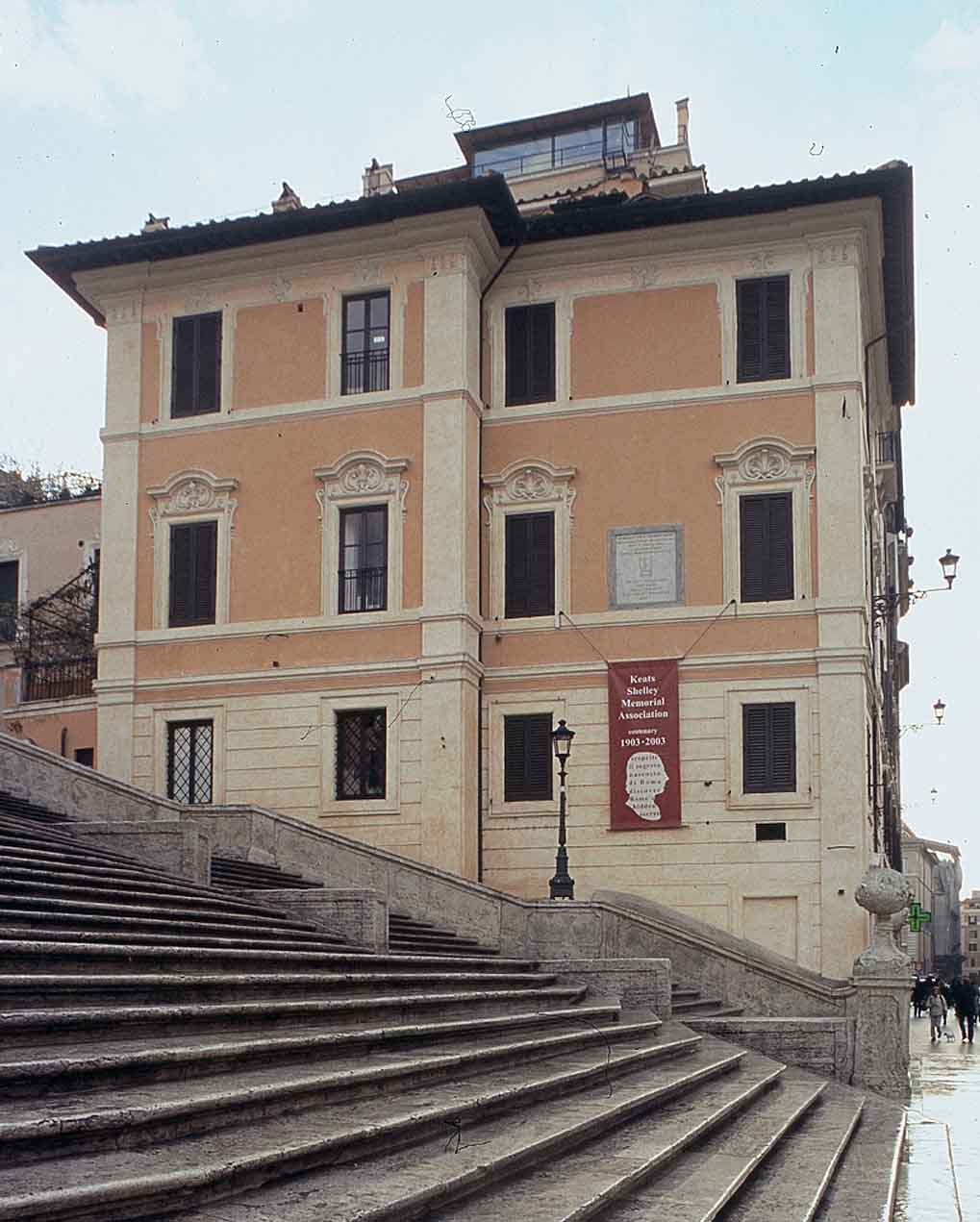
Keats-Shelley Memorial House
After John Keats died in this room on February 23, 1821, the authorities scraped the walls bare and burned everything inside. That was Roman health law in the 19th century: when a tuberculosis patient died, the room was sanitized by destruction. The furniture, the books, the personal effects of one of the English language's greatest poets -- all of it went into the fire. Keats was twenty-five years old. He had come to Rome three months earlier at the urging of friends and doctors who believed the warmer climate might save him. It did not. What survived was not the room itself, but the idea of it -- and more than eighty years later, a campaign to reclaim this small apartment at the foot of the Spanish Steps would create one of the world's most poignant literary museums.
The Last Three Months
Keats arrived in Rome in November 1820, accompanied by his friend Joseph Severn, a young painter who had volunteered to serve as companion and nurse. They took rooms on the second floor of 26 Piazza di Spagna, a building that had been remodeled in 1724-25 as part of Francesco de Sanctis's project to construct the Spanish Steps. The apartment had just two rooms, and from its windows Keats could see the famous stairway cascading down from the Trinita dei Monti church above. Severn nursed Keats through his final months with a devotion that would define the rest of his own life. The poet's condition deteriorated steadily, and by February he could no longer leave his bed. He died knowing that his work had received mixed reviews in England, unaware that within a generation he would be considered one of the greatest lyric poets in the language.
Reclaiming the Rooms
The effort to recover the apartment began in 1903, spearheaded by the American poet Robert Underwood Johnson. With support from literary circles in the United States, England, and Italy, the two rooms were purchased in late 1906 and dedicated in April 1909 as the Keats-Shelley Memorial House. The museum was established to honor not only Keats but also Percy Bysshe Shelley, who had drowned off the Italian coast in 1822, just a year after Keats's death. Over the decades, the collection grew to encompass one of the world's most extensive assemblages of Romantic-era memorabilia: letters, manuscripts, and paintings relating to Keats, Shelley, Byron, Wordsworth, Robert Browning, Elizabeth Barrett Browning, and Oscar Wilde. The library eventually held some 10,000 volumes, transforming a place of death into a living archive of English literary genius abroad.
The Wartime Rescue
When World War II reached Rome, the museum's custodians faced a stark choice: risk losing the collection to Nazi confiscation, or hide it. They chose to hide. After 1943, all external markings identifying the museum were removed from the building. The library's 10,000 volumes were too bulky to move, so they stayed in place -- a calculated gamble. But two boxes of the most precious artifacts were sent to the Abbey of Monte Cassino in December 1942 for safekeeping. When the abbey was evacuated ahead of the Allied bombing campaign, its archivist quietly placed the two unlabeled boxes of Keats-Shelley memorabilia among his own personal possessions, ensuring they would leave with him rather than fall to the Germans. The boxes made it out. In June 1944, when Allied forces entered Rome, the museum's curator reclaimed the artifacts and reopened them at the Keats-Shelley House. The collection had survived intact.
A Living Shrine
The museum today occupies the same second-floor rooms where Keats spent his final weeks, though nothing in them is original to his stay -- the 19th-century sanitation laws saw to that. What the rooms hold instead is a reconstruction and an accumulation: the memorial association furnished the space to evoke the Romantic era, and over more than a century, donors have added relics that make the small apartment feel impossibly dense with literary history. A lock of Keats's hair. Shelley's fragment of jawbone, recovered from his funeral pyre on the beach at Viareggio. Letters in Byron's hand. The building itself, designed by Francesco de Sanctis to frame the Spanish Steps symmetrically, places visitors at one of Rome's most recognizable landmarks. Tourists streaming up and down the steps rarely realize that behind the windows at their base, a young man once lay dying, attended by a friend who would spend the rest of his life championing a poet the world had not yet learned to value.
From the Air
Located at 41.91°N, 12.48°E at the base of the Spanish Steps in central Rome. The building sits on the east side of Piazza di Spagna. From the air at 2,000-3,000 ft AGL, look for the distinctive cascade of the Spanish Steps descending from the Trinita dei Monti church, with the Piazza di Spagna and the Fontana della Barcaccia at the base. The nearest major airport is Rome Fiumicino (LIRF/FCO), approximately 30 km southwest. Rome Ciampino (LIRA/CIA) lies about 15 km southeast.