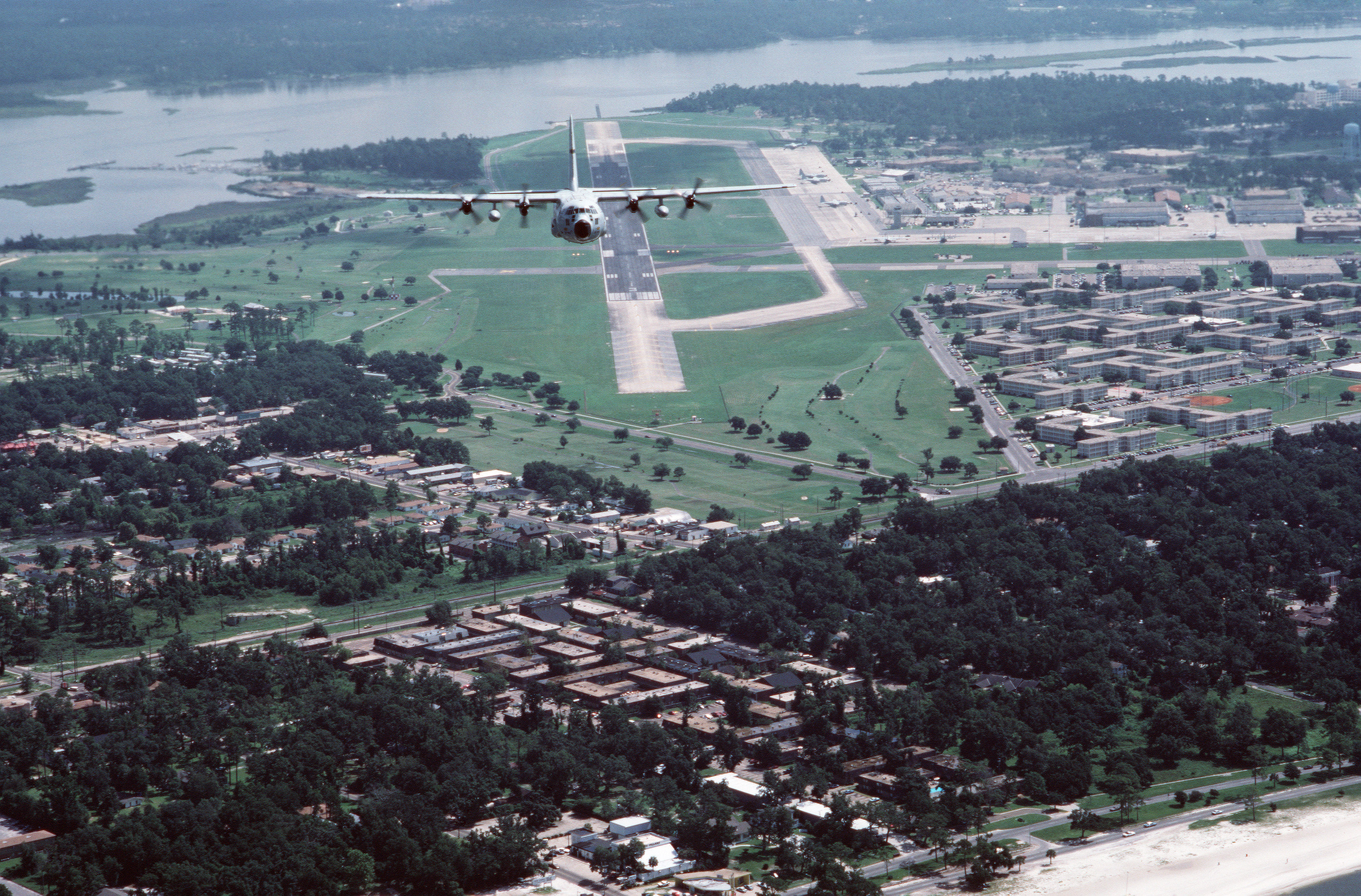
Keesler Air Force Base
Second Lieutenant Samuel Reeves Keesler Jr. was shot six times over the skies of Verdun. Wounded in the chest and abdomen during an aerial reconnaissance mission on October 8, 1918, the Mississippi-born observer still managed to shoot down the lead aircraft of a four-plane German formation before his own plane was forced to the ground. Captured by the enemy, Keesler's fortitude so impressed his German captors that they remarked upon it. He died the following day in a field hospital. Twenty-three years later, when the Army needed a name for its newest technical training center on the Mississippi Gulf Coast, they chose his. Keesler Air Force Base has operated in Biloxi ever since, growing into one of the largest and most important training installations in the United States Air Force.
Born for War, Built for Learning
In January 1941, Biloxi city officials made the Army an offer: come build a base here. The timing was urgent. War was coming, and the nation needed trained mechanics and technicians at a pace peacetime systems could never deliver. The War Department activated the installation on June 12, 1941, as an aviation mechanics school. Congress appropriated $6 million for construction plus $2 million for equipment, but by the time contracts were awarded, the cost had ballooned to $10 million, making Keesler the most expensive government project ever undertaken in Mississippi at that time. The first recruits arrived on August 21, 1941. Many trained as airplane and engine mechanics; others moved on to aerial gunnery or aviation cadet schools. The base transformed Biloxi, spurring residential construction and new businesses across the city.
The Tuskegee Connection
Keesler's wartime story includes a chapter that speaks to both the promise and the pain of its era. The Tuskegee Airmen trained at Keesler Field. By autumn 1943, more than 7,000 Black soldiers were stationed on base, serving as pre-aviation cadets, radio operators, aviation technicians, bombardiers, and aviation mechanics. These men were part of the broader effort to prove that African American servicemembers could perform every role in the Army Air Corps, a proposition that much of the military establishment resisted. Their presence at Keesler was part of the foundation upon which the desegregation of the armed forces would eventually be built.
Cold War Classrooms
When World War II ended, Keesler pivoted rather than closed. In 1947, the Radar School transferred in from Boca Raton, making Keesler responsible for the two largest military technical schools in the country. By 1949, the base had added radio operations training from Scott Air Force Base in Illinois and was teaching air traffic controllers, radar mechanics, and ground controlled approach specialists. In 1956, Keesler entered the missile age with Atlas missile ground support training. The base kept expanding its curriculum through the decades, and when President Ronald Reagan fired striking civilian air traffic controllers in August 1981, Keesler-trained military controllers stepped in to keep the nation's air traffic moving. Through the Cold War's long arc, the base earned its reputation as the place where the Air Force learned its technical trades.
Storms and Resilience
The Gulf Coast does not let its inhabitants forget the sea. Hurricane Camille devastated Biloxi in 1969, flooding much of Keesler's Back Bay housing area. Then, on August 29, 2005, Hurricane Katrina made a direct hit. About fifty percent of the base came under water. The commissary, base exchange, and housing units were flooded with more than six feet of storm surge. Yet by August 31, just two days later, relief flights were already landing on Keesler's runways. Airmen were evacuated to Sheppard Air Force Base in Texas, and the base began its recovery. Keesler rebuilt, as it always had, adding post-Katrina resilience to a service record that already stretched across eight decades.
The Hurricane Hunters' Home
Today, Keesler hosts about 3,100 students at any given time through the 81st Training Wing, studying everything from electronics and avionics to meteorology, cryptography, and air traffic control. But the base's most famous residents fly into the worst weather on Earth on purpose. The 53rd Weather Reconnaissance Squadron, part of the Air Force Reserve's 403rd Wing, operates ten WC-130J Super Hercules aircraft out of Keesler. Known as the Hurricane Hunters, they are the only Department of Defense unit that still flies directly into tropical storms and hurricanes, penetrating the eye at altitudes between 500 and 10,000 feet. The data they collect is sent in real time to the National Hurricane Center and is considered up to thirty percent more accurate than satellite estimates alone. From a base named for a man who refused to stop fighting even after being shot six times, that kind of mission feels about right.
From the Air
Located at 30.411N, 88.924W on the Mississippi Gulf Coast in Biloxi. Keesler AFB (KBIX) has an active runway and is clearly identifiable from the air. Caution: active military airspace. Nearby civilian airport: Gulfport-Biloxi International (KGPT) approximately 10 miles west. The base sits along the Back Bay of Biloxi on its north side and faces the Mississippi Sound to the south. WC-130J Hurricane Hunter aircraft are often visible on the ramp. Best viewed from 3,000-5,000 feet AGL with appropriate ATC coordination.