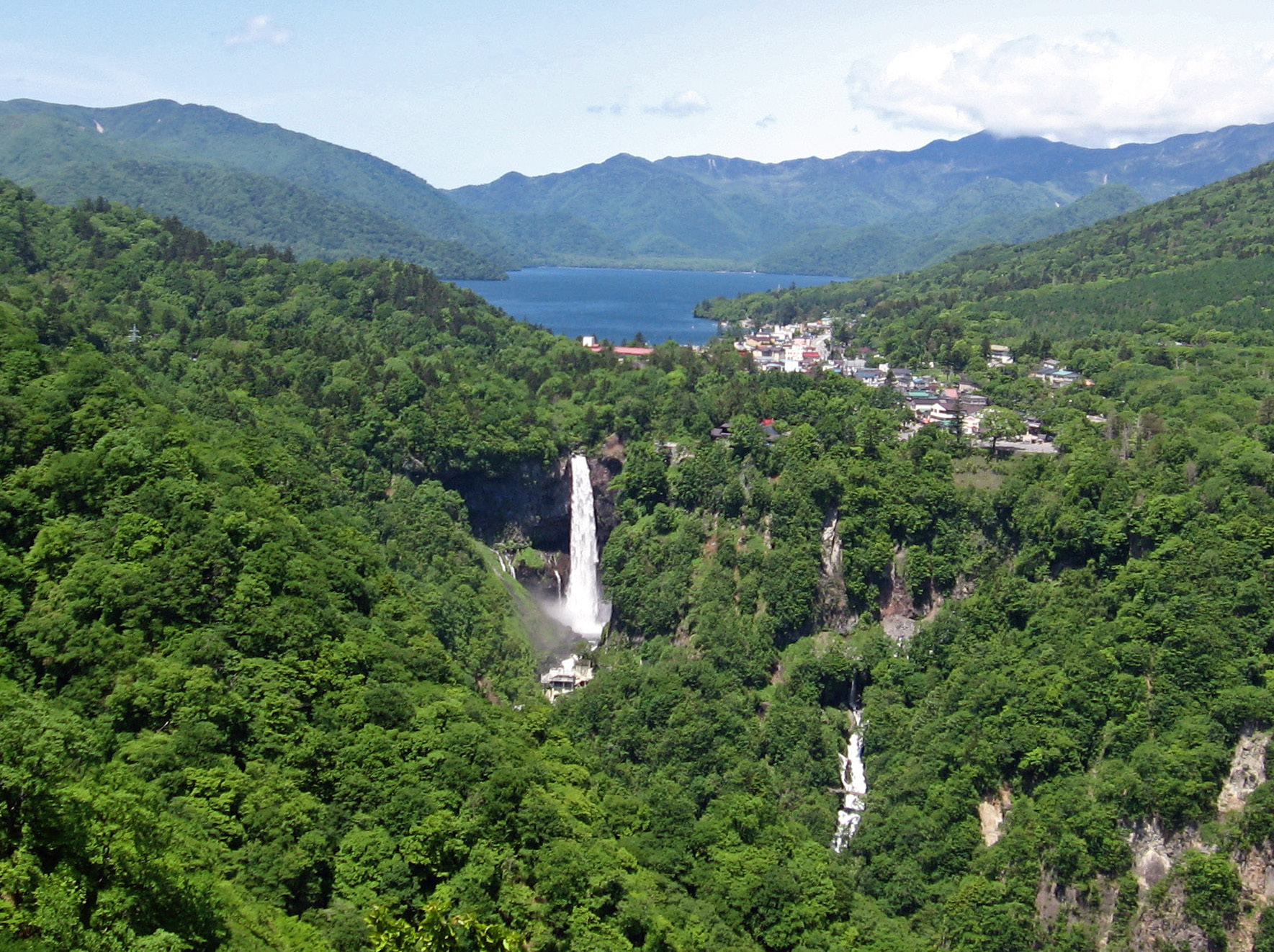
Kegon Falls
In 1903, a sixteen-year-old philosophy student named Misao Fujimura carved a poem into the bark of a tree, then stepped off the edge of a cliff and into Japanese literary history. The waterfall that swallowed him -- Kegon Falls -- had been drawing pilgrims and admirers for centuries before that moment, and it continues to draw them still. Dropping 97 meters from the lip of Lake Chuzenji in a single thundering column, Kegon is one of Japan's three most famous waterfalls, ranked alongside Nachi Falls in Wakayama and Fukuroda Falls in Ibaraki. But no guidebook statistic can prepare you for the visceral shock of standing at the base and feeling the mist on your face, the ground trembling beneath your feet as three tons of water per second slam into the rocky basin below.
Born from Fire
Kegon Falls exists because a volcano rearranged the landscape. Roughly 20,000 years ago, Mount Nantai erupted and sent lava flows cascading down its flanks, damming the valley and creating Lake Chuzenji at an elevation of 1,269 meters. The lake needed an outlet, and the Daiya River, rerouted by the hardened lava, found one at the eastern edge -- a sheer cliff face where the water now plunges in a single dramatic drop. The main curtain of water is not alone. Twelve smaller waterfalls thread through the cracks between the ancient lava and the mountainside, leaking and seeping alongside the central column. In winter, these subsidiary streams freeze into delicate curtains of ice while the main falls continue to roar. The geology here tells a story of violent creation followed by millennia of patient erosion, the water slowly carving its channel deeper into the volcanic rock.
A Sacred Landscape Revealed
The falls sit within a landscape that the Japanese have considered sacred for over a millennium. In 782, a Buddhist priest named Shodo Shonin succeeded in climbing Mount Nantai, the volcanic peak that towers above Lake Chuzenji. He founded Futarasan Shrine to honor the mountain's deity and, two years later, built Chuzenji Temple at the foot of the peak. The mountain was deemed so holy that women, horses, and cows were forbidden from ascending it until 1872. This deep spiritual connection shaped how people encountered Kegon Falls for centuries -- not merely as scenery, but as an expression of the power that flows through sacred ground. In 1927, the falls earned formal recognition as one of the Eight Views that best represented Japan and its culture in the Showa era. The Ministry of the Environment later included Kegon in its list of Japan's Top 100 Waterfalls in 1990.
Thoughts at the Precipice
The falls carry a darker legacy that no visitor can entirely ignore. Misao Fujimura was born in 1886 and enrolled as a philosophy student at the First Higher School in Tokyo, where the novelist Natsume Soseki taught English. Despondent and grappling with existential questions, Fujimura traveled to Nikko in May 1903. He carved his farewell poem, titled "Ganto no kan" -- "Thoughts at the Precipice" -- into the trunk of a tree near the falls' edge, then leapt. The newspapers sensationalized his death. Prominent journalist Kuroiwa Ruiko called him the first Japanese man "to die for philosophy's sake," and some commentators dubbed him "Japan's Hamlet" for the poem's reference to Horatio. By the end of 1903 alone, sixteen more people had died at the falls and twenty-six others had attempted suicide there. The Werther Effect -- the phenomenon of copycat suicides triggered by publicized deaths -- played out with devastating force at Kegon, casting a shadow that persists alongside the beauty.
Seasons of Transformation
Today, Kegon Falls transforms with the seasons in ways that reward repeat visits. In autumn, the traffic on the winding road from Nikko to Chuzenji slows to a crawl as visitors come to witness the maple and birch forests blazing in reds and golds, framing the white column of water in a canvas of fire. Winter strips the scene to monochrome -- ice formations clinging to the cliff face, the subsidiary falls frozen into sculptural columns while the main cascade pushes through the cold. Spring brings fresh green canopies and snowmelt surges that amplify the falls' power, and summer offers warm mist and the lush, almost tropical density of Nikko's mountain forests. An elevator shaft carved into the rock descends 100 meters to an observation platform at the base, where visitors stand close enough to feel the spray. From above, the viewing platform at the top offers a panoramic perspective that takes in the falls, the forested gorge, and the volcanic peaks beyond.
The View from Above
From the air, the relationship between Mount Nantai, Lake Chuzenji, and Kegon Falls snaps into immediate clarity. The lake sits like a dark mirror in a volcanic cradle, and the falls mark the precise point where water escapes the crater rim and begins its descent toward the lowland valleys. The dense forest canopy of Nikko National Park stretches in every direction, broken only by temple rooftops and the winding Irohazaka switchback road that connects Nikko city to the lake. The contrast between the tranquil lake surface and the violent energy of the falls is striking even from altitude -- a reminder that beauty and power are often the same thing in this volcanic landscape.
From the Air
Kegon Falls is located at 36.738N, 139.503E, at the eastern outlet of Lake Chuzenji. The falls and lake sit at approximately 1,269 meters (4,164 feet) elevation in mountainous terrain. Approach from the east following the Daiya River gorge for the most dramatic reveal. The nearest airfield is Utsunomiya (RJTU), approximately 40 km to the southeast. Ibaraki Airport (RJAH) is about 120 km to the south. Mount Nantai (2,484 meters) provides a prominent visual landmark northwest of the lake. Best viewed at 3,000-5,000 feet AGL for the relationship between the lake and falls. The Irohazaka switchback road is visible as a winding line climbing the mountainside south of the lake.