Keishun-in: The Warlord's Grandson and the Garden of Stone Moons
Oda Nobunaga nearly unified Japan by the sword before his assassination in 1582. Sixteen years later, his grandson Oda Hidenori founded a small Zen temple within the vast compound of Myoshin-ji in Kyoto's Hanazono neighborhood. Originally called Kensho-in, it was a quiet refuge -- the opposite of everything the Oda name conjured. When a samurai patron named Ishikawa Sadamasa renamed it Keishun-in in 1632 to mark the fiftieth anniversary of his own father's death, the temple settled into the identity it holds today: one of the few Myoshin-ji sub-temples that opens its gates to the public, its four gardens and painted sliding doors offering a concentrated lesson in the art of Zen contemplation.
Ravens and Gold on Sliding Doors
The abbot's residence, built in 1631, houses Keishun-in's most celebrated treasures: fusuma sliding doors painted by Kano Sansetsu, the master student of Kano Sanraku. In the central room, the sliding panels depict leafless trees and ravens, a boat dock, and monks in a spare winter landscape. The eastern room shows wild geese landing, while the western room features old pine trees and a waterfall draped in vines. Behind the altar, the composition 'Three-Day Moon and Pines on a Gold Background' -- originally a mural -- gleams with the Kano school's signature blend of ink brushwork and gold leaf. The building's main image is a Yakushi Nyorai, the Medicine Buddha, seated in a prayer room beneath an irimoya-style hipped roof. The entire structure is designated a Tangible Cultural Property of Kyoto Prefecture.
Stones That Count the Moon
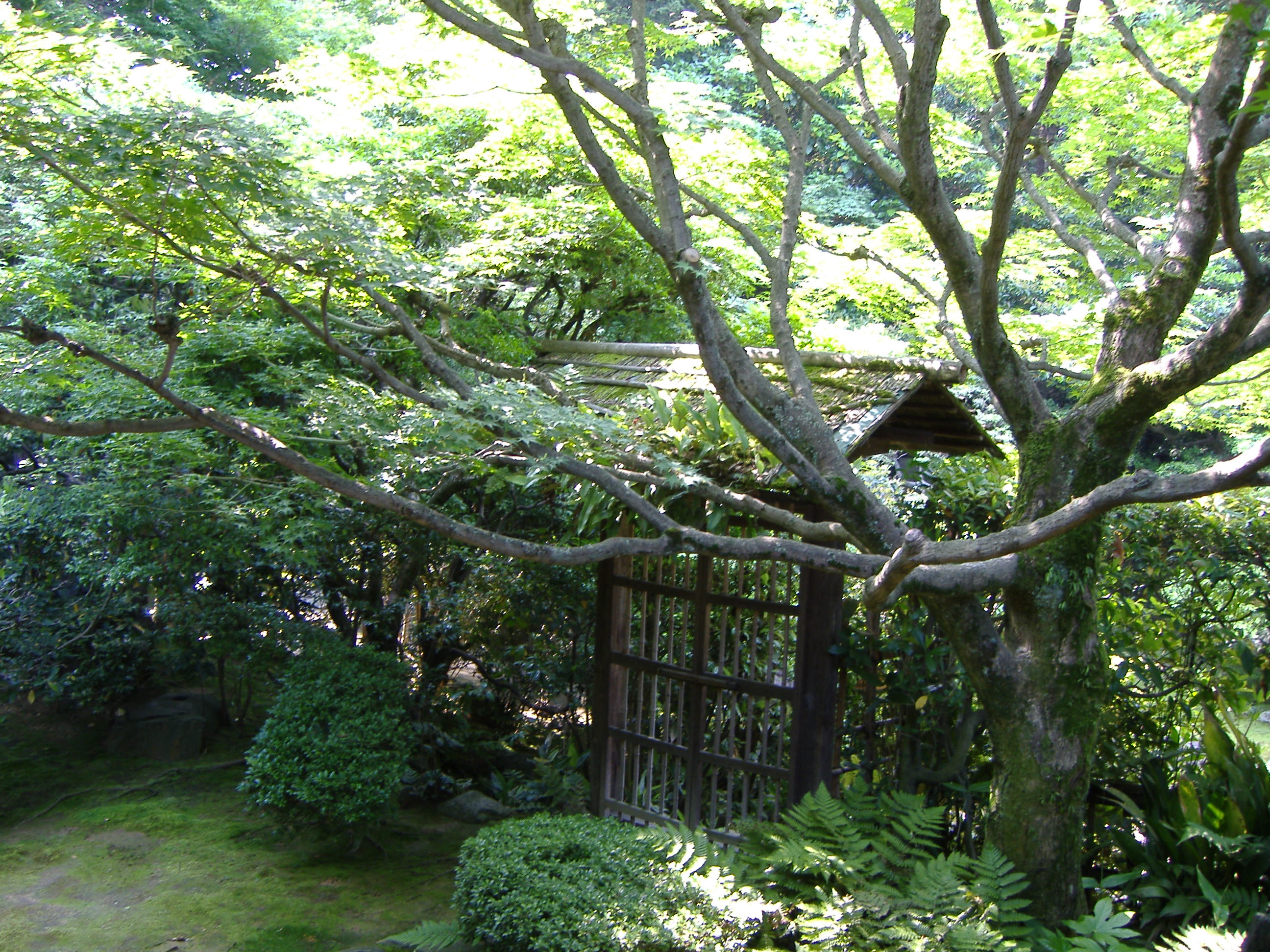
South of the abbot's residence, the Shinnyo Garden spreads across a carpet of dense moss punctuated by clipped azalea bushes on the embankment and maple trees on the lower level. Fifteen stones are arranged in a 7-5-3 pattern -- seven, five, and three -- numbers that add up to fifteen, indicating the full moon as it appears on the fifteenth day of the old lunar calendar. This arrangement follows the method of Kobori Enshu, the legendary tea master and garden designer of the early Edo period. A hedge separates this garden from the wabi garden to its south, where the mood shifts from mathematical precision to deliberate rustic simplicity. The Shinnyo Garden was praised in a description of Kyoto published in 1799, and in 1931 all four gardens were collectively designated a National Historic Site and National Place of Scenic Beauty.
Four Gardens, Four Worlds
Keishun-in packs four distinct gardens into its modest grounds. North of the abbot's quarters, a small kare-sansui dry garden fills the courtyard with a spring and a dry waterfall constructed from large, unusual stones brought from Wakayama Prefecture. East of the residence, the Shii Garden places sixteen Arhat stones on two artificial hillocks, with a central stone designated for Zen meditation. The wabi tea garden occupies the eastern area beyond the shoin, the abbot's private quarters -- a tea room called the 'Almost White Hermitage' is hidden behind its northeast corner, brought here from Nagahama Castle in 1631 and still closed to visitors. In the southeastern corner, seven stones sit 'like Buddhas' beside a water spring and the Green Dragon Pond. Stone slab paths descend through the garden, passing through the Baiken Gate, separating outer and inner worlds just as the tea ceremony separates the mundane from the sacred.
Hidden in Plain Sight
Myoshin-ji is a city within a city: forty-eight sub-temples clustered behind walls in Kyoto's Ukyo-ku district, most of them closed to outsiders. Keishun-in is one of the rare exceptions. Its accessibility makes it a quiet counterpoint to Kyoto's famous tourist circuits -- here there are no crowds jostling before golden pavilions, just the sound of raked gravel and the particular green silence of moss gardens. The temple sits a fifteen-minute walk from Hanazono Station on the JR West Sagano Line, an unremarkable approach through residential streets that gives no hint of what waits behind the small western gate. The gardens' designer remains uncertain, though evidence points to Gyokuenbo, a disciple of Kobori Enshu who designed the gardens of other Myoshin-ji sub-temples during the same period. What endures is the cumulative effect: four gardens, each with its own philosophy, wrapped around a single building where ravens still fly across gold-leafed doors.
From the Air
Located at 35.02N, 135.72E within the Myoshin-ji temple complex in Kyoto's Ukyo-ku district. From altitude, Myoshin-ji is visible as a large walled compound with dense tree cover amid Kyoto's western residential neighborhoods. Individual sub-temples like Keishun-in are not distinguishable from the air, but the overall complex is a clear green rectangle. Nearest airport is Osaka Itami (RJOO), approximately 28 nautical miles to the south-southwest. JR Hanazono Station and the Sagano Line tracks provide a linear reference just south of the complex.