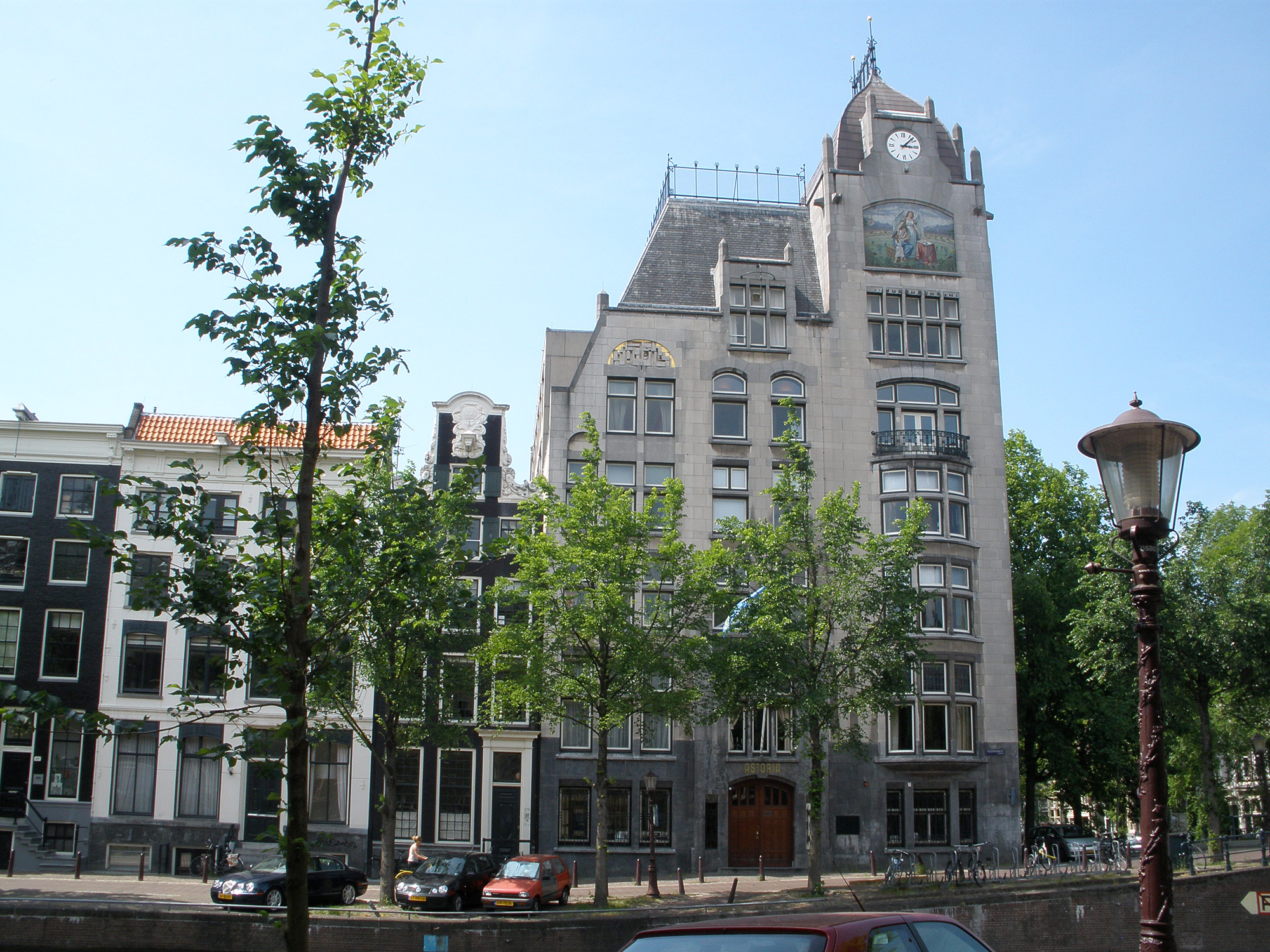
Keizersgracht
The merchants who carved the Keizersgracht out of marsh in the summer of 1615 nearly built it dry. There was a serious proposal that year to make it a grand tree-lined boulevard without water, modeled on the Lange Voorhout in The Hague. The plan died for the most practical of reasons - the future buyers wanted to reach their warehouses by boat, and the city did not have enough infill dirt to bury a channel that wide. So the Keizersgracht stayed wet. At 28.31 meters across - exactly one hundred Amsterdam feet - it became, and remains, the widest canal in the center of the city.
The Emperor's Canal
The name honors Maximilian I, the Holy Roman Emperor whose imperial crown Amsterdam was permitted to add to its coat of arms in 1489 as thanks for loans the city had floated him during a series of wars. By the time the Keizersgracht was dug, Maximilian had been dead for almost a century - but in seventeenth-century Amsterdam, an imperial connection still sold property. The canal is the middle of the three great rings that form the Grachtengordel: the inner Herengracht (Gentlemen's Canal) for the oldest and richest families, the outer Prinsengracht (Princes' Canal) for the working trades, and the Keizersgracht for the wealthy in between. The first stretch ran from the Brouwersgracht south to roughly today's Leidsegracht. By 1618, hardly a vacant lot remained. The eastern extension to the Amstel was not dug until 1663, in the great fourth expansion of the city, and the two halves were finally joined in 1667.
The Houses on the Water
Plots on the Keizersgracht were sold at the same width as on the Herengracht - thirty feet - which gave the canal its characteristic rhythm of tall, narrow, gable-fronted homes pressed shoulder to shoulder. Some of the best-known houses are the work of the architect Philips Vingboons and his contemporary Jacob van Campen, whose Coymanshuis at number 177 went up in 1625. Number 123, the Huis met de Hoofden - the House with the Heads - dates from 1622 and gets its name from the six classical heads carved above the entrance. Number 401, Huis Marseille, has been a photography museum since 1999. Number 672 is the Museum Van Loon, set inside a 1671 mansion that the Van Loon family bought in 1884 and never substantially remodeled. The trees that shade the water today are linden; the original elms were cut down by the city in 1949 after Dutch elm disease swept through.
The Residents It Remembers
Pieter Cornelisz Hooft, the seventeenth-century poet whose name now graces one of Amsterdam's shopping streets, lived at number 65. The painter Ferdinand Bol, a pupil of Rembrandt's, lived at 672 - now part of the Van Loon museum. Nicolaes Tulp, the doctor immortalized in Rembrandt's Anatomy Lesson, lived at 210. The Czech educator John Amos Comenius stayed at 123 with the merchant Louis de Geer. And at number 529, from the summer of 1781 through 1782, a Massachusetts lawyer named John Adams rented a house while he negotiated Dutch recognition and a loan for the new United States. He was the second president America would ever have, though he did not yet know it. The plaque on the wall today commemorates the moment when the Netherlands became the second country in the world, after France, to recognize American independence.
Honest About the Wealth
Walking the canal today, it is easy to see only the prosperity. The houses are beautiful. The reflections in the water are postcard-perfect. But honesty requires acknowledging where some of that money came from. Hendrik Carloff and Jan Valckenburgh, who lived at 111 and 113, made their fortunes in the slave trade between the Gold Coast and South America. Hendrick van Baerle at 198 was involved in slave transports to Suriname. The Italian Cosimo III de Medici stayed on the Keizersgracht with the merchant Francesco Feroni, whose wealth came from wool and slaves. The seventeenth-century Dutch Golden Age was built in part on plantations in the Caribbean and Brazil, and a portion of the gabled splendor along this canal is, plainly, the architecture of that economy.
Ice, Bridges, and the Canal Today
Fourteen fixed bridges span the Keizersgracht, all of them low enough that the city center's water level, by design, sits 40 centimeters below the Amsterdam Ordnance Datum - the elevation reference still used across much of Europe. When the canals freeze deeply enough, the city closes the locks, stops the boats, and lets skaters take over. The Keizersgracht is the designated main skating canal. Since 1991 a sprint race called the Keizersrace has been held between Leidsestraat and Spiegelgracht when conditions allow - which is rarely; it has run only four times in three decades, most recently in 2012. Climate has made it rarer still. The 17th-century canal belt was added to UNESCO's World Heritage list in 2010, the recognition that what those merchants dug in 1615 has lasted, in continuous use, for more than four centuries.
From the Air
The Keizersgracht traces an arc through Amsterdam's central canal belt, running from the Brouwersgracht in the northwest to the Amstel river in the southeast, centered around 52.367 N, 4.885 E. From the air the three concentric semicircles of the Grachtengordel - Herengracht, Keizersgracht, Prinsengracht - are unmistakable. Nearest airport: Schiphol (EHAM), 8 nm southwest. The canal belt lies under approach routes; visibility from cruising altitude is poor, but lower transits along the IJ waterfront offer clear views.