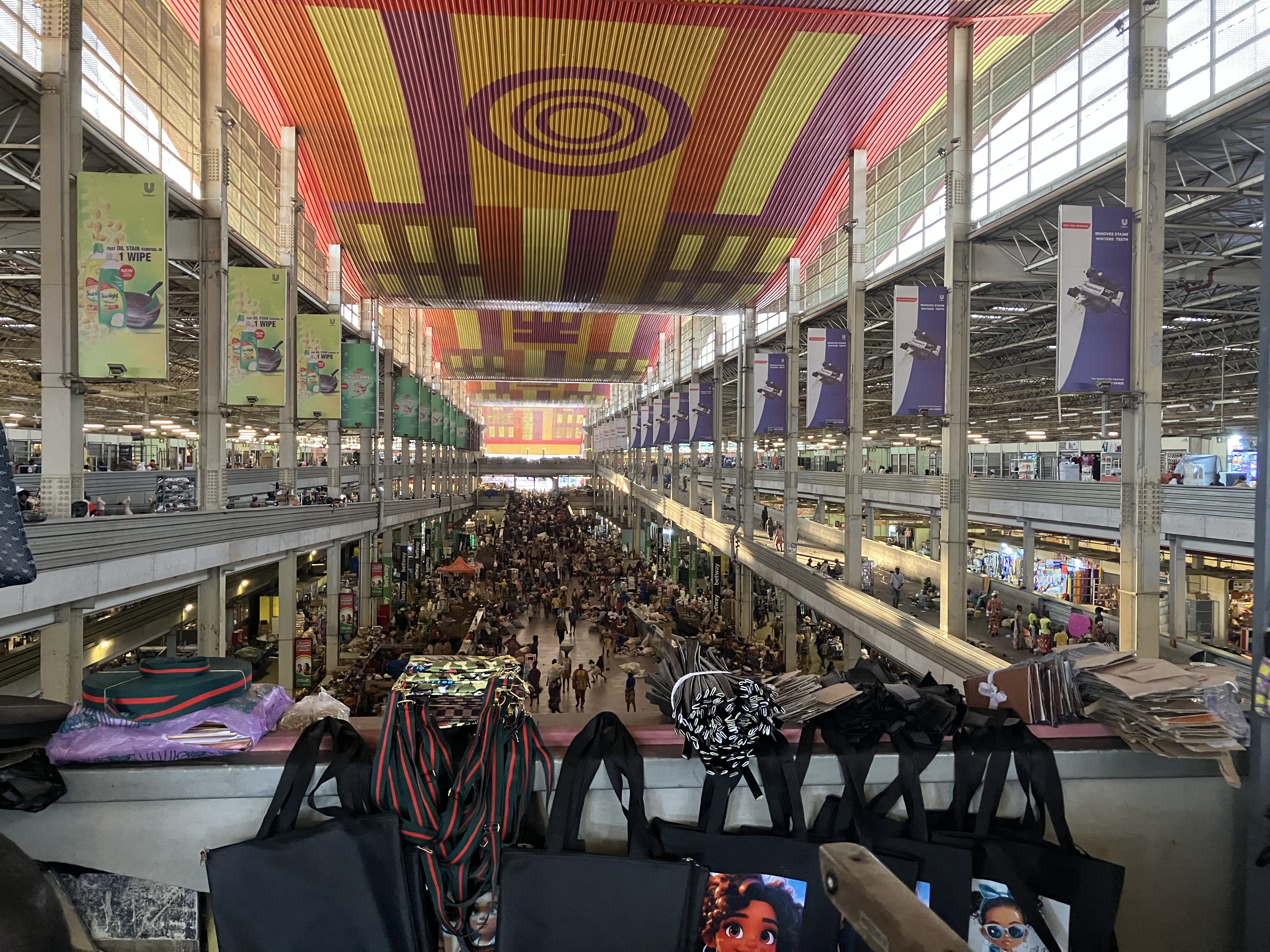
Kejetia Market
Twenty thousand vendors open their stalls before dawn, and by mid-morning the corridors pulse with the kind of energy that no shopping mall could replicate. Kejetia Market in Kumasi is not merely a place to buy and sell. It is the commercial heartbeat of the Ashanti Region, the largest single market in West Africa, and a living archive of a trading culture that predates the colonial boundaries around it. Walk through its passages and the air thickens with the scent of ground pepper, shea butter, and freshly dyed kente cloth. The sounds layer over one another: haggling in Twi, the clatter of wooden crates, a radio somewhere playing highlife. Fifty thousand people pass through here every day, making Kejetia less a market and more a small city within a city.
A Century of Commerce
The market traces its origins to 1924, when British colonial administrators established it alongside the Makola Market in Accra, modeling both on British market halls meant to consolidate the growing number of street vendors. A lorry park was built nearby to handle the traffic of buyers traveling from across the Gold Coast. But colonial intentions and Ghanaian realities diverged quickly. The British wanted industrialization to absorb the growing vendor class; the vendors had other plans. Trade at Kejetia only expanded, stubbornly and relentlessly. After Ghana's independence in 1957, small-scale trading remained a cornerstone of the economy, and Kejetia sat at the center of it. Decades of growth without matching investment left the infrastructure fraying at the edges, but the commercial energy never dimmed.
Reinvention Under a New Roof
In 2015, the Ghanaian government announced an ambitious plan to rebuild Kejetia from the ground up. The first phase alone cost over 259 million US dollars, financed with support from Deutsche Bank and UK Export Finance, with construction handled by the Brazilian firm Contracta Engenharia. By late 2018, a new market hall stood where the old open-air chaos had been, equipped with roughly 8,420 modern store units. The design team at Avangarde Design Services wove the building's cultural identity into its architecture. Look up inside the new market and the ceiling tells an Ashanti story: Adinkra symbols rendered in bold yellow, orange, red, and purple hues echo the patterns of traditional kente weaving. Nkyinkyim, the symbol of resilience and adaptability, twists through the design. Akofena, crossed swords representing valor, presides over the traders below.
Fire, Debt, and Resilience
Kejetia has always contended with hazards that reflect the precariousness of informal commerce. Fire outbreaks have been a recurring threat throughout its history. In January and March of 2016, blazes destroyed more than 200 shops and the livelihoods that depended on them. In June 2022, the market was disconnected from the national electrical grid after accumulating 14 months of unpaid bills totaling 5.2 million Ghanaian cedis. Power was eventually restored after vendors collectively paid 20 percent of the debt owed to the Electricity Company of Ghana. These are not just infrastructure problems; they are the recurring tests of a marketplace that operates at the scale of a small economy, where a fire or a power cut ripples outward through thousands of families.
The Pulse That Persists
The second phase of Kejetia's redevelopment, estimated at 248 million US dollars, remains underway. When complete, the rebuilt market will represent over half a billion dollars of investment in a single commercial space. But numbers tell only part of the story. Kejetia endures because it is woven into the daily rhythm of Kumasi, a city that once earned the nickname the Garden City of West Africa. Vendors here inherit stall positions from their mothers and grandmothers. Relationships between buyer and seller stretch across generations. The market is where Kumasi feeds itself, clothes itself, and conducts the daily negotiations that hold a community together. Beneath the Adinkra ceiling, that rhythm continues as it has for a century, adapted and renewed but never interrupted.
From the Air
Located at 6.70N, 1.62W in central Kumasi, Ashanti Region, Ghana. The market's large roofed structure is identifiable from medium altitude. Nearest airport is Kumasi Airport (DGSI), approximately 8 km to the southeast. Best viewed at 3,000-5,000 feet AGL. The sprawling urban landscape of Kumasi surrounds the market on all sides, with Lake Bosomtwe visible to the southeast.