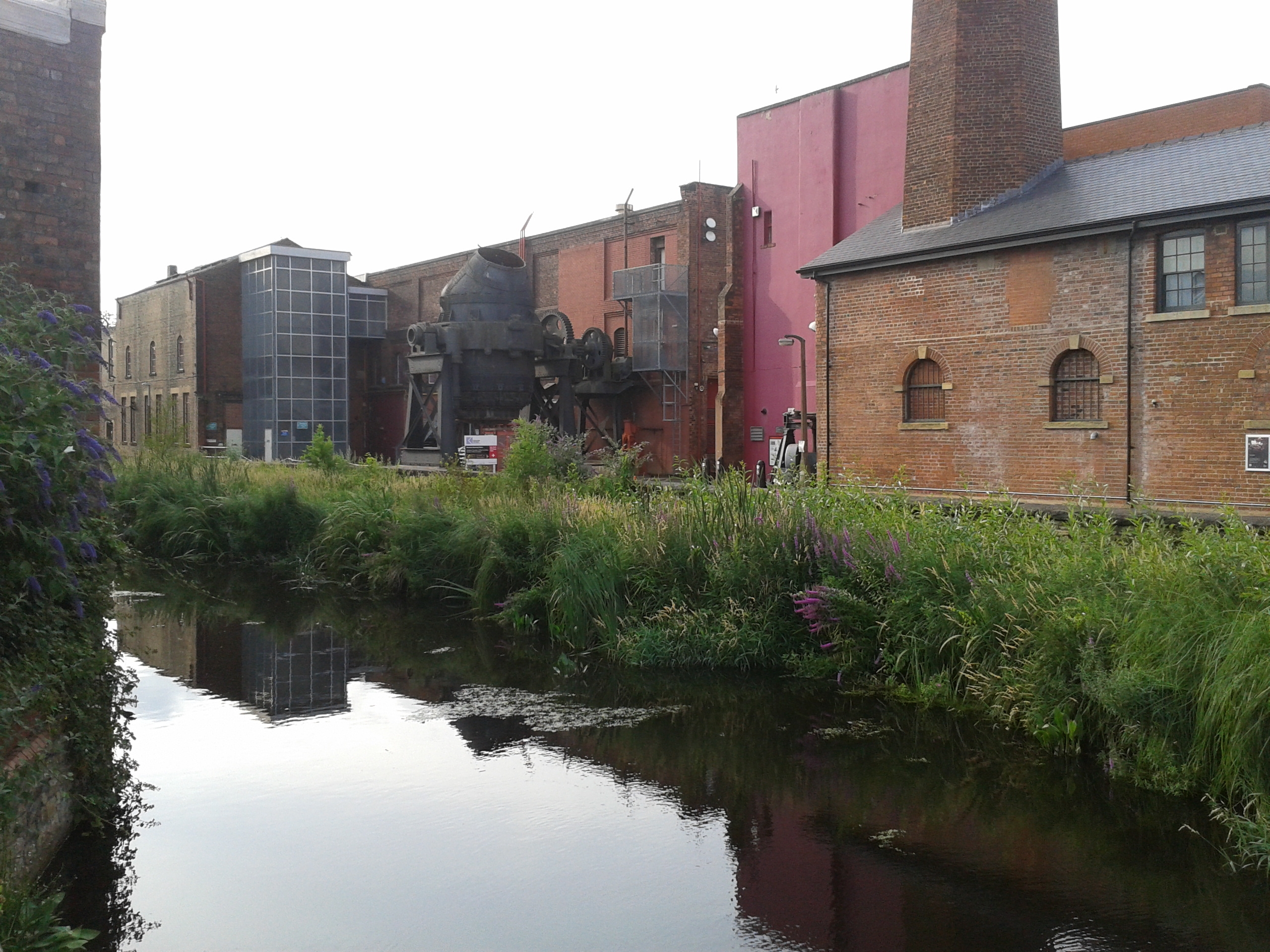
Kelham Island Museum
The River Don Engine fires up with a sound that starts in your chest. Twelve thousand horsepower of Victorian engineering, a steam engine so large it originally powered an armour plate rolling mill, its massive beam rising and falling with a precision that seems impossible for something built in 1905. Kelham Island Museum, set on an artificial island in Sheffield's River Don, keeps this engine alive with regular demonstrations, a living reminder that Sheffield did not simply make steel. Sheffield made the steel that made the modern world. The museum sits on a site where industry has operated continuously since the twelfth century, from corn mill to iron foundry to power station, a thousand-year continuum of making things beside moving water.
An Island Made by Industry
Kelham Island is man-made, created in the twelfth century when a mill race was cut to divert water from the River Don to power a corn mill belonging to the Lord of the Manor. The island takes its name from Kellam Homer, the Town Armourer, who owned a grinding workshop on the neighbouring goit in 1637. For centuries the island remained meadowland, but in 1829 John Crowley built an iron foundry on the site. The foundry survived the Great Sheffield Flood of 1864, when Dale Dyke Dam burst and sent a wall of water through the Don Valley, killing 240 people and damaging workshops across the area. Crowley's foundry operated until the 1890s, when it was replaced by a power station built to supply electricity for Sheffield's new tram network. The power station ran until the 1930s, after which the buildings served as workshops and storage until the museum opened in 1982.
The Engine That Rolled the World's Steel
The River Don Engine is the museum's centrepiece and Sheffield's most visceral connection to its industrial past. Built in 1905, the 12,000-horsepower steam engine originally powered an armour plate rolling mill at Charles Cammell's Grimesthorpe Works, rolling heavy steel plate for warships, tanks, and eventually nuclear reactors. The engine's most remarkable feature is its ability to reverse direction almost instantly, a capability essential for the back-and-forth process of rolling thick steel. It was last used in production in 1978, and when the museum acquired it, Sheffield gained what amounts to a working monument to the city's defining industry. The museum also houses a Bessemer converter, the technology that revolutionised steelmaking in the nineteenth century, though Henry Bessemer's original pilot converter is at the Science Museum in London.
From Sheffield-Simplex to the Last Little Mester
Beyond the heavy industry, the museum holds objects that reveal Sheffield's range. The prototype Sheffield-Simplex car, one of only three surviving examples, was described by The Times in 1913 as 'one of the best and most remarkable vehicles available, representing the highest point to which motor design has yet attained.' The Benjamin Huntsman Clock, the first manufactured object to contain crucible cast steel, sits in the Enid Hattersley Gallery, a direct link to the eighteenth-century clockmaker whose invention of crucible steel gave Sheffield its global reputation. From 2009 until his death in 2021 at the age of ninety-four, Stan Shaw worked at the museum as a 'little mester,' the local term for the independent craftsmen who once filled Sheffield's workshops. Shaw demonstrated traditional knife-making to visitors, his hands performing skills that had been passed down through generations of Sheffield cutlers.
Flood, Recovery, and Continuity
In July 2007, the River Don flooded again, inundating the museum with over a metre of water and causing 1.5 million pounds in damage. Paintings by William Cowen and Henry Perlee Parker were among the objects damaged. The museum closed for eighteen months, reopening in September 2008 to national acclaim for its recovery, receiving a commendation from the Museums, Libraries and Archives Council. New flood defences completed in 2011 now protect the site. The flooding was a bitter irony for a museum built on an island created by water engineering, but it also demonstrated the tenacity that has characterised this spot for centuries. Industry arrived on this stretch of the Don in the twelfth century and has not entirely left. The museum, an Anchor Point on the European Route of Industrial Heritage, ensures that Sheffield's industrial memory persists even as the forges and foundries that created it fall silent.
From the Air
Located at 53.390N, 1.472W on the River Don in central Sheffield. The museum site sits on a man-made island adjacent to the river. Nearest airports: Sheffield City/Doncaster (EGCN, 18nm east), East Midlands (EGNX, 30nm south). The industrial buildings along the Don are visible from 2,000ft AGL.