Kellogg (Idaho)
The statue stands at a highway pullout east of town - a bronze miner holding his drill aloft, forever frozen in the moment before descent. Behind him, headstones mark where ninety-one men never emerged from the Sunshine Mine on May 2, 1972. A subterranean fire had filled the tunnels with carbon monoxide, killing miners faster than rescuers could reach them. It remains one of the worst hard-rock mining disasters in American history. The memorial captures something essential about Kellogg: this is a town built on extraction, on the dangerous work of pulling silver and lead from mountain rock, and the memory of that work persists long after the industry that created it has largely departed. The ski gondola that now rises from downtown to Silver Mountain follows the route where miners once commuted to their shifts underground. The transformation from industrial sacrifice zone to recreation destination is incomplete, and perhaps never will be complete. Kellogg remembers.
The Bunker Hill Complex
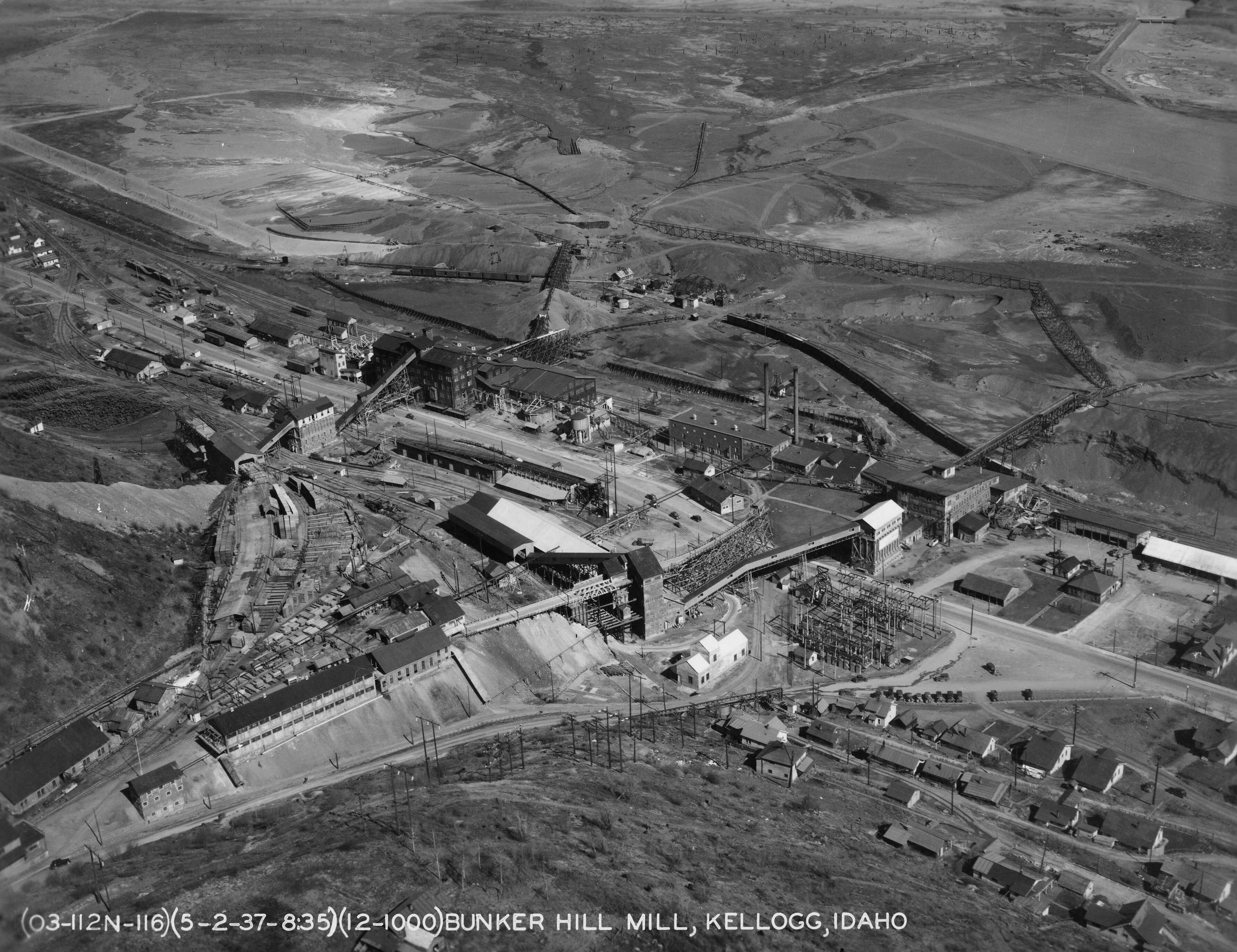
For decades, the Bunker Hill Mine and Smelting Complex was the largest such facility on Earth. The smelter processed lead, zinc, and silver from mines throughout the Silver Valley, its smokestacks visible for miles. The operation provided good-paying jobs but extracted a price. Lead contaminated the soil, the water, the children's blood. When the smelter finally closed in 1981, the Environmental Protection Agency declared the entire valley a Superfund site - one of the largest and most contaminated in America. Cleanup has cost billions and continues today. The smelter stack came down in 1996. The slag piles have been capped and grassed. But the legacy lingers in warning signs, in restricted areas, in the knowledge that the earth itself bears scars that will outlast anyone now living.
Silver Mountain Rising
The gondola changed everything. When Silver Mountain Resort opened in 1990, it offered something no other Idaho ski area could match: a 3.1-mile gondola ride from downtown Kellogg directly to the ski slopes. No driving narrow mountain roads. No parking lot at altitude. Just step into a cabin at street level and arrive at the mountain village twenty minutes later. The gondola was a statement of reinvention. Kellogg would become a destination rather than a cautionary tale. The resort has expanded over the years, adding a waterpark, summer mountain biking, and the Mountain Haus village at the summit. The skiing is respectable - 73 runs across 1,600 acres of varied terrain - though it lacks the destination glamour of Sun Valley. What it offers instead is accessibility: a mountain vacation without the mountain drive.
The Valley's Echoes
Drive through Kellogg today and the past remains visible. Metal sculptures of miners and dragons line the streets - folk art fabricated from industrial scrap. The Crystal Gold Mine offers tours of a working gold mine, a small-scale reminder of what once powered the regional economy. The Sunshine Mine itself is closed, its surface works rusting in the narrow canyon where tragedy struck. Nearby Wallace, the only city in America entirely listed on the National Register of Historic Places, preserves the Victorian architecture that silver money built. The Silver Valley Historical Society maintains exhibits that don't flinch from the darker chapters. This is not a region that has forgotten its industrial past, even as it courts the tourist future. The memorial to the ninety-one stands where every visitor will see it, demanding remembrance alongside recreation.
From the Air
Located at 47.54N, 116.13W in the narrow Silver Valley along I-90, approximately 35nm east of Spokane. The valley runs east-west, hemmed by forested mountains rising 3,000 feet above the valley floor. Silver Mountain's gondola terminal is visible in downtown Kellogg; the ski terrain spreads across Kellogg Peak and Wardner Peak above. The Sunshine Mine complex is in a side canyon southeast of town. No commercial airport in Kellogg - nearest is Spokane (GEG) at 78nm or Coeur d'Alene (COE, uncontrolled) at 35nm. The I-90 corridor through the valley follows the South Fork of the Coeur d'Alene River, with Wallace visible 5nm east. Terrain requires careful attention - the valley floor sits at 2,300 feet with peaks to 6,300 feet nearby.