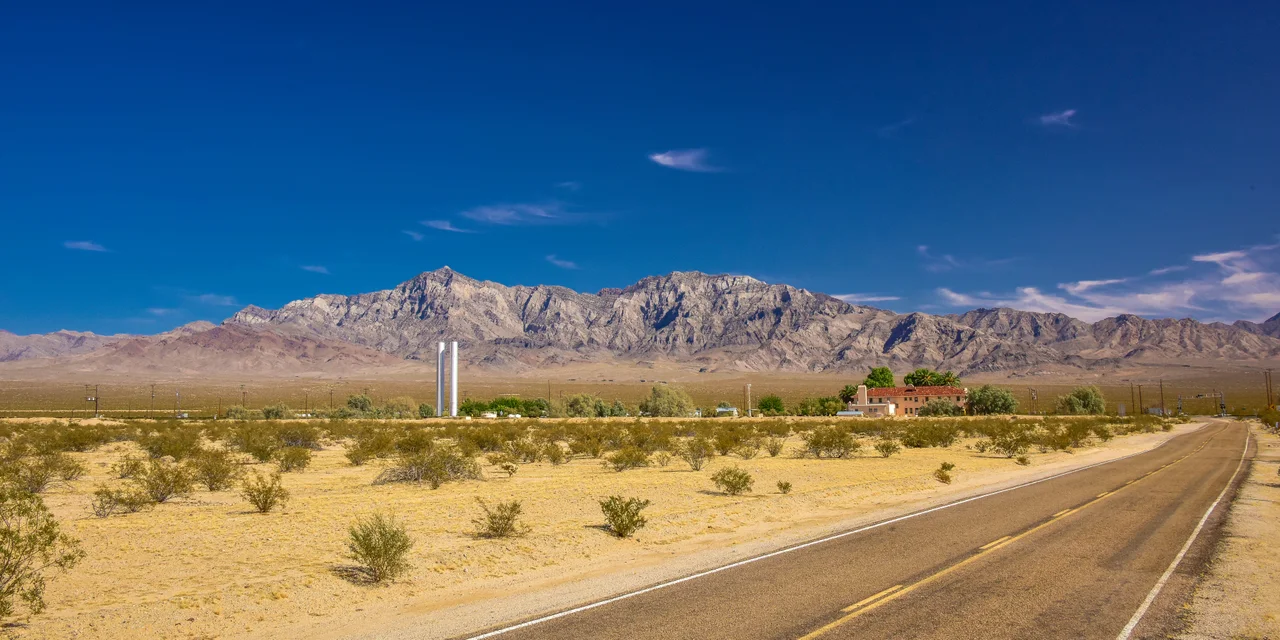

Kelso, California
Three railroad workers put their names in a hat and drew one out. The winner became the name of the new station. This is how Kelso got its name in 1905 — not from a geographic feature, a local hero, or a company executive, but from a lottery among workers who were building the line and had to call the place something. The name of the man whose name was drawn has been largely forgotten. The station, Siding 16 on the Union Pacific's line through the Mojave Desert, eventually grew into a town, peaked at 2,000 residents during World War II, and declined back toward nothing before the restored depot gave it a second purpose.
How a Railroad Stop Became a Town
Kelso was built in 1905 as a service point on the Union Pacific's Los Angeles and Salt Lake Railroad — a watering stop and crew change location on the long desert crossing. The Mojave's heat and grade created practical demands: steam locomotives needed water more frequently in the desert, and the grades through the Providence Mountains required helper engines that were stationed at Kelso.
As the mining activity in the surrounding desert intensified — iron ore from the Vulcan Mine, borax from deposits to the north — Kelso grew from a railroad utility into a community with the features that communities require: a depot, a hotel, a store, a café. The Spanish Colonial Revival depot, completed in 1924, was an architectural statement for a desert town: a tile-roofed building in the manner of a California mission, incongruous in the creosote flats and thereby memorable.
The Peak and the Decline
World War II brought Kelso its largest population. The mining operations intensified, the railroad traffic increased, and the town reached 2,000 residents — a number that made it a functioning small community with enough critical mass to sustain schools, services, and the social life that communities generate. The famous 'Beanery' restaurant at the depot fed railroad crews around the clock. A strap-iron jail held drunks who needed somewhere to sleep it off.
When the war ended and the economic rationale contracted, the population declined steadily. By the 1970s, Kelso had so few residents and so little commercial activity that no television broadcaster found it worth reaching. The town became known as the town without television — a curiosity in an era when television was considered universal infrastructure. The mountains blocked any signal that might otherwise have found its way in.
Union Pacific Tries to Demolish the Depot
In 1985, Union Pacific proposed demolishing the Kelso Depot — the 1923 building that had served as the town's center for six decades. The proposal was consistent with the railroad's logic: the building was no longer needed for railroad operations, it was expensive to maintain, and the desert would be simpler without it.
The proposal generated opposition significant enough to delay and eventually prevent the demolition. Preservation advocates, the National Park Service, and the state of California all intervened in various capacities. Union Pacific transferred the building to the Bureau of Land Management in 1992 as part of negotiations over the federal land the railroad occupied. The preservation fight had worked.
Restoration and the Visitor Center
The Kelso Depot reopened in 2005, after years of restoration work, as the visitor center for Mojave National Preserve. The Spanish Colonial Revival building that Union Pacific had wanted to demolish became the primary public interface for one of the largest national preserves in the lower 48 states — a building that had been built for railroad crews now welcoming hikers, campers, and desert explorers.
The depot's restoration gave Kelso a form of permanence that its original function as a railroad stop could never have guaranteed. Buildings that become visitor centers acquire institutional protection. The Mojave National Preserve that surrounds Kelso covers 1.6 million acres of desert, and the depot sits at its center, offering orientation to a landscape that has no single obvious point of entry. The date palms planted around the depot during its operational years survived the long closure and the desert heat, now shading a building that a name drawn from a hat helped create.
From the Air
Located at 35.013°N, 115.654°W in Mojave National Preserve, eastern San Bernardino County. The Spanish Colonial Revival depot is visible from low altitude as a distinctive tile-roofed structure amid the desert. Kelso Dunes, a major sand dune formation, are visible a few miles to the southwest. Nearest airports: Needles Airport (EED), approximately 45 miles east; Las Vegas (LAS), approximately 95 miles northeast.
Nearby Stories
- Clipper Mountains 8.7 km away
- Zzyzx, California 12 km away
- Ragtown, California 20 km away
- London Bridge (Lake Havasu City) 67 km away
- Boulder City and Hoover Dam 73 km away
- The PEPCON Disaster 88 km away
- Hoover Dam: The Depression-Era Marvel That Tamed a River 107 km away
- The 49ers of Death Valley: The Shortcut That Became a Deathtrap 126 km away