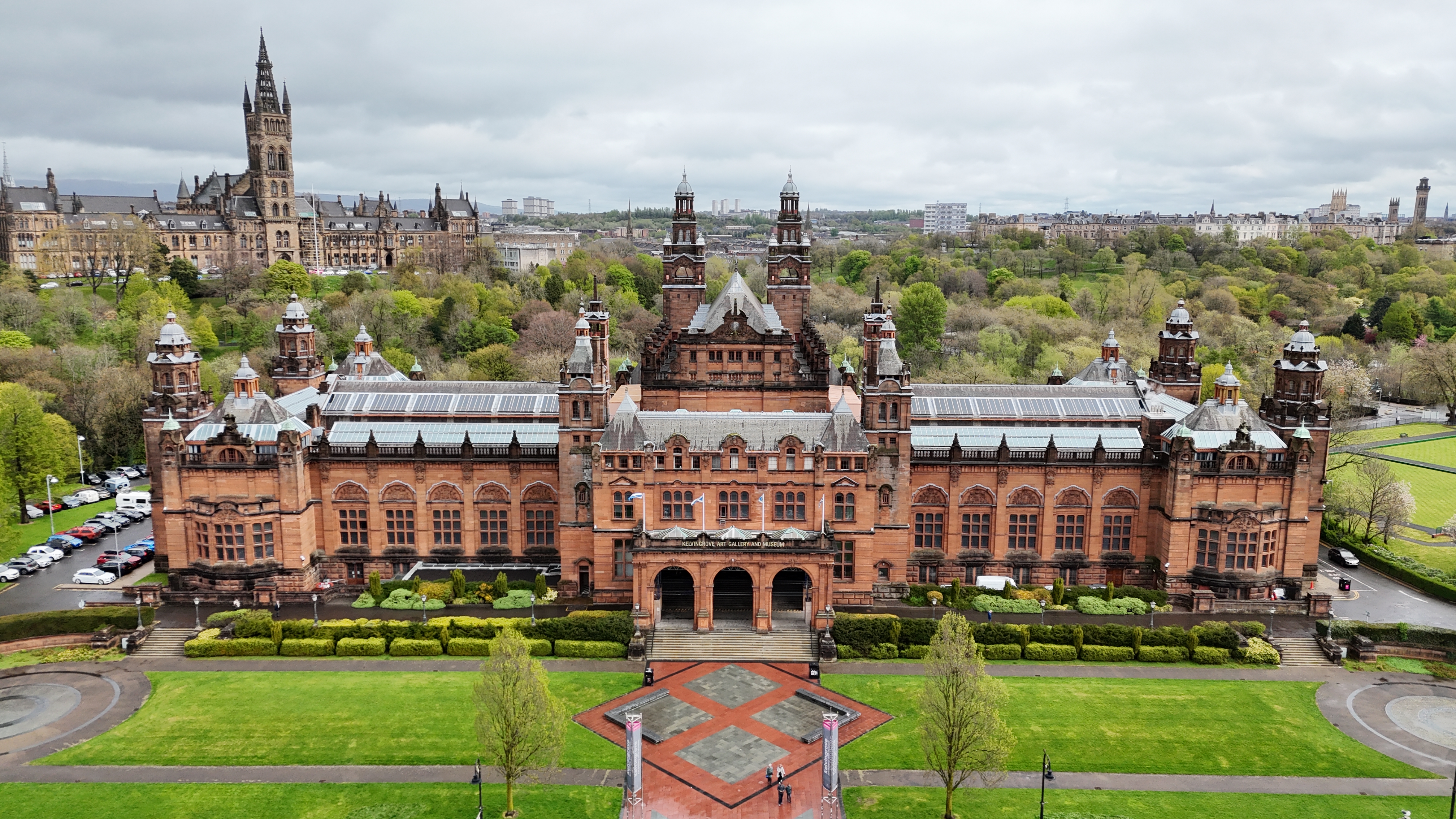
Kelvingrove Art Gallery and Museum
There is a persistent story in Glasgow that Kelvingrove Art Gallery and Museum was accidentally built back-to-front, and that the architect, upon realizing his mistake, threw himself from one of the towers. Neither claim is true. The grand entrance was always intended to face into Kelvingrove Park rather than Argyle Street, and its architects, Sir John W. Simpson and E.J. Milner Allen, lived long enough to see the building become the most beloved cultural institution in Scotland. The myth endures because Glaswegians enjoy telling it -- and because Kelvingrove, from every angle, looks like a building that could inspire that kind of devotion.
A Palace Born of Exhibition
Kelvingrove owes its existence to Glasgow's appetite for international exhibitions. The profits from the 1888 International Exhibition, held in Kelvingrove Park, partly funded the construction. The gallery opened in 1901 as the Palace of Fine Arts for that year's Glasgow International Exhibition, a vast showcase of the city's industrial confidence. Built in Spanish Baroque style using Locharbriggs red sandstone on the exterior and Giffnock white sandstone within, the building is an architectural statement of civic ambition. George Frampton, Francis Derwent Wood, and other sculptors populated its facades with an elaborate program of architectural sculpture. At the center of the building, a concert pipe organ by Lewis and Company was installed after a councillor argued that without it, 'the art gallery would be a body without a soul.'
The Painting Glasgow Bought Twice
In 1952, Glasgow's museum director Tom Honeyman traveled to meet Salvador Dali and purchased Christ of Saint John of the Cross, a painting that depicts the crucifixion from above, looking down onto the cross from the heavens. The acquisition was controversial -- Glaswegians questioned whether public money should be spent on surrealist art. Honeyman also secured the copyright from Dali, a decision that proved financially shrewd: the reproduction rights alone have generated income many times the original purchase price. The painting became Kelvingrove's most famous exhibit. Between 1993 and 2006 it was moved to the St Mungo Museum of Religious Life and Art, but it has since returned to the gallery where it draws visitors from around the world.
A Spitfire Over the Animals
When Kelvingrove closed for a three-year, thirty-five-million-pound refurbishment in 2003, the curators reimagined the entire experience. The collections were reorganized into two halves: Life and Expression. The Life galleries hold natural history, human history, and prehistory. The Expression galleries contain the fine art. Among the most striking decisions was to suspend a Spitfire Mark 21 from the ceiling above the Life gallery -- serial number LA198, which had served with 602 (City of Glasgow) Squadron of the Royal Auxiliary Air Force between 1947 and 1949. Below it, Sir Roger the Asian elephant and the Avant Armour, one of the finest surviving suits of plate armor from the 1440s, occupy the same dramatic space. Queen Elizabeth II reopened the museum on 11 July 2006.
Europe's Great Civic Collection
Kelvingrove's art holdings rival many national galleries. The collection spans Old Masters -- Rembrandt's A Man in Armour, works by Francesco Vecellio and Gerard de Lairesse -- through French Impressionists including Monet, Renoir, Pissarro, Van Gogh, and Mary Cassatt. The Glasgow Boys and the Scottish Colourists are represented in depth. Van Gogh's Portrait of the Art Dealer Alexander Reid, painted in 1887, captures a Glasgow man who championed Impressionism in Scotland. The museum also holds the Anne Hull Grundy collection, a major gift covering European jewelry of the 18th and 19th centuries, and one of the finest arms and armor collections in the world.
The Most Visited Museum Outside London
In the year following its 2006 reopening, Kelvingrove recorded 2.23 million visitors, making it the most popular free-to-enter attraction in Scotland and the most visited museum in the United Kingdom outside London. Between 2006 and 2009, five million people walked through its doors. The building that started as a Victorian exhibition palace had become something more enduring -- a civic living room where Glaswegians and visitors encounter everything from Egyptian sarcophagi to floating sculptural heads by Sophie Cave, from Paul Gauguin's Copenhagen landscapes to a full-scale recreation of a 1930s Glasgow street. The organ still plays. The myth about the back-to-front building still circulates. And Kelvingrove, facing precisely the direction its architects intended, continues to do what it was built to do.
From the Air
Kelvingrove Art Gallery and Museum sits at 55.87°N, 4.29°W in Kelvingrove Park, in the West End of Glasgow. The distinctive red sandstone Spanish Baroque building with twin towers is visible from the air, set within the green expanse of Kelvingrove Park. The University of Glasgow tower rises to the north, and the River Kelvin runs along the park's eastern edge. Nearest airport: Glasgow International (EGPF, 6 nm west). The Kelvin Hall lies immediately to the south.