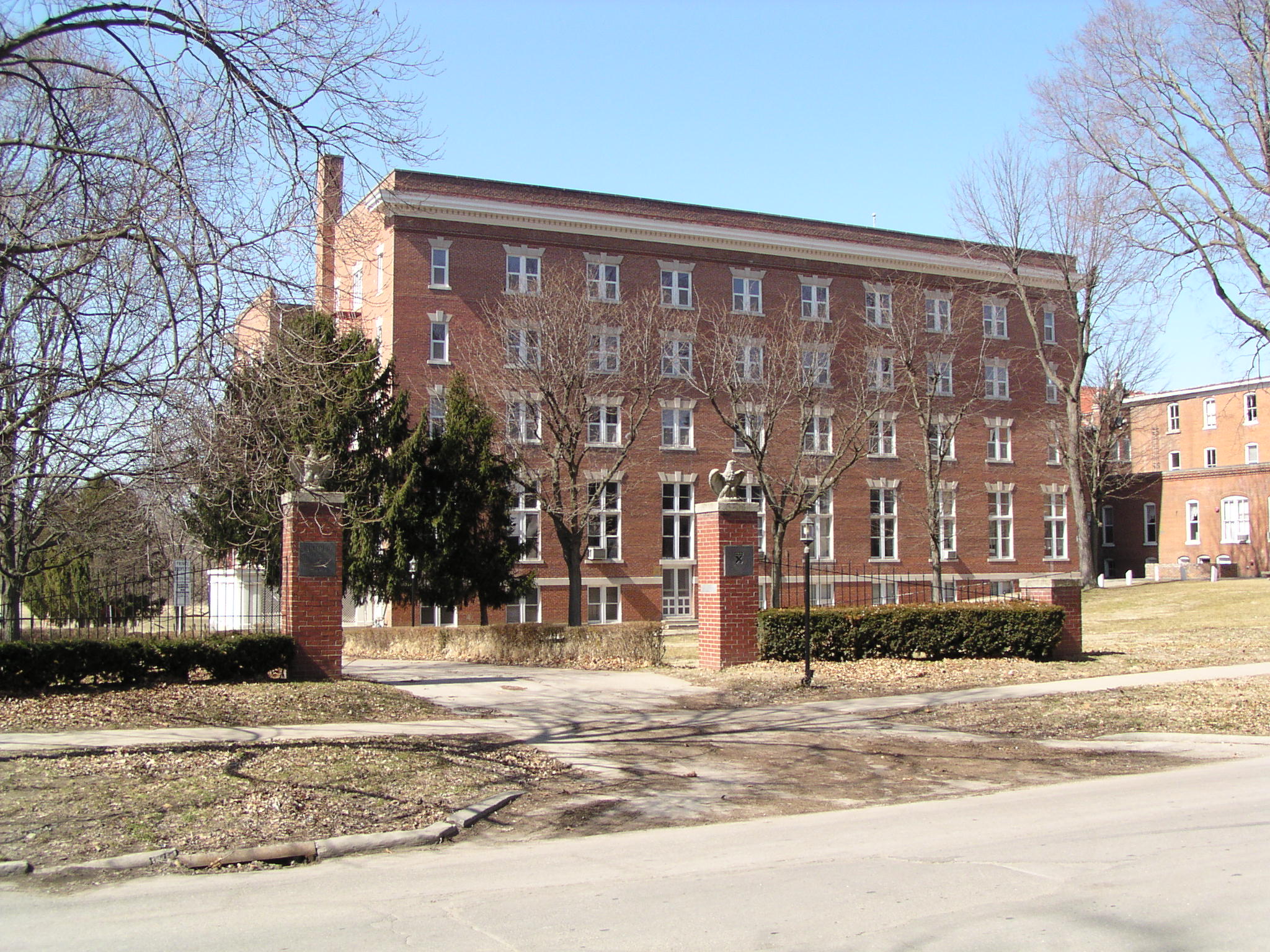
Kemper Military School
The filmmakers behind National Lampoon's Animal House once asked to shoot their movie at Kemper Military School in Boonville, Missouri. Kemper said no. When the producers of Taps came calling in 1981, the school's president declined again, declaring that the film 'portrayed the military school student as a radical.' In the end, Child's Play 3 -- a horror movie about a murderous doll -- did film on campus, with cadets serving as extras. These refusals and acceptances trace the arc of an institution that survived 158 years, seven American wars, and the cultural upheaval of the 1960s and 70s, only to succumb to debt and dwindling enrollment in 2002. Its motto, 'Nunquam Non Paratus' -- Never Not Prepared -- proved bitterly ironic at the end.
Five Students and a One-Room Schoolhouse
On June 3, 1844, Frederick T. Kemper gave his first lesson at the Boonville Boarding School, an all-male institution designed to educate sons of the frontier West. Five students showed up. By fall, there were 50. Kemper built a proper schoolhouse the following year and spent the next four decades running the institution essentially by himself, changing its name regularly -- Boonville Boarding School, Male Collegiate Institute, Kemper Family School, Kemper & Taylor Institute. When the Civil War erupted, Kemper kept the school open by accepting female students for the first time and maintaining careful neutrality, a delicate balancing act given that his brother was Confederate General James L. Kemper, famous for participating in Pickett's Charge at Gettysburg and later serving as governor of Virginia. Kemper graduates fought on both sides, and many participated in the Battle of Boonville fought practically at their doorstep.
The West Point of the West
After Frederick Kemper's death in 1881, alumnus Thomas A. Johnston transformed the school into a military academy. Students had already been wearing West Point-style grey uniforms since the 1870s, but Johnston formalized military training in 1885, hiring a recent Virginia Military Institute graduate as instructor. The school became Kemper Military School in 1899, advertising itself as 'The West Point of the West.' Its most famous student, Will Rogers, attended in the 1890s before going on to become one of America's most beloved humorists and performers. By World War I, enrollment had soared to 502 cadets. The annual Thanksgiving football game against rival Wentworth Military Academy in Lexington, Missouri, drew front-page coverage in Kansas City and St. Louis papers, who called it the 'Little Army-Navy Game.'
Generals, Governors, and a Mobster
Kemper's alumni roster spans the improbable range of American ambition. Will Rogers became the nation's most popular entertainer. Donald J. Tyson built Tyson Foods into a corporate empire. James E. Stowers founded American Century Investments. Hugh O'Brian starred as Wyatt Earp on television, while George Lindsey became Goober Pyle on The Andy Griffith Show. Sergeant Travis W. Atkins earned the Medal of Honor. Lieutenant General Charles R. Hamm became superintendent of the Air Force Academy. Lawrence Vest Stephens served as governor of Missouri. And then there was Johnny Stompanato, the mobster boyfriend of actress Lana Turner, whose murder by Turner's daughter became tabloid legend. The junior college football program, though ultimately a financial drain, produced NFL players including Jamal Williams of the San Diego Chargers.
The Long Decline
The first 112 years of Kemper's history saw only four leaders. After the school went nonprofit in 1956, no superintendent served more than a few years. The instability hit hardest in the early 1970s, when anti-Vietnam War sentiment and double-digit inflation battered military schools nationwide. Enrollment, which peaked at 544 in the mid-1960s, cratered to 89 cadets in 1976. The school tried everything -- admitting women, reviving junior college football, loosening admissions standards. Brief upswings in the 1980s and 1990s proved unsustainable. In 2000, the expensive junior college athletic program was cut. By 2002, enrollment stood at 124 students and the bills could no longer be paid. On May 31, 2002, the flag was lowered for the final time.
Frederick T. Kemper Park
The City of Boonville purchased the 46-acre campus and renamed it Frederick T. Kemper Park. The campus had been added to the National Register of Historic Places in 1983, with 15 contributing buildings. The T.A. Johnston Field House now houses the local YMCA, with basketball courts, an indoor pool, and fitness facilities. Football fields, soccer fields, a lake, and baseball diamonds fill the former parade grounds. In 2010, the old administration building's tower collapsed. By 2016, the administration building itself was deemed too costly to repair and was demolished after careful documentation. The ground where it stood is now green space. State Fair Community College operates out of the renovated Science Hall. The school's records were donated to the State Historical Society of Missouri. Boonville absorbed Kemper's physical legacy, but the institution's 158-year arc -- from five students in a one-room schoolhouse to bankruptcy -- belongs to the wider story of American military education.
From the Air
Located at 38.9714°N, 92.7469°W in Boonville, Cooper County, Missouri, at approximately 700 feet MSL on the south bank of the Missouri River. The former 46-acre Kemper campus, now Frederick T. Kemper Park, is visible as a cluster of historic buildings and green space on the town's east side. Boonville has over 400 structures on the National Register. Nearest airports include Boonville Jesse Viertel Memorial Airport and Columbia Regional Airport (KCOU) approximately 25 nm east. The Missouri River and bluffs frame the town to the north. Best viewed at 2,000-4,000 feet AGL.