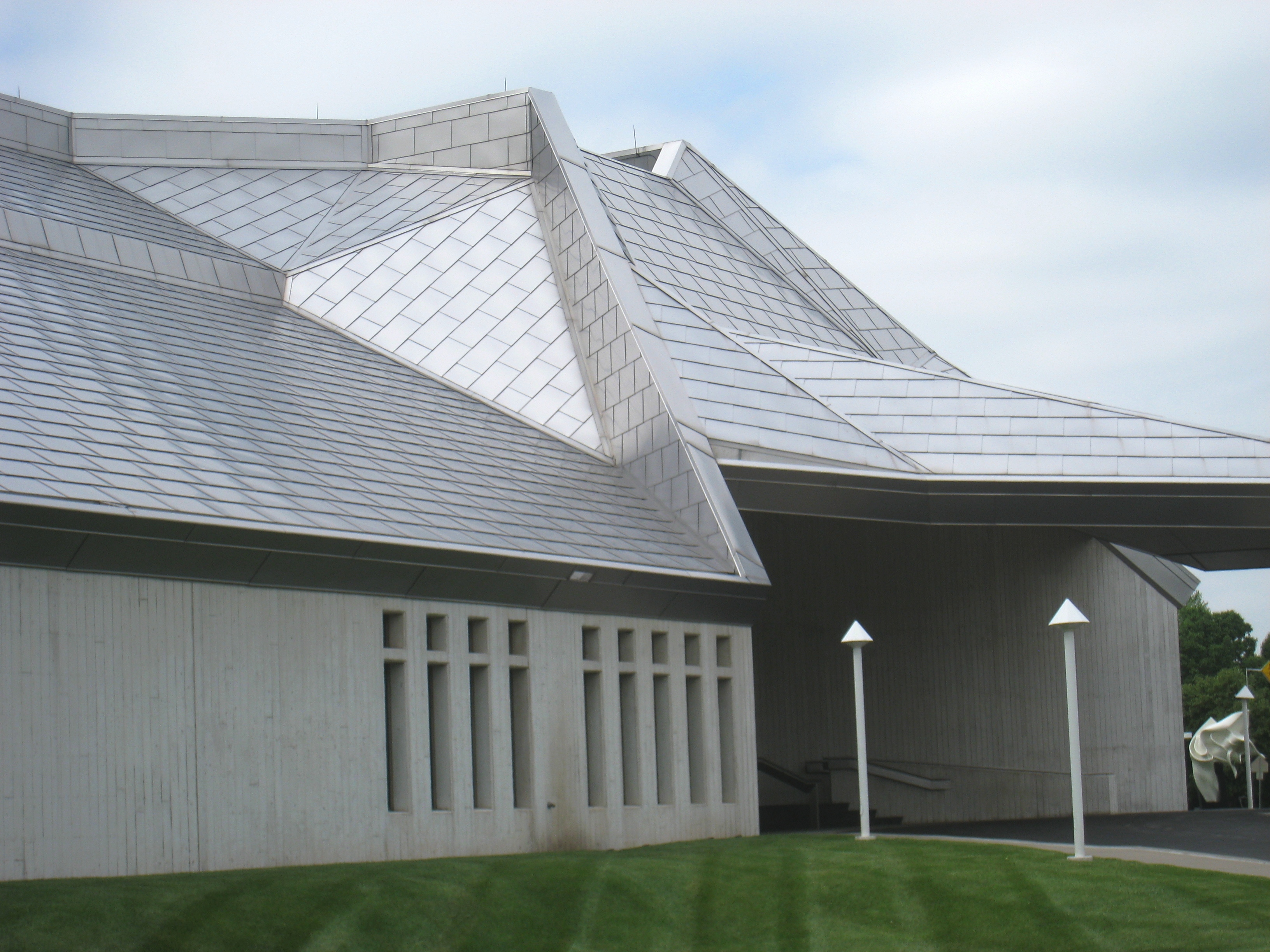
Kemper Museum of Contemporary Art
The museum opened with a scandal. In 1994, the Kemper Museum of Contemporary Art debuted with a rare series of 28 watercolors by Georgia O'Keeffe, the "Canyon Suite," dating from 1916 to 1918 and never before shown publicly as a group. Five years later, experts challenged their authenticity. The paper used for some of them could not have been obtained in the United States during the years when O'Keeffe was teaching art at West Texas State Normal College in Canyon. The National Gallery of Art excluded the "Canyon Suite" from O'Keeffe's catalogue raisonne, and the Gerald Peters Gallery refunded the $5 million the Kemper had paid. It was the kind of opening act that might have defined a lesser institution. Instead, the Kemper built something genuine.
Concrete That Flows Like Water
Latvian-American architect Gunnar Birkerts designed the Kemper's 23,200-square-foot building of concrete, steel, and glass, constructed between 1992 and 1994 at a cost of $6.6 million. The San Francisco Chronicle noted that Birkerts "used concrete, glass and steel in ways that seemed to flow, almost as if shaped by hand." The structure centers on a large atrium beneath an articulated skylight, with two wings extending from either side. The main gallery hosts three major exhibitions each year, while side galleries rotate works from the permanent collection. Art is always on view in the atrium and the corridors, making the architecture itself an act of curation, guiding visitors through light and space from one encounter to the next.
From Pollock to the Present
The Kemper's permanent collection of more than 1,400 works spans from the 1913 Armory Show, the exhibition that introduced modern art to America, through to present-day artists. The roster reads like a survey course in postwar American art: Jackson Pollock, Willem de Kooning, Robert Rauschenberg, Jasper Johns, Helen Frankenthaler, Georgia O'Keeffe, Frank Stella, Louise Bourgeois, Dale Chihuly, David Hockney, Robert Mapplethorpe, and Andrew Wyeth, among many others. In 2000, the museum received 15 works from the collection of Peter Norton, including photographs by Nan Goldin. The museum presents 10 to 12 special exhibitions each year, balancing traveling shows with self-organized presentations. Missouri's first and largest contemporary art museum, with approximately 75,000 visitors annually, the Kemper punches well above the weight of its modest footprint.
The History of Art on the Walls of a Cafe
The Kemper's most unexpected artistic experience may be lunch. Cafe Sebastienne, located in the heart of the museum, combines contemporary cuisine with an immersive art installation. The dining area is surrounded by 110 paintings collectively known as "The History of Art" by Frederick J. Brown, a renowned African-American artist who created a sweeping visual survey of artistic movements and masters. The restaurant is named after Brown's daughter, Sebastienne Nicole Brown. It is a space where the boundary between gallery and gathering place dissolves, where a meal becomes part of the museum experience. The Kemper was founded on the personal collection of Bebe and R. Crosby Kemper Jr., Kansas City banking figures who gifted their holdings and stepped down from the board in 2013, with their daughter Mary Kemper Wolf taking the chair.
From the Air
The Kemper Museum is located at 39.046N, 94.585W, near the Country Club Plaza district in south Kansas City. It sits along Warwick Boulevard, south of the main downtown area. The Nelson-Atkins Museum of Art is nearby to the northeast. Nearest major airport: Kansas City International (KMCI). Recommended viewing altitude: 2,000-3,000 feet AGL to see the museum in its neighborhood context near the Plaza.