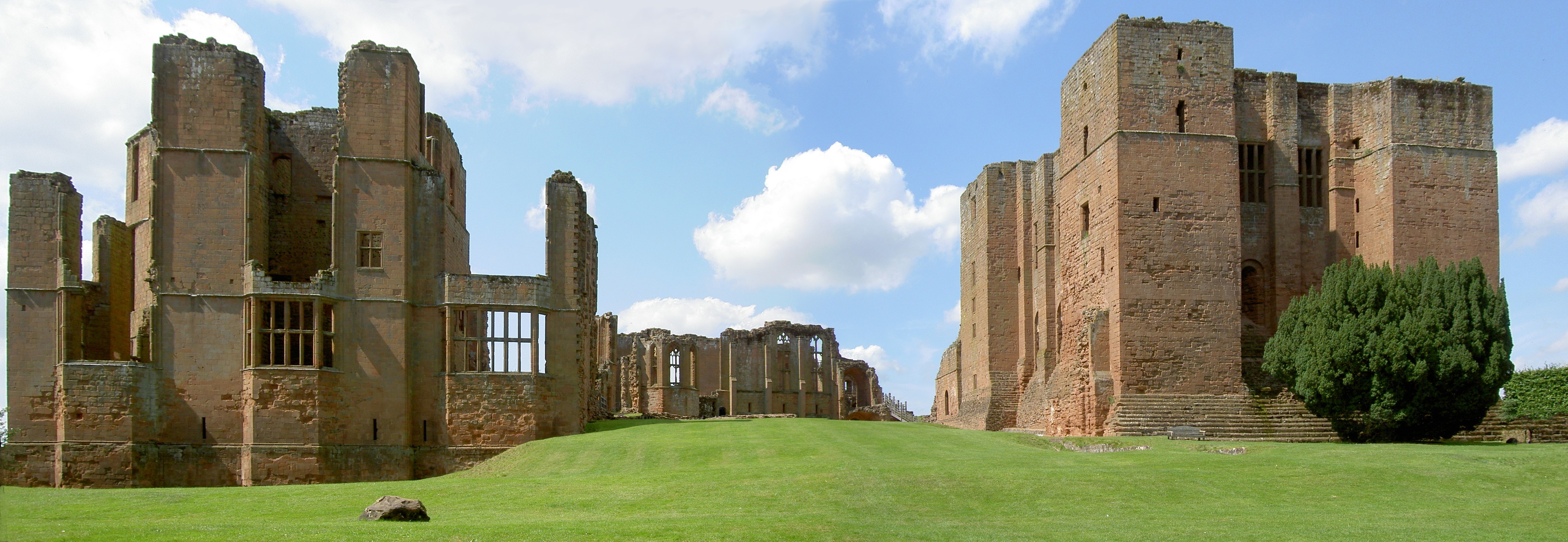
Kenilworth Castle
For nineteen days in the summer of 1575, Robert Dudley, Earl of Leicester, staged the most expensive courtship in English history. He filled Kenilworth Castle with fireworks, bear-baiting, mystery plays, and banquets so lavish they nearly bankrupted him -- all in a final, desperate attempt to convince Queen Elizabeth I to marry him. She arrived with thirty-one barons and four hundred staff. Twenty horsemen a day galloped to and from the castle carrying royal messages. The cost may have reached 1,700 pounds, a staggering sum. Elizabeth enjoyed every moment. She did not say yes.
Nine Centuries of Stone
Kenilworth's story begins around 1120, when Geoffrey de Clinton, treasurer to Henry I, built a substantial stone fortress on the site. The castle passed through a succession of royal and noble hands, each leaving their mark in stone. Henry III transformed it in the mid-13th century, expanding the defenses and creating an elaborate water defense system -- a great mere that surrounded the castle and made it virtually impregnable from three sides. King John had made it a royal castle in 1199, and the Crown held it for much of the medieval period. The massive Norman keep, built of local red sandstone, still dominates the ruins today, its walls thick enough to have withstood everything history has thrown at them except deliberate destruction.
The Siege That Would Not End
In 1266, following Simon de Montfort's defeat at Evesham, his surviving supporters barricaded themselves inside Kenilworth. What followed was the longest siege in medieval English history. The castle's water defenses -- the great mere that turned it into a virtual island -- made conventional assault impossible. Henry III's forces tried everything: siege engines hurled stones at the walls (archaeologists discovered catapult-fired projectiles at the site in 2024), but the defenders held firm. The siege dragged on for months, from summer through autumn. Disease and starvation eventually accomplished what military force could not. The royalists, recognizing the futility of continued assault, drafted the Dictum of Kenilworth, allowing rebels to buy back their confiscated lands. Even then, the garrison initially refused the terms. They finally surrendered in late 1266, having held out for approximately six months.
Leicester's Renaissance Palace
Robert Dudley, Earl of Leicester, inherited the castle from his father and poured resources into transforming it from a medieval fortress into what historians have called an English "Renaissance palace." He commissioned the royal architect Henry Hawthorne for a dramatic classical extension, but when that proved too ambitious, he hired William Spicer to rebuild and extend the residential quarters. Leicester's goal was strategic as well as romantic: he needed Kenilworth to attract Queen Elizabeth during her summer progresses around the country. Elizabeth visited in 1566, 1568, and 1572, viewing the evolving improvements. But it was the 1575 visit -- those legendary nineteen days of entertainment -- that represented Leicester's ultimate gamble. He enlarged the chase, rebuilt the guest apartments, and orchestrated entertainments so spectacular they may have inspired Shakespeare, who was eleven years old and living just thirteen miles away in Stratford-upon-Avon.
Deliberate Ruin
The English Civil War brought Kenilworth's active life to an end. Parliamentary forces, understanding all too well what a fortress of this strength could mean in the wrong hands, ordered the castle slighted after the war. The great mere was drained, removing the water defenses that had frustrated Henry III's army four centuries earlier. The keep was partially demolished. The residential buildings Leicester had so carefully constructed were left to decay. In 2009, English Heritage reconstructed the Elizabethan garden based on a letter describing the 1575 entertainments, restoring one small corner of what Leicester had built. Today the red sandstone ruins stand open to the sky, surrounded by the dry depression where the mere once gleamed -- a castle that was too powerful to ignore and too dangerous to leave intact.
From the Air
Located at 52.35N, 1.59W in Warwickshire, approximately 5 miles south of Coventry. The castle ruins are visible as a substantial red sandstone complex surrounded by open parkland. The dry basin of the former mere is discernible as lower ground around the castle. Nearest airports: EGBE (Coventry, 6nm E), EGBB (Birmingham, 15nm NW). Best viewed at 1,500-2,500 ft AGL.