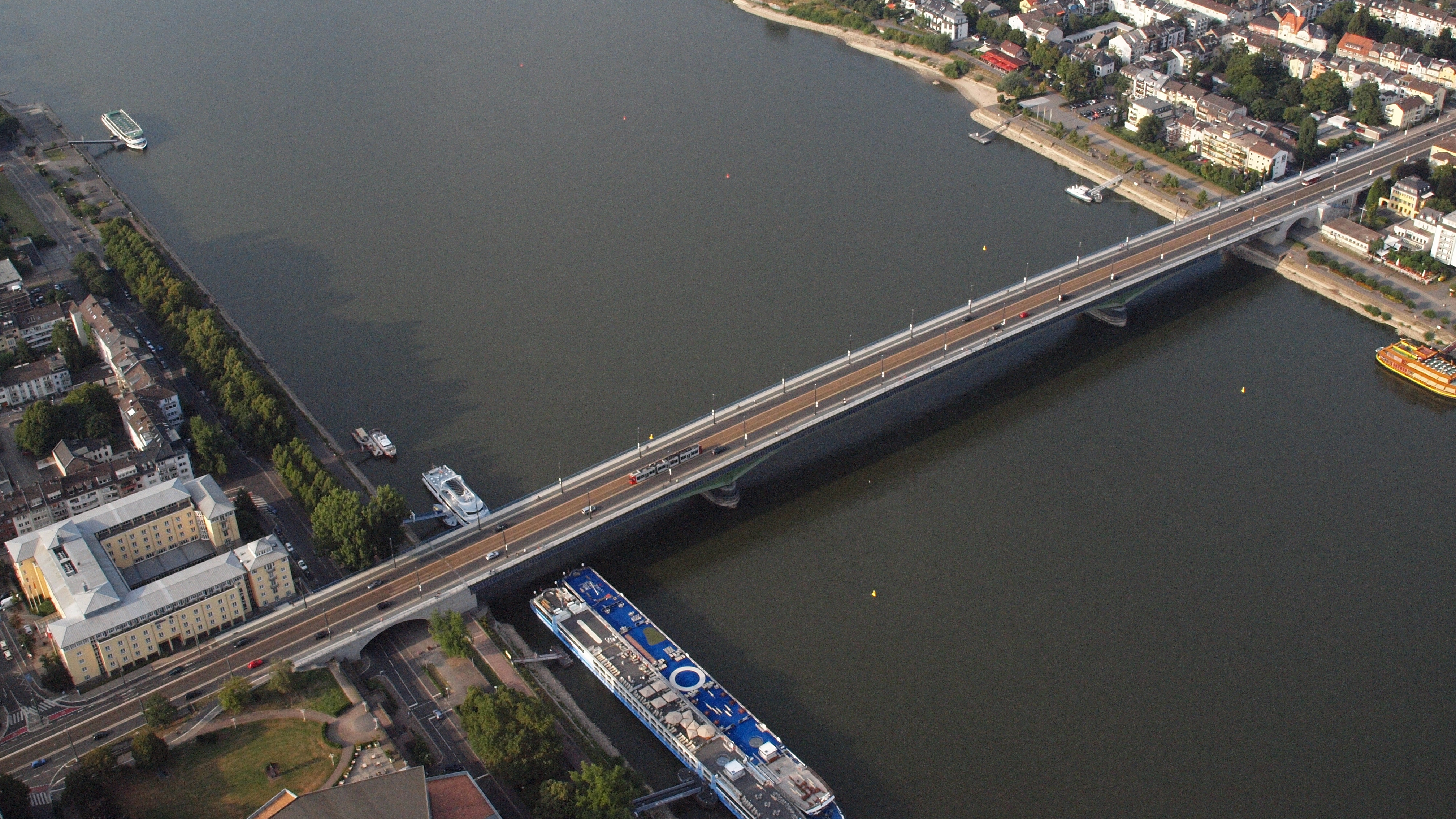
Kennedy Bridge (Bonn)
On 2 December 1963 — ten days after the assassination in Dallas — a small ceremony took place on the middle of Bonn's three Rhine bridges. The U.S. Ambassador George McGhee and the mayor of Bonn, Wilhelm Daniels, stood under a sign that read, in fresh paint, Kennedybrücke. The structure they were renaming was sixty-five years old, had been built by a German Empire that thought of itself as permanent, blown up by a retreating Wehrmacht in 1945, rebuilt by a war-bankrupt republic in 1949, and christened in the 1940s after a fairly minor SA functionary. By renaming it for John F. Kennedy, the new West Germany was making a quiet statement about which side of the twentieth century it intended to stay on.
Ferrymen and Marks
Before the bridge there were boats. From the seventeenth century onward, a regulated ferry service moved people, livestock, and goods between Bonn on the left bank and the village of Vilich, later called Beuel, on the right. The ferry families held formal rights — Fährrechte — and they were not going to lose them for free. When Bonn announced in 1889 it would build a real bridge, the Fährbeerbten threatened to sue. The case dragged. On 13 May 1896 the city paid the ferry community 190,000 marks plus a further 30,000 in compensation, and the right to throw a fixed structure across the Rhine became Bonn's alone. The Empire, Prussia, and the Rhine Province all declined to help with the cost. The city paid alone.
The Largest and Most Beautiful
A design competition in July 1895 went to a team from the industrial town of Oberhausen — Gutehoffnungshütte — together with R. Schneider of Berlin and the architect Bruno Möhring. Construction began in April 1896 and finished thirty-three months later, on 17 December 1898. With a main span of 188 metres, the new bridge was the largest on the Rhine. Standing on it you looked downstream toward the bumpy silhouette of the Siebengebirge, and contemporaries decided this was also the most beautiful bridge across the river. The final cost was 4 million marks — 155 percent of the first estimate, which surprised no one. A toll was collected from every passerby until 1938, when the last fees were finally lifted.
Blown Up at 8:20 in the Evening
The Nazis renamed the bridge Klaus-Clemens-Brücke, after a Bonn SA functionary, and used it as they used everything. On 8 March 1945, at 8:20 in the evening — two months before the war in Europe ended — the retreating Wehrmacht blew it up. The Allies crossed the Rhine elsewhere. The bombing didn't matter militarily, but it left Bonn cut in half. Ferries and improvised truck barges resumed almost immediately. By August 1945 the city's planning committee was already meeting to design a replacement. Stahlbau Rheinhausen and Grün & Bilfinger started construction in September 1946 on the surviving piers — they had taken little damage — and the new bridge opened on 12 November 1949. The old name was quietly dropped. For fourteen years it was simply the Rheinbrücke.
Kennedy, Again
Then November 1963 happened. Within ten days of the assassination, Bonn's council had decided to rename the bridge for the murdered American president, and on 2 December the signs went up. The choice mattered: in the early 1960s West Germany was still finding ways to publicly anchor itself to its Western alliance, and Kennedy's visit to Berlin five months earlier — 'Ich bin ein Berliner' — had been one of the era's defining symbols. Forty years on, the steel underneath the road surface began to fail. In 2003 inspectors found heavy corrosion below the sidewalks; by September 2005 the sidewalks were fenced off. A 40-million-euro reconstruction in three phases began on 16 April 2007 and finished in July 2011. The bridge that came out the other side was ten metres wider — 26.8 metres in total — and looked, from a distance, like its old self. Trams cross it. So do bicycles. The Siebengebirge is still downstream.
From the Air
50.7382 N, 7.1102 E across the Rhine at the centre of Bonn, linking the city centre to Beuel on the right bank. Cologne-Bonn (EDDK / CGN) lies about 18 km north; Bonn-Hangelar (EDKB) is roughly 4 km northeast. Best appreciated from 1,500–2,500 feet, with the bridge framed by Bonn's old town to the west and the rolling silhouette of the Siebengebirge downstream to the southeast — the view that nineteenth-century visitors called the most beautiful crossing on the Rhine.