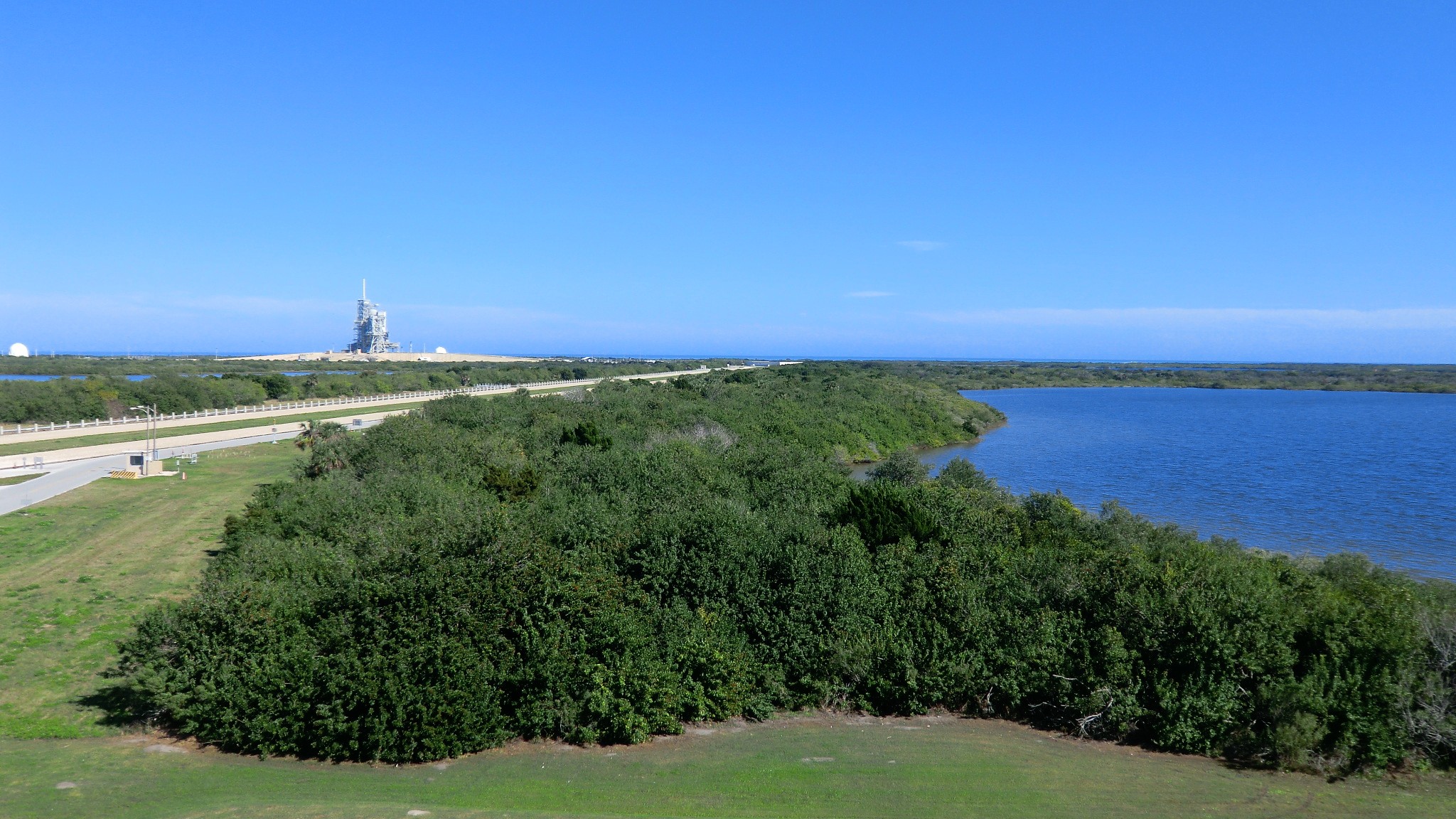
Launch Complex 39: America's Moonport
They called it the Moonport. When NASA began acquiring land on Merritt Island in 1962, the plans called for a launch facility of a scale the world had never seen -- one capable of assembling, transporting, and launching the tallest, heaviest rocket ever built. Launch Complex 39 was the answer: a sprawling industrial campus centered on the Vehicle Assembly Building, connected by a gravel Crawlerway to a pair of launch pads facing the Atlantic. From here, thirteen Saturn V rockets thundered skyward during the Apollo program, including the one that carried Neil Armstrong, Buzz Aldrin, and Michael Collins toward the Moon on July 16, 1969. More than six decades later, LC-39 remains operational -- no longer belonging solely to NASA, but shared with SpaceX in an arrangement that would have been unimaginable to the engineers who first broke ground.
Designing for the Unknown
When engineers began planning LC-39 in 1961, they did not yet know how America would get to the Moon. The two leading approaches -- direct ascent using a single enormous Nova-class rocket, and Earth orbit rendezvous requiring multiple launches in quick succession -- demanded radically different pad designs. The plans went through continuous revision. Originally, three pads were envisioned, named A through C from north to south. When lunar orbit rendezvous and the Saturn V were selected, the design simplified. In March 1963, NASA formalized plans to build only two of the three pads. The naming convention flipped to south-to-north, so the two that would be built became 39A and 39B. The never-built northern pad became 39C, a ghost in the blueprints. The Crawlerway still contains the interchange that would have branched toward it, and the traffic-light warning system at the junction still has lights for Pad C -- signals for a destination that was never constructed.
The Cathedral of Assembly
At the heart of LC-39 stands the Vehicle Assembly Building, one of the largest enclosed structures on Earth. Inside its four high bays, the stages of the Saturn V were stacked vertically on Mobile Launcher platforms -- each platform a two-story structure weighing thousands of tons, topped by a Launch Umbilical Tower bristling with nine swing arms. These arms provided the physical connections -- power, fuel, data, and crew access -- between the launch infrastructure and the rocket. The uppermost arm, the Spacecraft Access Arm, led to the White Room, an environmentally controlled chamber where astronauts made their final transition from Earth-bound humans to spaceflight crew. When assembly was complete, the entire stack -- rocket, spacecraft, launcher platform, and umbilical tower -- was moved as a single unit onto a crawler-transporter for the slow journey to the pad. The system was designed so that damage to one pad would not halt the program; the other could continue operations independently.
From Saturn to Shuttle to SLS
The first launch from LC-39 came on November 9, 1967, when the uncrewed Apollo 4 lifted off from Pad 39A aboard the first Saturn V. Twelve more Saturn V missions followed over the next six years, culminating in the launch of the Skylab space station in 1973. After Apollo, the pads were remodeled for the Space Shuttle. Fixed and Rotating Service Structures replaced the Apollo-era mobile towers. A Sound Suppression Water System was added, releasing hundreds of thousands of gallons of water onto the platform at ignition to protect the Shuttle from its own acoustic energy. Pad 39A hosted the first shuttle launch -- STS-1 in April 1981 -- and eventually supported 82 shuttle missions. Pad 39B saw its first shuttle use with STS-51-L in January 1986, the Challenger disaster. It also hosted the return-to-flight mission, STS-26, in 1988. After the Shuttle retired in 2011, Pad 39B was reconfigured for NASA's Space Launch System, which launched Artemis I on November 16, 2022.
The Commercial Turn
The retirement of the Space Shuttle left the future of LC-39 uncertain. In 2013, NASA opened Pad 39A to commercial bidders. SpaceX and Blue Origin competed for the lease -- SpaceX seeking exclusive use, Blue Origin proposing shared access. Blue Origin filed a protest with the Government Accountability Office, which ruled in NASA's favor. On April 14, 2014, SpaceX signed a 20-year exclusive lease for Pad 39A. The transformation was dramatic. SpaceX built a Horizontal Integration Facility near the pad, assembling rockets on their sides and rolling them to the launch mount on a Transporter Erector -- a sharp departure from NASA's vertical integration tradition in the VAB. The first SpaceX launch from 39A came on February 19, 2017, a Falcon 9 cargo mission to the International Space Station. On February 6, 2018, the Falcon Heavy's maiden flight departed from the same pad, sending a Tesla Roadster on a trajectory past Mars. On May 30, 2020, astronauts Bob Behnken and Doug Hurley launched from 39A aboard Crew Dragon -- the first crewed orbital flight from the pad since the final Shuttle mission nine years earlier.
A Launchpad That Keeps Evolving
LC-39 continues to change. SpaceX began constructing a Starship orbital launch pad at 39A in 2021, with a launch tower rising alongside the existing Falcon infrastructure. Pad 39B serves NASA's Space Launch System for the Artemis program, carrying crews toward the Moon once again. A small pad designated 39C was built in 2015 for small-lift launch vehicles, though it was later shelved when Artemis operations at 39B made it unavailable. Plans for future expansion include Launch Complex 49 to the north and Launch Complex 48 to the south of 39A. What began as a two-pad facility for a single rocket type is becoming a multi-operator spaceport launching vehicles of every size. The Moonport has outgrown its name.
From the Air
Launch Complex 39 is located at approximately 28.608°N, 80.604°W on Merritt Island, Kennedy Space Center, Florida. The Vehicle Assembly Building is the dominant visual landmark -- one of the largest buildings on Earth, visible from miles away. Pads 39A and 39B are positioned to the east-northeast along the coast, connected to the VAB by the pale gravel Crawlerway. SpaceX's Horizontal Integration Facility is visible near Pad 39A. Best viewed at 3,000-5,000 feet AGL. Nearby airports include KTIX (Space Coast Regional, Titusville) and KMLB (Melbourne Orlando International). Note that Kennedy Space Center is within restricted airspace (P-093); check NOTAMs and obtain clearance before overflying.