Kennedy Space Center Visitor Complex
The ticket cost fifty cents for a child and two dollars and fifty cents for an adult. That was the price, back in July 1966, to board a repurposed Greyhound bus operated by TWA and ride past the Vehicle Assembly Building at Kennedy Space Center. More than 1,500 people showed up that first day, and the bus fleet had to be expanded before the week was out. What those early visitors glimpsed through their windows -- launch pads, rocket gantries, the flat Florida horizon broken by impossible vertical structures -- was the beginning of what would grow into one of the most compelling museums in the United States. Today the Kennedy Space Center Visitor Complex draws 1.7 million visitors a year to see not replicas or reconstructions, but the actual machines that carried Americans into orbit, to the Moon, and back.
From Card Tables to the Space Age
It started almost by accident. In 1963, NASA Administrator James Webb opened the Cape Canaveral Air Force Station to self-guided car tours on Sunday afternoons. A small trailer with exhibits displayed on card tables served as the visitors' information center. A hundred thousand people came that first year, drawn by the Mercury Program and Alan Shepard's historic launch. By 1964, a quarter million visitors were driving through on those Sunday windows. KSC Director Kurt Debus received authorization to spend two million dollars on a proper facility covering 42 acres. When Spaceport USA opened in 1967, half a million visitors came. By 1969, as Apollo neared the Moon, the visitor center was the second most popular attraction in Florida, behind only Tampa's Busch Gardens. When Walt Disney World opened nearby in 1971, attendance jumped another 30 percent -- though visitors sometimes found the NASA displays, cobbled together from donated trade-show exhibits, underwhelming compared to Disney's polish.
Atlantis at 43.21 Degrees
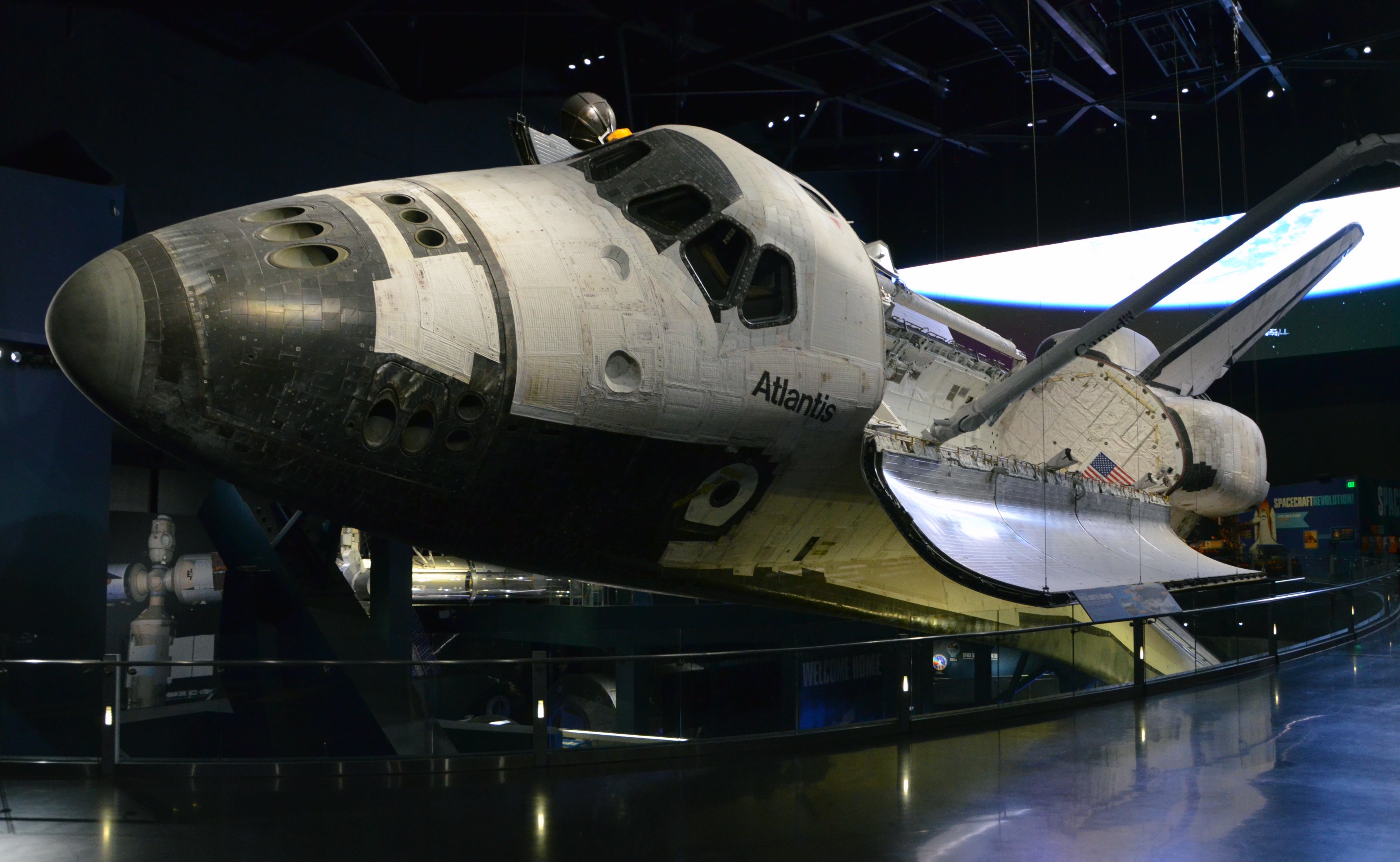
The most dramatic exhibit arrived in 2013, when Space Shuttle Atlantis went on permanent display in a hundred-million-dollar, ten-story facility. The orbiter is mounted at a precise 43.21-degree angle with its payload bay doors open -- a view that previously only astronauts in orbit had seen. The exhibit surrounds visitors with the full story of the Shuttle program, from Dr. Maxime Faget's 1969 prototype to a life-sized replica of the Hubble Space Telescope. On the ground level, the Forever Remembered exhibit commemorates the fourteen astronauts lost in the Challenger and Columbia disasters, displaying personal artifacts and recovered pieces of both orbiters. Nearby, the Shuttle Launch Experience puts guests through a simulated launch in one of four simulators that each seat 44 people, shaking riders through main engine ignition and solid rocket booster separation. Former Shuttle commander Charles Bolden narrates the pre-show.
A Garden of Real Rockets
Just past the entrance, the Rocket Garden stands as an outdoor gallery of American spaceflight history. Almost every rocket is genuine hardware. A Juno I bears the serial number of the vehicle that launched Explorer 1, the first American satellite. A Titan II rescued from an Arizona boneyard is painted to resemble the Gemini 3 booster. The Saturn IB on its side -- SA-209, originally designated for a possible Skylab rescue mission -- was restored in 2018. Mercury-Redstone, Thor-Delta, Atlas-Agena: each of these machines either carried astronauts or flung satellites and probes toward the Moon, Venus, and Mars. Visitors walk among them, craning upward at nozzle bells and fins, able to climb into replica capsules from the Mercury, Gemini, and Apollo programs. An F-1 engine, the five-nozzle powerplant that shoved Saturn V off the pad, sits on display nearby.
The Saturn V and the Weight of Apollo
A bus ride north through restricted NASA property delivers visitors to the Apollo/Saturn V Center, built around a restored Saturn V -- the most powerful rocket ever successfully flown. The center opened in December 1996 as the first large exhibit inside a restricted area, accessible only by tour bus. Two theaters immerse visitors in the Apollo era: one recreates the tension of an Apollo firing room during the launch of Apollo 8, the other simulates the Apollo 11 lunar landing. Among the artifacts are Alan Shepard's Apollo 14 spacesuit, a touchable Moon rock, lunar samples from Apollo 15 and Apollo 17, and an unused Lunar Module -- LM-9, originally slated for Apollo 15 before later missions were canceled. Since 2017, the Ad Astra Per Aspera exhibit has commemorated the Apollo 1 crew, displaying the charred Block I hatch from the fire alongside the redesigned Block II hatch that flew on every subsequent Apollo mission.
Heroes, Legends, and the Next Horizon
The Heroes and Legends building, a twenty-million-dollar exhibit opened in 2016, houses the U.S. Astronaut Hall of Fame and artifacts from the earliest days of American spaceflight. The Gemini 9A capsule flown by Thomas Stafford and Eugene Cernan sits alongside Wally Schirra's Sigma 7, Gus Grissom's suborbital flight suit from July 1961, and the original consoles from Mercury Mission Control. The newest addition, Gateway: The Deep Space Launch Complex, opened in 2022 and looks forward rather than back, showcasing a Falcon Heavy booster, the Orion EFT-1 capsule, and interactive exhibits about missions beyond the Moon. From card tables in a trailer to a sprawling campus where real spacecraft tell real stories, the Visitor Complex has grown alongside the American space program itself, always finding a way to put visitors within arm's reach of the machines -- and the people -- that pushed the boundary of what was possible.
From the Air
The Kennedy Space Center Visitor Complex sits on Merritt Island on Florida's Atlantic coast at 28.52N, 80.68W. The massive Vehicle Assembly Building is the dominant landmark, visible from considerable distance. The complex is immediately west of Cape Canaveral Space Force Station with its multiple launch pads. Nearest airports: NASA Shuttle Landing Facility (KTTS) adjacent, Space Coast Regional Airport / Titusville (KTIX) 8nm northwest, Melbourne Orlando International (KMLB) 25nm south, Orlando International (KMCO) 45nm west. Best viewed at 3,000-5,000 feet AGL for full complex perspective. Clear weather provides views of the entire spaceport including launch pads 39A and 39B.