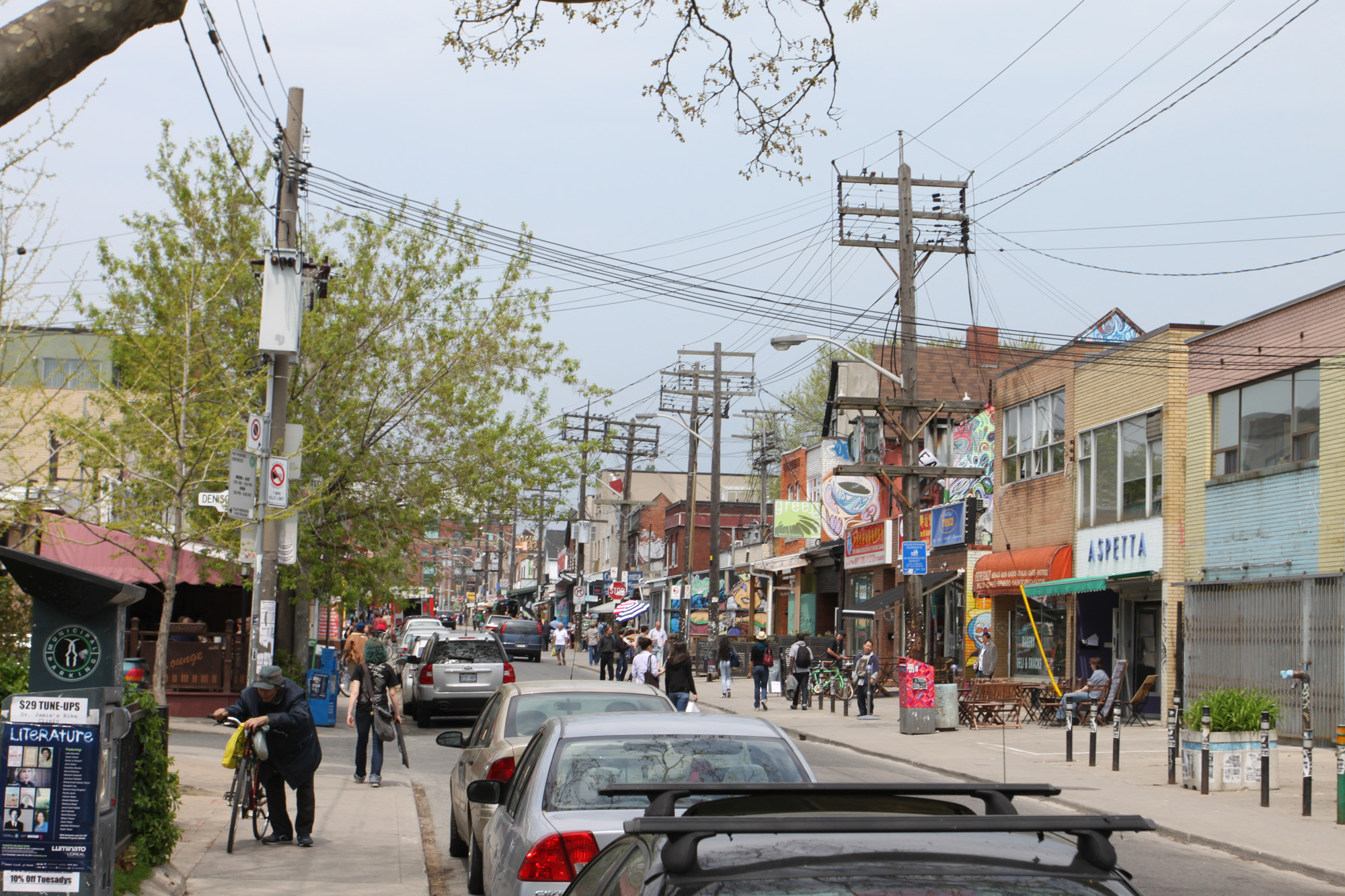
Kensington Market: The Neighbourhood That Refused to Be Tamed
When a Nike store tried to open in Kensington Market, the neighbourhood dumped dozens of running shoes splattered with red paint on the sidewalk in protest. The store was, as the locals noted, a tremendous corporate failure. That single episode captures something essential about this half-dozen blocks of Victorian row houses wedged between Spadina Avenue and Bathurst Street in downtown Toronto. Kensington Market does not submit to outside ideas about what it should be. Designated a National Historic Site of Canada in 2006, it is, as journalist Robert Fulford wrote, 'as much a legend as a district' - probably the most photographed site in Toronto, and certainly the most stubbornly independent.
From Cavalry Ground to Jewish Market
The land beneath Kensington Market was purchased in 1815 by George Taylor Denison, a War of 1812 veteran who used what is now Bellevue Square Park as a parade ground for his volunteer cavalry troop - a unit that later became the Governor General's Horse Guards. When the Denison estate was subdivided in the 1850s, small plots filled with row houses built for Irish and Scottish immigrant labourers during the 1880s. Many of those Victorian houses still stand along Wales Avenue and elsewhere. By the early twentieth century, eastern European Jewish immigrants poured into the neighbourhood from 'The Ward,' an overcrowded reception area between Yonge Street and University Avenue. Jewish merchants opened shops as tailors, furriers, and bakers. Around 60,000 Jews lived in and around the Market during the 1920s and 1930s, worshipping at over 30 local synagogues. From the beginning, the market sold goods imported from the homelands of whoever had arrived most recently.
Waves Keep Coming
After the Second World War, most Jewish residents moved north to uptown neighbourhoods and suburbs. During the 1950s, immigrants from the Azores arrived, fleeing the Salazar regime in Portugal, and settled further west along Dundas Street. Then came waves from the Caribbean and East Asia. The Vietnam War brought American political refugees to nearby Baldwin Village. Through the 1980s and 1990s, identifiable communities from Central America, Somalia, Ethiopia, Sudan, Iran, Vietnam, and Chile found their way to Kensington. In the 1960s, city planners proposed demolishing the densely packed small houses and replacing them with apartment-style housing projects, as was done to neighbouring Alexandra Park. The election of David Crombie as Mayor of Toronto ended those plans. Crombie opposed the massive urban restructuring that had been in vogue, and Kensington survived intact - its small scale preserved by politics rather than accident.
The Latin Rebirth of Augusta Avenue
The mid-1990s nearly broke the Market. George Brown College, whose students had sustained foot traffic for years, sold its Kensington property. Many Portuguese shop owners had grown too old to keep working. Vacancy spread. But the empty storefronts invited a new wave: Latin American entrepreneurs opened businesses like La Perola, El Emporio Latino, and El Buen Precio. Jumbo Empanadas began selling from a cart before moving into a basement near Nassau Street. Other Latin shops started offering pupusas, and by 2000, a young couple of entrepreneurs opened what they called the first taqueria in Canada - El Trompo. Augusta Avenue was reborn. Today, the neighbourhood's narrow streets are a chaos of fish shops, cheese stores, spice merchants, vintage clothing racks spilling onto sidewalks, and the kind of cafes where the menu is handwritten on cardboard. A unique architectural feature of the area: the extensions built onto the fronts of many buildings, which would violate by-laws anywhere else in the city.
Pedestrian Sundays and Winter Fire
Since 2004, Kensington has organized Pedestrian Sunday events, closing parts of Augusta Street, Baldwin Street, and Kensington Avenue to car traffic. The streets become a pedestrian mall with live music, dancing, street theatre, and food. In the 2006 census, 34.59 percent of Kensington residents walked to work, compared to 7.10 percent citywide. The Market's other signature event is the Winter Solstice Festival, created by Ida Carnevali in 1987 as a way of beckoning the return of the sun on the longest night of the year. Giant puppets, fire-breathers, stilt-walkers, and samba musicians parade through the narrow streets. The Samba Squad, Shadowland Theatre, and Clay and Paper Theatre are regular participants. Former Toronto mayor Mel Lastman and actor Al Waxman - who starred in the CBC series King of Kensington - were both born and raised in the neighbourhood. After Waxman's death in 2001, a statue was erected in Bellevue Square Park.
Holding the Line
Kensington remains, against considerable economic pressure, a predominantly working-class immigrant community. In 2021, after a year of neighbourhood organizing against the eviction of building residents, a local Community Land Trust purchased a three-storey building to preserve its affordable rents. The Kensington Market Community Land Trust continues to own and operate it. City policy protects the Market through site-specific guidelines: low-scale buildings with retail at street level, minimal setbacks, and open-air display of goods on the boulevard. The neighbourhood where Trotskyists still hand out pamphlets at the corner of Baldwin and Kensington, where the Garden Car - a parked automobile converted into a community garden - has been a local fixture since 2007, refuses to become the thing that gentrification wants it to be. It remains, as it has been for over a century, whatever the most recent arrivals need it to be.
From the Air
Located at 43.655N, 79.401W in downtown Toronto, roughly halfway between the CN Tower to the south and the University of Toronto campus to the north. From altitude, Kensington Market is not individually distinguishable - it occupies a dense grid of narrow streets bounded by College Street (north), Spadina Avenue (east), Dundas Street West (south), and Bathurst Street (west). The neighbourhood sits immediately west of Toronto's Chinatown. Billy Bishop Toronto City Airport (CYTZ) is 2.5 km south. Toronto Pearson International Airport (CYYZ) is 22 km northwest. Best appreciated from below, but from 3,000-4,000 feet the dense Victorian row-house fabric contrasts visibly with the taller buildings surrounding it.