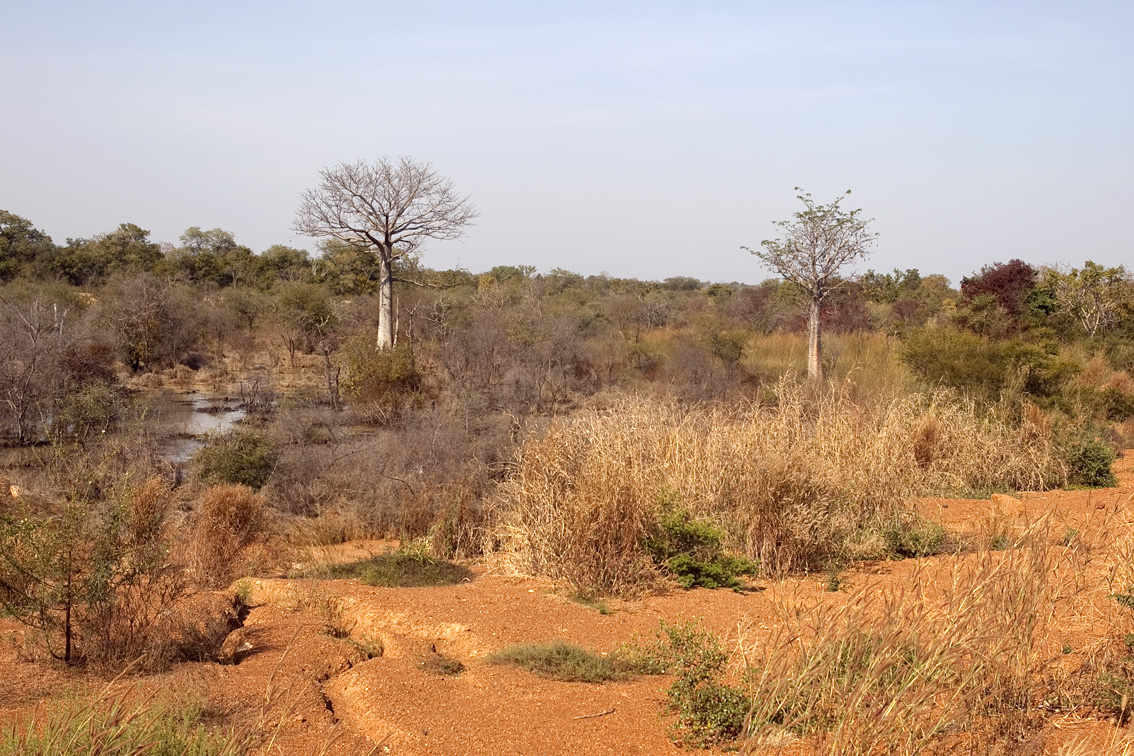
Oti-Keran National Park
Photographs still exist of elephant herds moving through the savanna of Oti-Keran National Park in northern Togo. In the 1980s, a South African company had invested in a hotel, roads, and observation platforms, and the park was generating monthly revenues of 50 to 60 million CFA francs -- roughly $100,000 to $120,000 -- making it a regional model for protected-area ecotourism. Then, in 1990, political turmoil swept Togo, and decades of resentment against the park erupted in a wave of destruction that left the wildlife dead and the infrastructure in ruins. Today, those photographs are all that remain of what Oti-Keran once was.
A Park Built Without Consent
The origins of Oti-Keran's collapse reach back to the 1960s, when the Togolese government began expanding a network of nature reserves across the country's north. The expansion was carried out without the consent or participation of the people who lived on the land. Communities were displaced. Agricultural developments were abandoned. Rather than sharing in tourism revenues or new economic opportunities, local residents watched their livelihoods disappear behind park boundaries. To make matters worse, elephants and other wildlife from the unfenced protected areas regularly crossed into surrounding farmland, destroying crops and deepening the hardship. What was intended as conservation became, for the people living alongside it, a source of poverty and hunger. The resentment grew quietly for three decades.
The Reckoning of 1990
When political instability shook Togo in 1990, that resentment found its outlet. Communities that had been excluded from the park's benefits turned on the protected areas with fury. Wildlife was slaughtered en masse. The infrastructure -- hotels, roads, viewing platforms -- was destroyed. The environmental damage was severe and, in many cases, irreversible. The elephants that had once drawn tourists in herds were reduced to sporadic sightings of migrating individuals. By the time order was restored, Oti-Keran's ecosystem had been fundamentally altered. The park's story became a cautionary example, studied by conservation organizations worldwide, of what happens when protected areas are imposed on local communities without their participation or benefit.
Wings Over the Savanna
What survived the destruction was the birds. BirdLife International has designated Oti-Keran as an Important Bird Area, recognizing its significant populations across some 214 recorded species. Black crowned cranes stalk the grasslands. Goliath herons and pink-backed pelicans work the waterways. Violet turacos flash through the woodland canopy, and red-throated bee-eaters hunt from exposed perches. The Togo paradise whydah, found in only a handful of locations worldwide, breeds in the park's savanna. Bearded barbets, purple starlings, bronze-tailed starlings, and the exclamatory paradise whydah round out an avian community that thrives in the mosaic of Sudanian woodland, grassland, and riverine habitat. For birdwatchers willing to navigate Togo's limited tourist infrastructure, Oti-Keran offers sightings that neighboring Ghana's better-known parks cannot match.
A Corridor Taking Shape
Oti-Keran's future may depend on connections beyond its own borders. The park is planned as part of a transboundary conservation corridor linking through Oti-Mandouri National Park to the WAP Complex -- the vast W, Arli, and Pendjari protected-area system spanning Burkina Faso, Benin, and Niger. A UNDP project launched in 2010 aimed to reestablish a population of roughly 20 elephants in the park, a modest beginning for a landscape that once supported herds. Challenges remain: settlements, cotton farming, and charcoal production continue to encroach within the park's boundaries. Togo's Ministry of Tourism has stated that habitats and fauna must be reestablished before ecotourism can realistically restart. The only road through the area limits access, and few facilities exist for visitors. But the birds keep coming, the corridor is slowly taking shape, and the lesson of 1990 -- that conservation without community consent is conservation without a future -- has not been forgotten.
From the Air
Oti-Keran National Park is located at 10.20°N, 0.63°E in the Kara Region of northern Togo. From altitude, the park appears as a patchwork of savanna woodland and grassland, bisected by a single road. The Oti River flows through the eastern portion. The nearest airport is Niamtougou Airport (DXNG), approximately 50 km to the south. The park borders Ghana to the west and connects northward toward the Oti-Mandouri protected area and the broader WAP transboundary complex. The terrain is gently undulating, with scattered trees and open grassland characteristic of the West African Sudanian savanna.