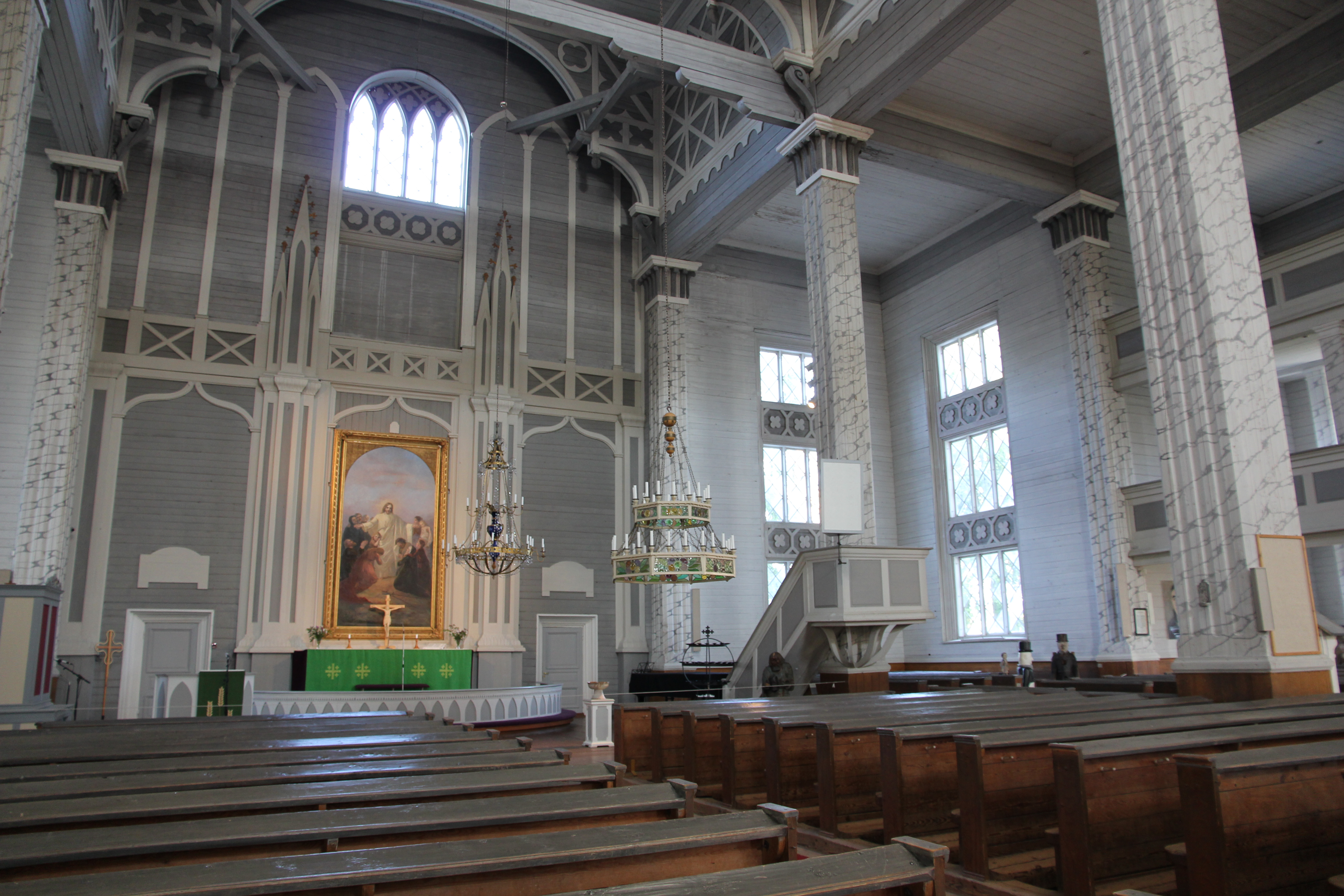
Kerimaki Church
The legend is irresistible: an architect specified dimensions in centimeters, a builder read them as inches, and Finland ended up with a church two and a half times larger than anyone intended. The story has circulated for generations around Kerimaki, and while scholars have since debunked it -- the church was built to exactly the size its planners wanted -- the myth speaks to something real. The Kerimaki Church is preposterously, magnificently large. At 45 meters long, 42 meters wide, and with a dome reaching 37 meters, it is the largest wooden church in the world, confirmed by Guinness World Records. It seats 3,000 people and holds 5,000 standing, in a municipality that has never come close to needing that capacity in a single service.
Built for Half a Parish
Anders Fredrik Granstedt designed the church, and construction lasted from 1844 to 1847, during the period when Finland was a Grand Duchy of the Russian Empire. The intent, scholars now believe, was sincere: the parish wanted a building large enough to hold half its population at once, ensuring that the entire community could attend services in just two sittings. The result was a wooden structure of extraordinary ambition. Some 1,670 meters of pew benches line the interior. The building's footprint approaches 1,900 square meters. Every beam, every plank, every joint was fashioned from timber, making the engineering achievement all the more remarkable. No steel framework, no reinforced concrete -- just wood, skill, and a congregation's outsized faith in what their church should be.
The Problem of Winter
Grandeur comes with consequences. The Kerimaki Church has no heating system -- has never had one -- because warming a wooden interior of this volume would be impractical and potentially dangerous. In a Finnish climate where winter temperatures routinely drop below minus 20 degrees Celsius, this makes the main church unusable for roughly half the year. Services during cold months are held in a separate, smaller winter church built in 1953 and remodeled in 1997. The arrangement gives Kerimaki a split personality: a monumental summer cathedral and a modest winter chapel, the two buildings standing side by side as proof that ambition and practicality do not always occupy the same structure.
Wood Against the World
What makes Kerimaki's claim to fame distinctive is not just size but material. Larger churches exist, of course -- stone cathedrals, steel-framed megachurches, concrete basilicas. But no wooden church anywhere on Earth matches these dimensions. The Sapanta-Peri Monastery church in Romania stands taller at 78 meters, the Ascension Cathedral in Almaty, Kazakhstan reaches 56 meters, and St. George's Cathedral in Georgetown, Guyana rises to 43.5 meters. All are taller than Kerimaki's 37-meter dome. But none approaches its sheer floor area or seating capacity. Wood imposes constraints that stone and steel do not -- it burns, it warps, it rots -- and building this large in timber was an act of confidence in craftsmanship that has been vindicated by nearly two centuries of survival.
A Church and Its Legend
The centimeters-to-inches story persists despite the evidence against it, and perhaps that tells us something worth knowing. A church built to rational specification is admirable. A church built by accident -- by a comedy of misunderstanding that produced something too wonderful to tear down -- is a better story. Kerimaki has chosen the better story, and visitors arrive expecting to see the product of a magnificent error. What they find instead is a building that exceeds expectations regardless of origin: a wooden interior so vast that sunlight from the high windows seems to take a moment to reach the floor, pews stretching in every direction, and a silence that fills the space the way water fills a basin. The myth brought them here. The reality is what stays.
From the Air
Located at 61.91N, 29.29E in Kerimaki, eastern Finland, near the shores of Lake Saimaa. The church is visible from altitude as an unusually large structure for a small Finnish village -- its footprint is significantly larger than surrounding buildings. Nearest airport is Savonlinna Airport (EFSA), approximately 23 km west. Joensuu Airport (EFJO) is roughly 130 km northeast. The surrounding Finnish Lakeland is characterized by dense forest and interconnected lake systems. The church's distinctive yellow exterior and massive gabled roof make it identifiable from low altitude.