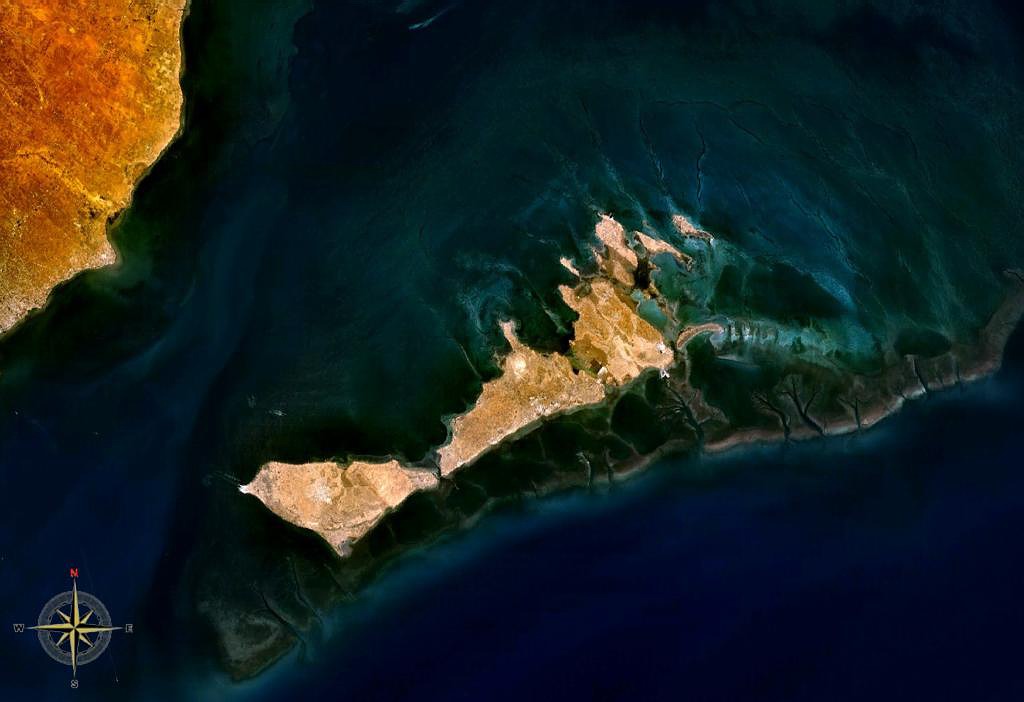
Kerkennah Islands
In 2 BCE, Emperor Augustus needed a place to dispose of an inconvenient man. Sempronius Gracchus, lover of Augustus's daughter Julia the Elder, was exiled to a cluster of flat, windswept islands off the Tunisian coast, condemned to spend fourteen years in a place that barely rose above the Mediterranean. The Kerkennah Islands have been receiving the unwanted, the overlooked, and the quietly essential ever since. This archipelago of 160 square kilometers, never more than thirteen meters above sea level, has functioned as a Roman outpost, a Christian bishopric, a target for Aragonese raiders, a World War II naval battleground, and one of the most important migratory bird bottlenecks in the Mediterranean.
An Exile's Horizon
The Romans found practical uses for Kerkennah beyond banishing inconvenient aristocrats. The islands served as a port and lookout point, monitoring offshore activity in the Gulf of Gabes. The Greeks had known them as Cercina and Cercinna; Strabo and Ptolemy both recorded the name. By late antiquity, the islands had acquired enough Christian population to warrant a bishop: Athenius of Cercina was among the Catholic clergy whom the Arian Vandal king Huneric summoned to Carthage in 484. In 532, Saint Fulgentius of Ruspe is believed to have built a monastery on one of the smaller islets. An Aragonese raiding expedition struck in 1424. Through it all, the islands maintained a character defined by their geography: too flat for fortification, too remote for wealth, but positioned perfectly for anyone who needed to watch the sea.
Salt Wind and Octopus
Geography determines everything on Kerkennah. The islands sit in the Gulf of Gabes, where strong westerly winds cross the mainland and arrive hot and dry, stripping moisture from the air before it reaches shore. The landscape is xerophytic and halophytic: palms, saltbushes, and hardy grasses adapted to conditions that would defeat most agriculture. The islanders keep chickens and goats for personal consumption, but the real economy is the sea. Fishing, particularly for octopus, is the principal industry, the catch exported to mainland Tunisia and neighboring countries. Tourism exists but remains limited. There are no grand sandy beaches here, no resort infrastructure. Wealthier Tunisians from the mainland build second homes, and some European visitors come for the quiet, the heat, and the absence of crowds. Temperatures can swing from a winter minimum of 4 degrees Celsius to summer highs exceeding 40.
A Bottleneck for Wings
What Kerkennah lacks in human spectacle it compensates for in avian significance. BirdLife International classifies the archipelago as a critical Important Bird Area, a major migration bottleneck where species concentrate in numbers that make the islands globally significant. Between one thousand and ten thousand great cormorants pass through in some winters, depending on rainfall patterns along their migration route. Eurasian spoonbills arrive in groups of four hundred to eight hundred. Greater flamingos number between four hundred and fifteen hundred. Seven species largely restricted to the Mediterranean North African biome maintain significant populations here, including the Barbary partridge, Moussier's redstart, and the spectacled warbler. Some species do not merely pass through but breed on the islands: common kestrels, cream-colored coursers, European bee-eaters, and great grey shrikes all nest here. Hundreds of thousands of migrant passerines use Kerkennah as a stopover each spring and autumn.
Water Running Out
The islands face threats that no amount of birdsong can mask. During the 1980s, drought devastated Kerkennah's population. The archipelago's freshwater supply, always precarious, proved unable to sustain even basic irrigation. Clean water ran out, and many islanders had no choice but to leave for mainland Tunisia, most heading for Sfax, the nearest city. The population has never fully recovered. The same vulnerability persists: a landscape that never rises more than thirteen meters above sea level is existentially threatened by climate change. Even the Kerkennah Islands gerbil, a subspecies endemic to the archipelago, depends on a habitat that could be reshaped by rising seas within decades. During the Second World War, the Battle of the Tarigo Convoy was fought near these islands on April 16, 1941, British destroyers intercepting an Axis supply convoy in the shallow waters. Today the islands face a slower but no less consequential battle, this one against the water itself.
From the Air
Located at 34.72°N, 11.19°E, approximately 20 km off the coast of Sfax in the Gulf of Gabes. The archipelago consists of two main islands, Chergui and Gharbi, connected by a causeway and bridge. The islands are extremely flat and low-lying, visible from altitude as sandy shapes in the turquoise shallows. A ferry connects the islands to Sfax. Nearest airport is Sfax-Thyna (DTTX). Overfly at 3,000-5,000 ft AGL for an excellent view of the archipelago's outline, the shallow surrounding waters, and the ferry route to the mainland.