Kerr-Addison Mine
Ignace Tonene found the gold first. Around 1900, the chief of the Teme-Augama Anishnabai community discovered gold ore on the shore of Larder Lake in what would become Ontario's Timiskaming District. He did everything right -- registered his staking claims through the proper legal channels. It did not matter. European settlers jumped his claim, re-registered the land in their own names, and wrote Tonene out of the story. The mine that grew from his discovery would produce over 12 million ounces of gold and become the largest gold producer in North America by 1960. His name appears nowhere on the property.
From Stolen Ground to Continental Giant
The man whose name the mine eventually bore, Kerr, was a 1903 University of Toronto graduate who had spent exactly one week doing geological mapping as an assistant at the Geological Survey of Canada. He shared his analysis with William Addison, who visited the Larder Lake area in 1906 only to find a Dr. Reddick of Ottawa already surveying it. Ownership passed through multiple hands before Associated Goldfields Limited began serious development. Production was initially modest, but by 1939 the mill was processing 1,090 tons of ore per day. When prospectors struck significantly richer deposits at a depth of 1,000 feet in 1940, the mill was upgraded again to handle 1,725 tons daily. At its peak the mine employed 2,500 people. Workers formed the Kerr-Addison Employees' Association in 1943, a union that later affiliated with the Canadian National Federation of Independent Unions in 1981 before merging with the United Steelworkers of America in 1989.
Rocks That Tell Deep Time
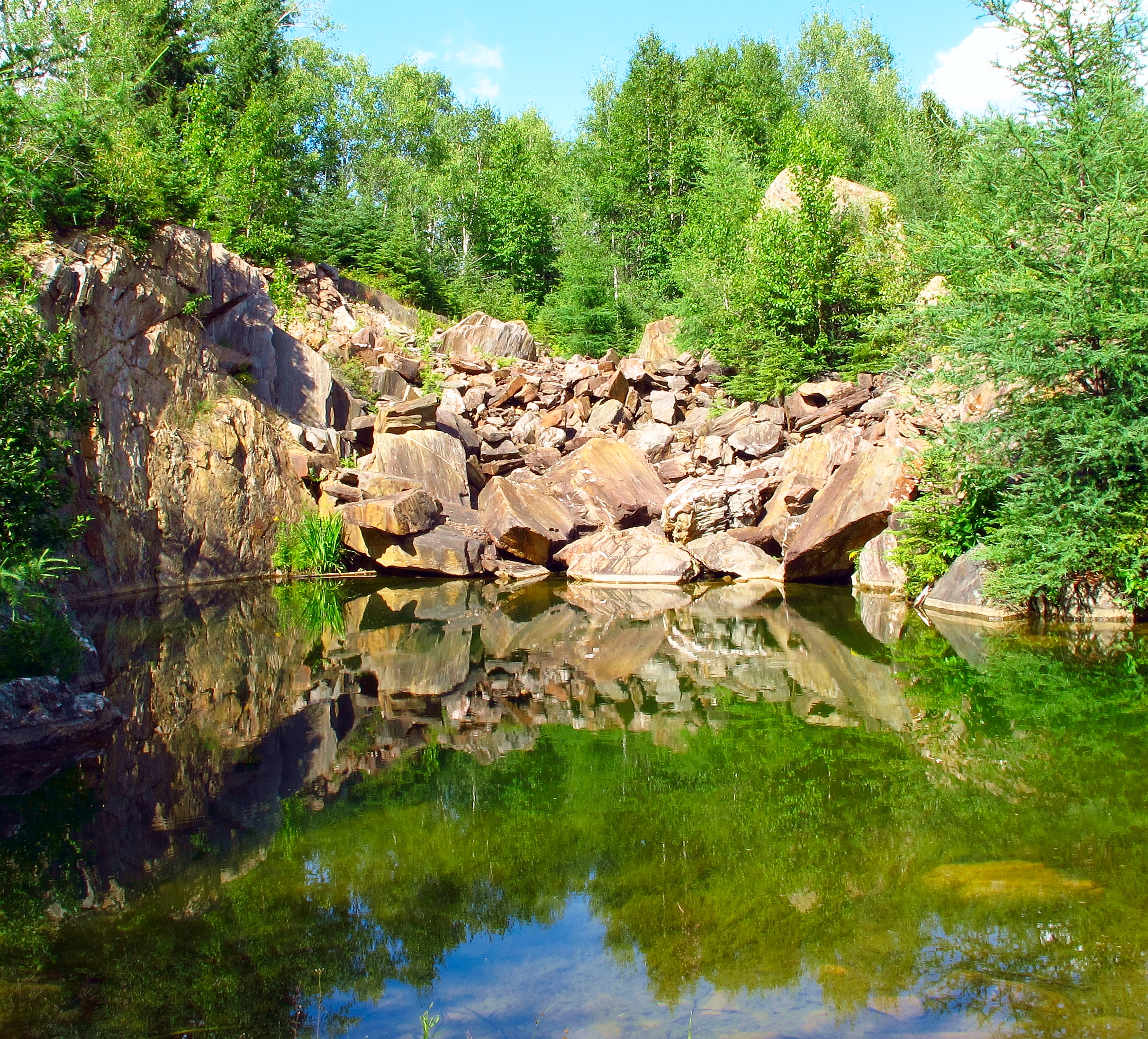
The Kerr-Addison sits in the Abitibi gold belt, one of the most mineral-rich geological formations on the planet. The mine is embedded in basalt, positioned between the Timiskaming grouping of metasedimentary rock and Keewatin groupings of metavolcanic rock. The surrounding terrain holds greywacke, talc-chlorite schist, and syenite -- an ancient assemblage that records billions of years of volcanic activity, sedimentation, and metamorphism along the Canadian Shield. It was this geology that made the Larder Lake corridor so phenomenally productive. The gold did not occur in a single vein but was distributed through the fractured, altered rock in patterns that rewarded patient, large-scale extraction. By the time ore extraction ended in 1960 and production fully ceased in 1963, the Kerr-Addison had produced the second-highest gold output of any mine in North America, trailing only the Homestake Mine in South Dakota.
The Price of Gold in Water
When global gold prices were deregulated in 1971, the price climbed from $35 to $800 per ounce by 1980, then collapsed. The resulting volatility was devastating for the mine's succession of owners. Golden Shield Resources went bankrupt in 1989. During the Deak Resources era, the Ontario Ministry of the Environment fined the company $50,000 for discharging polluting effluent -- including heavy metals and cyanide -- into a waterway from the mine's mill. A 1994 Environment Canada study documented high concentrations of nickel, gold, copper, lead, and zinc in Larder Lake itself, a legacy of decades of dumping tailings directly into the water. The mine reopened from 1990 to 1996 during another gold price surge, but the environmental damage had been done. The tailings in Larder Lake remain a reminder that the 12 million ounces came at a cost measured not just in labor but in the health of the watershed.
A Mine Nobody Wanted to Clean Up
The Kerr-Addison's post-closure history reads like a game of corporate hot potato. Ownership cycled through Golden Shield Resources, Deak Resources, AJ Perron, and a tangle of numbered companies. In 1997, McGarry Township sent in bailiffs to seize mine assets over $2.1 million in unpaid property taxes and $50,000 in business taxes. Four different companies threatened litigation. AJ Perron was delisted from the stock exchange in 1998. In 2010, Armistice Resources Corporation acquired the property and announced plans to drill for more gold. When the Ontario Government ordered Armistice to submit a decommissioning plan, the company refused, arguing at an environmental tribunal in 2013 that it was not the surface owner under the Mining Act and therefore bore no cleanup responsibility. Armistice renamed itself Kerr Mines Inc. in 2014 and promptly sold the property to Golden Candle Limited for $11 million. In 2016, Golden Candle's owner filed a court affidavit documenting that previous dissolved owners had simply failed to remediate the site. As of 2021, Golden Candle held full ownership -- surface and mining rights together for the first time in years.
From the Air
Kerr-Addison Mine at 48.139N, 79.578W on the northeast shore of Larder Lake in the Timiskaming District. The mine's surface infrastructure and tailings are visible along the lakeshore. Look for the disturbed ground and remnant structures contrasting with the boreal forest on the approach to Larder Lake from the north. The tailings deposits extending into Larder Lake itself are particularly visible from altitude. Nearest airport: Kirkland Lake Airport (CYKL) approximately 20nm northwest. Best viewed at 2,000-4,000 ft AGL to see the relationship between the mine workings, the tailings, and Larder Lake.