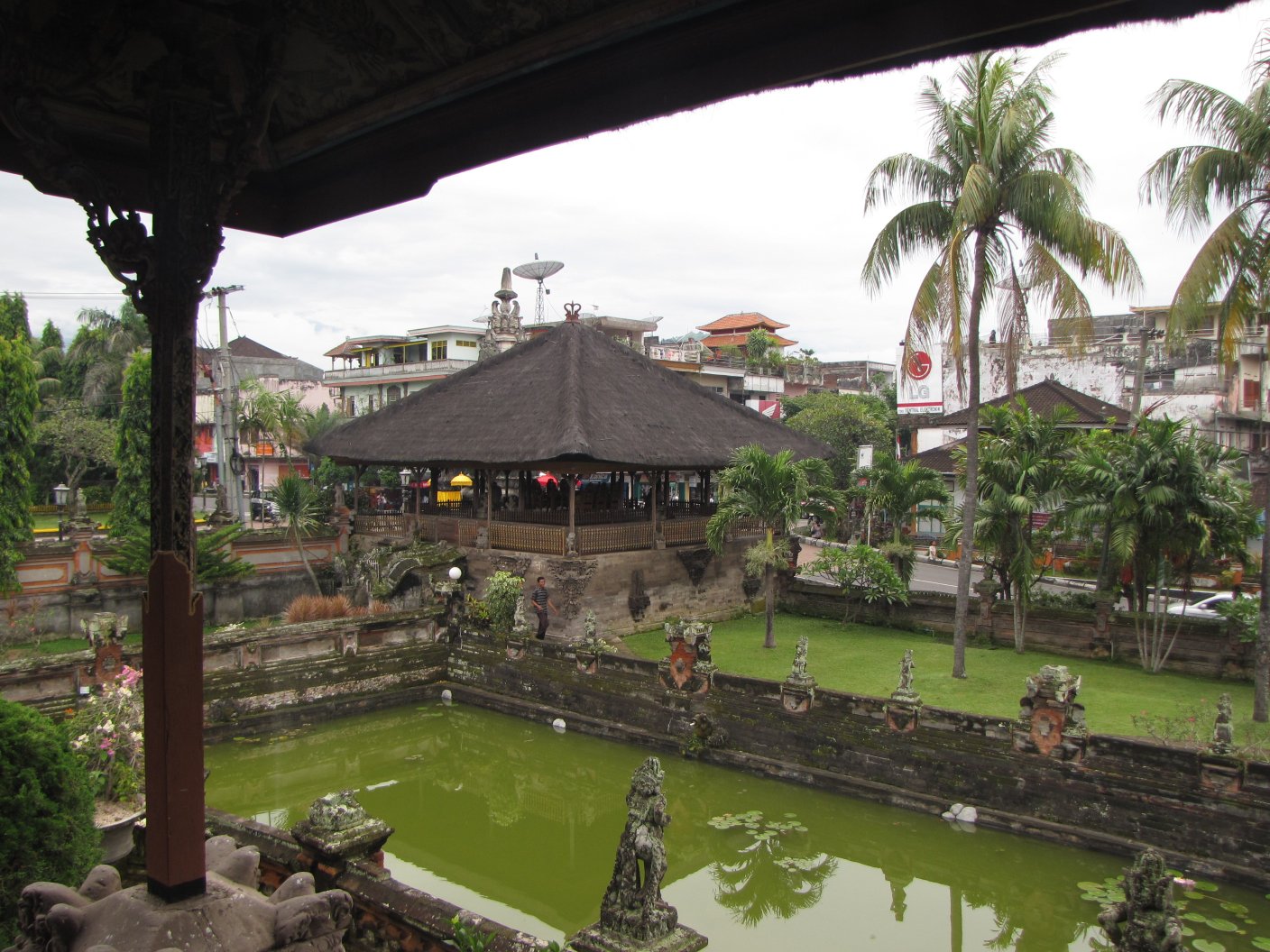
Kertha Gosa: Where Justice Looked Up
Imagine standing trial while the ceiling above you depicts, in vivid detail, sinners being boiled alive by demons. The Kertha Gosa Pavilion at Klungkung Palace was designed with exactly this effect in mind. Built around 1700 by Dewa Agung Jambe I as part of the palace's nine-center mandala layout, the open-sided pavilion served as Bali's highest court of justice. Its name comes from Sanskrit: Kerta meaning prosperity or result, Gosita meaning a place of discussion. But the discussions held here carried life-and-death weight, and the painted ceiling made sure everyone in the room understood the stakes.
Nine Centers, One Purpose
Klungkung Palace followed the design principle of the sanga mandala, a layout of nine interconnected centers distributed among courtyards and ritual spaces. Kertha Gosa was one of these nine. The pavilion's construction date has been debated: a carving at the palace's main door, the Pemedal Agung, bears the Saka year 1622, which translates to approximately 1700 AD, though 1686 is also commonly cited. Whatever the precise year, the pavilion took shape during Dewa Agung Jambe's effort to build a new capital worthy of the Gelgel dynasty's legacy. The open-air design was deliberate. Without walls, the pavilion invited the community to witness proceedings. Justice in Klungkung was meant to be seen.
The Ceiling That Preaches
The oldest written record of paintings at Kertha Gosa dates to 1842, noted in a lontara, the traditional palm-leaf manuscripts that preserve Balinese prayers, history, and epic literature. Whether the paintings existed from the pavilion's construction or were added later remains unknown. What survives today is a 1930 restoration, when the original paintings were redone on plaster. The dominant narrative is the Bhima Swarga, the story of the warrior Bhima's journey through hell and heaven to rescue the souls of his parents. Across the painted panels, demons torment sinners with inventive cruelty while the virtuous ascend to celestial reward. The moral was inescapable for anyone sitting beneath these images during a trial: the universe itself enforces justice, and no transgression goes unpunished.
Reading the Bodies
Every figure in the Bhima Swarga paintings obeys strict visual rules that a Balinese audience would have read as fluently as text. Kasar characters, the coarse and demonic ones, are painted with large eyes, broad noses, and gaping mouths, their hands positioned upward in aggressive gestures. Halus characters are their opposite: refined, flowing, with delicate fingers, small features, thin lips, and faces angled downward in composure. Bhima and his siblings belong to the halus category, though Bhima carries one unmistakable marker of his own. His right thumb ends in a long, curved nail, a magical weapon unique to him in the entire visual tradition. Social hierarchy is encoded in scale and placement. Shiva, heaven's supreme deity, towers over every other figure. Bhima dominates the human characters. His servants Twalen and Mredah appear side by side, with the son positioned slightly below the father. Even in the painted cosmos, rank is inviolable.
Smaller in Heaven
One of the painting's subtlest details reveals a sophisticated theology. In the hell panels, Bhima is enormous, his physical power filling the frame as he battles demons and liberates suffering souls. But when the scene shifts to heaven, his body shrinks. Physical strength, so dominant in the underworld, diminishes in significance before the gods. Bhima wears a black-and-white-checked sarong that Balinese tradition holds possesses magical protective qualities. Battle scenes in heaven are bloodless, unlike the visceral violence below. The contrast teaches a lesson that goes beyond simple reward and punishment: power itself is relative, its meaning transformed by context. What makes a hero in hell makes a humble petitioner in paradise.
Still Standing, Still Teaching
Dutch soldiers posed for photographs at the Kertha Gosa in 1949, after the colonial power that destroyed the rest of Klungkung Palace had left this pavilion intact. The irony was fitting. The building designed to teach the consequences of injustice survived the regime that had provoked the 1908 puputan, the suicidal last stand in which the royal family chose death over subjugation. Today visitors walk beneath the same painted ceiling that once bore witness to trials, sentences, and the formal machinery of Balinese royal justice. The Bhima Swarga still preaches its sermon overhead. The Mahabharata text that inspired it promises that anyone who listens to the epic with devotion will have their sins washed away. Whether or not that promise holds, the pavilion ensures the story keeps being told, its painted figures frozen in their eternal drama of consequence and redemption.
From the Air
Kertha Gosa sits at 8.535S, 115.404E within the Klungkung Palace compound in Semarapura, eastern Bali. From the air, look for the palace grounds on the north side of the town center, identifiable by the open courtyards and the moat surrounding the adjacent Bale Kambang pavilion. The nearest major airport is Ngurah Rai International (WADD), roughly 45 kilometers southwest. Mount Agung rises prominently to the northeast. At lower altitudes, the pavilion's distinctive open-sided roof and the adjacent floating pavilion are visible within the palace remnants.