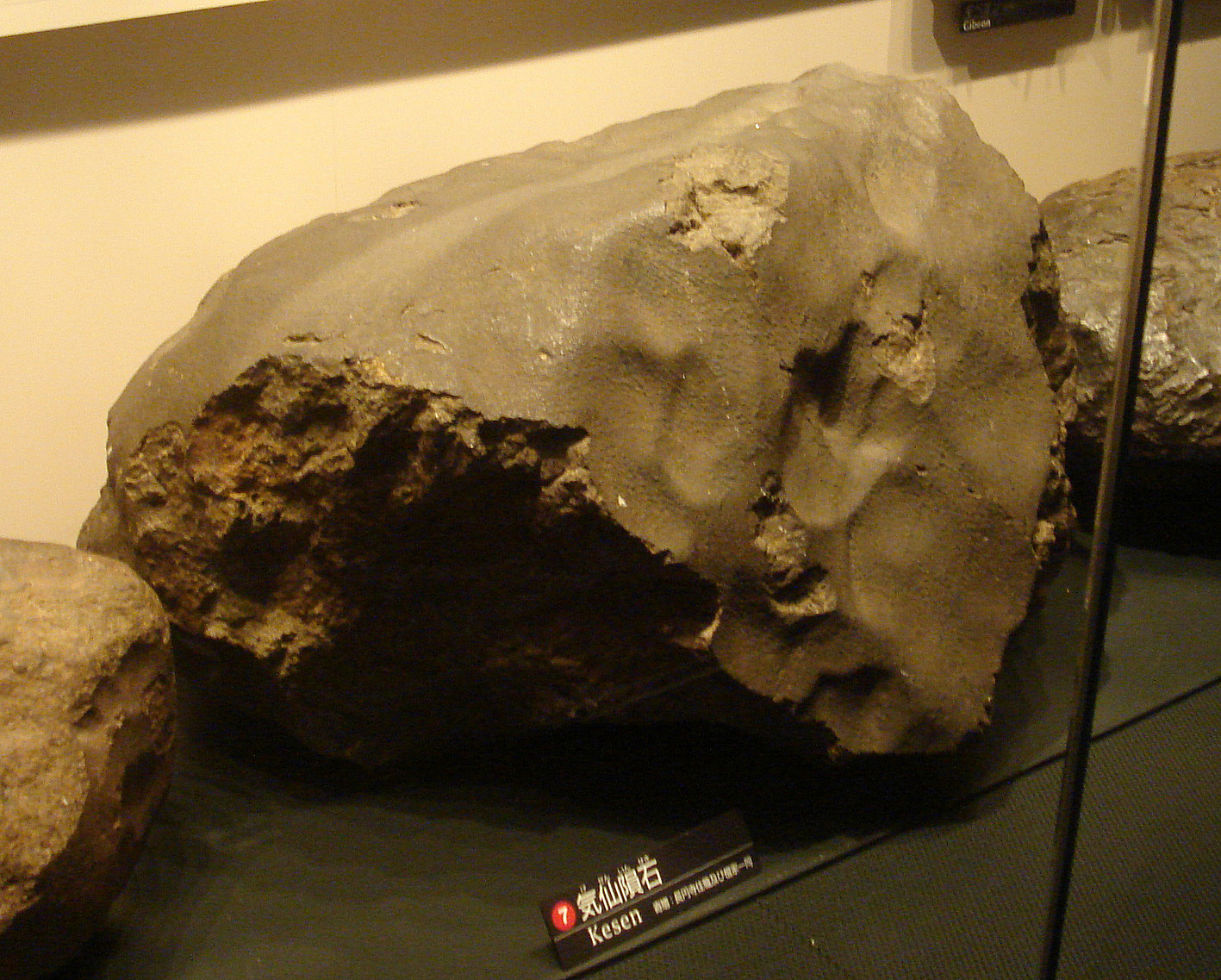
Kesen Meteorite
The thunderous detonations came first -- booming across the hills of Kesen District on June 13, 1850, loud enough to send farmers running from their paddies and fishermen scanning the sky above Rikuzentakata. Then something heavy punched through the air and buried itself in a swamp on the outskirts of town, driving 1.4 meters into the soft earth and creating its own crater. When villagers dug it out, they found a dense, dark stone weighing 135 kilograms -- roughly 298 pounds of rock that had traveled millions of miles through space before choosing this particular patch of Iwate Prefecture to end its journey. No one in Kesen District had ever seen anything like it. They would not see its like again.
Stone from the Asteroid Belt
Scientists later classified the Kesen meteorite as an H4-type ordinary chondrite, a category of stony meteorite rich in iron -- 17.6 percent by weight -- with mineral signatures that trace its origin to the asteroid belt between Mars and Jupiter. The designation "H4" marks it as a high-iron chondrite that experienced moderate thermal metamorphism in space, its olivine and pyroxene crystals equilibrated by heat within a parent asteroid before some ancient collision broke it free and sent it spiraling inward toward Earth. Ordinary chondrites are the most common type of meteorite to reach Earth's surface, but a 135-kilogram witnessed fall -- one where people actually saw and heard the arrival -- remains a genuinely rare event, making the Kesen meteorite a significant specimen in the global record of meteor science.
Charms and Souvenirs
The meteorite did not remain intact for long. In nineteenth-century rural Japan, a stone that fell from the sky carried powerful spiritual significance. Local residents chipped off pieces to keep as lucky charms and souvenirs, gradually reducing the mass from its original 135 kilograms to approximately 106 kilograms -- nearly thirty kilograms of space rock distributed in fragments across the households and temples of Kesen District. Eventually the main mass was relocated to Tokyo, where it entered the collection of the Imperial Household Museum. It resides today at the National Museum of Nature and Science in Tokyo, one of the most important meteorite specimens in Japan's collection and a testament to the enduring human impulse to pocket a piece of the cosmos.
The Replica and the Wave
For decades, a full-scale replica of the Kesen meteorite held a place of pride at the Rikuzentakata Municipal Museum, connecting the city to its most extraordinary natural event. Then, on March 11, 2011, the Tohoku earthquake sent a thirteen-meter tsunami surging through Rikuzentakata. The wave killed more than 1,700 of the city's residents -- roughly eight percent of the population -- and destroyed eighty percent of its residential areas. The museum was obliterated. The replica vanished into the debris. The original meteorite, safe in its Tokyo museum case some 450 kilometers to the south, survived. It is a strange echo: a rock that endured millions of years of space travel and a fiery atmospheric entry was replicated in a coastal museum, and the replica was destroyed by the same ocean the original had flown over on its way down.
Where Sky Met Earth
The impact site near Rikuzentakata sits in the coastal lowlands of southeastern Iwate Prefecture, where the rugged Sanriku coast meets narrow river plains. The landscape that received the Kesen meteorite in 1850 was a mosaic of rice paddies, marshland, and fishing villages -- a geography that made it catastrophically vulnerable to the 2011 tsunami and that has since been reshaped by massive reconstruction efforts, including the elevation of Rikuzentakata's city center by more than ten meters of rock fill. The meteorite's story threads through 175 years of this region's history, from feudal-era wonder at a stone from heaven to modern disaster and rebuilding. Rikuzentakata lost much in 2011, but the Kesen meteorite endures in Tokyo -- proof that something extraordinary once fell from the sky into this small corner of Japan.
From the Air
Located at 38.98N, 141.62E near Rikuzentakata in southeastern Iwate Prefecture along the Sanriku coast. The impact site is in a low-lying coastal area. From the air, the dramatically reshaped Rikuzentakata cityscape -- raised by over 10 meters of fill after the 2011 tsunami -- is a striking visual landmark. The Sanriku rias coastline with its deep inlets is visible as a major geographic feature. Nearest airport: Iwate Hanamaki Airport (RJSI) approximately 60nm to the west-northwest. Sendai Airport (RJSS) lies approximately 80nm to the south. The reconstructed seawalls and elevated terrain of the tsunami recovery zone provide distinctive visual references. Marine fog is common along this coast, especially in spring.