Ket people
Somewhere in a linguistics department, a professor named Edward J. Vajda spent a year in Siberia and came back with a hypothesis that redrew the map of human migration. The Ket language, spoken by around 150 fluent speakers along the middle Yenisei River, appeared to share deep structural connections with the Na-Dene languages of North America -- Navajo, Tlingit, the Athabaskan family. If the link holds, it means a thread of shared speech stretches from the taiga of Krasnoyarsk Krai to the deserts of the American Southwest, preserved across ten millennia of separation. The Ket people, numbering just 1,088 according to Russia's 2021 census, may be the last living evidence of a connection most of the world has forgotten.
The Word for Man
Ket means "man" in the Ket language. The plural, deng, means "men" or "people." It is the kind of self-designation that indigenous groups worldwide share -- we are the people, and the word for us is the word for human being. During the Russian Empire, the Ket were lumped together with other Siberian groups under the label Ostyaks, a generic term that erased distinctions between peoples with very different languages and cultures. Later they were called Yenisei Ostyaks to distinguish them geographically. Their own name was not officially recognized until the 1930s, when the Soviet Union began implementing its policy of self-definition for indigenous peoples. The Kets of the Kas, Sym, and Dubches rivers use a different self-designation entirely: jugun. In 1788, the explorer Peter Simon Pallas became the first scholar to publish observations about the Ket language, recording a tongue that was already, even then, isolated from every known language family.
Ancestors on Two Continents
Genetic studies have confirmed what linguistics suggested: the Ket people carry markers linking them to both Siberian indigenous populations and Native Americans. The vast majority of Ket men belong to Y-DNA haplogroup Q, the same lineage found at high frequencies among indigenous peoples of the Americas. A 2016 study found that the Ket, along with the Mansi, Selkups, and Native Americans, carry the highest levels of Ancient North Eurasian ancestry found in any modern population. The Ket and other Yeniseian peoples likely originated somewhere near the Altai Mountains or Lake Baikal, and their genetic profile connects them to Paleo-Eskimo groups. These are not abstract findings. They suggest that the Ket are the Siberian end of a human migration that crossed Beringia and populated an entire hemisphere.
What Collectivization Cost
The Ket survived as nomadic hunters, fishermen, and reindeer herders along the Yenisei taiga for centuries. Then the 20th century arrived. Soviet collectivization in the 1930s forced the Ket into settled communities, confiscated their reindeer herds, and restructured their lives around collective agriculture. By the 1950s, collectivization was complete, and the Ket had been compelled to adopt a sedentary Russian lifestyle. Education was conducted exclusively in Russian, accelerating the loss of the Ket language. In 1926, 85.8 percent of the 1,428 Ket were native speakers. By 1989, that figure had fallen to 48.3 percent. As of 2008, only about 100 people spoke Ket fluently, and half of them were over 50. The Ket now live in small villages along the riverbanks of Turukhansky District in Krasnoyarsk Krai, no longer nomadic, facing the same unemployment and alcoholism that afflict many of Siberia's indigenous communities.
Shamans and Spirit Dolls
The Ket maintained a rich shamanic tradition, one tied to the broader spiritual practices of Siberian peoples -- the very region from which the word "shaman" originates. Ket shamans served different functions: some conducted sacred rites, others specialized in healing, and their power was associated with specific animals, particularly deer and bears. The loon held special significance as a helper animal capable of bridging the air and underwater worlds, mirroring the shaman's own journeys between the sky and the underworld. Today, shamanism has largely given way to monotheism, but spirit images remain important to Ket families -- small figures made from animal shoulder bones wrapped in cloth, regarded as household deities that sleep during the day and protect the home at night. One Ket man, whose house burned down, mourned the loss simply: "It's a shame I don't have my doll. My house burnt down together with my dolls."
A Language Running Out of Speakers
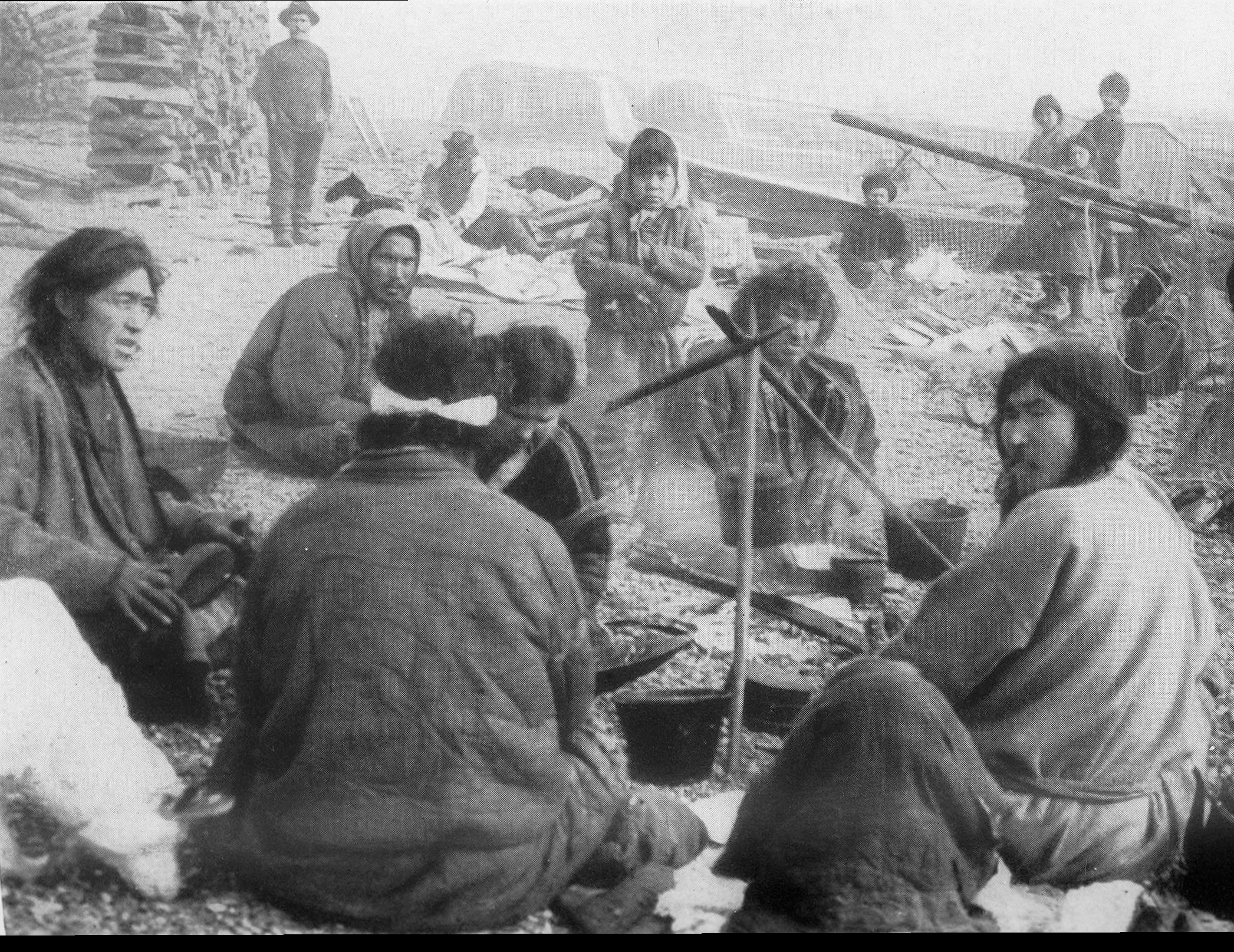
The proposed Dene-Yeniseian language family, linking Ket to the Na-Dene languages of North America, remains one of the most provocative hypotheses in historical linguistics. Not all linguists accept the connection, but it has generated collaboration between Ket communities and northern Athabaskan peoples -- a meeting of cultures separated by an ocean and ten thousand years of independent history. The urgency is real. With around 150 fluent speakers remaining, the Ket language is critically endangered. Each year, the number shrinks. Norwegian explorer Fridtjof Nansen photographed the Ket in 1913, capturing a people who still lived along the Yenisei in houseboats and gathered around campfires in the taiga. A century later, the houseboats are gone, the campfires are cold, and the language that named them is falling silent.
From the Air
The Ket homeland is centered along the middle Yenisei River at approximately 62.48N, 86.27E in Turukhansky District of Krasnoyarsk Krai. Ket settlements are small villages scattered along the riverbanks, barely visible from altitude. The nearest significant airfield is at Turukhansk. The Yenisei itself is a major visual landmark, one of Siberia's great rivers flowing north to the Arctic. Expect taiga forest extending to the horizon in all directions, with river valleys providing the primary navigation reference.