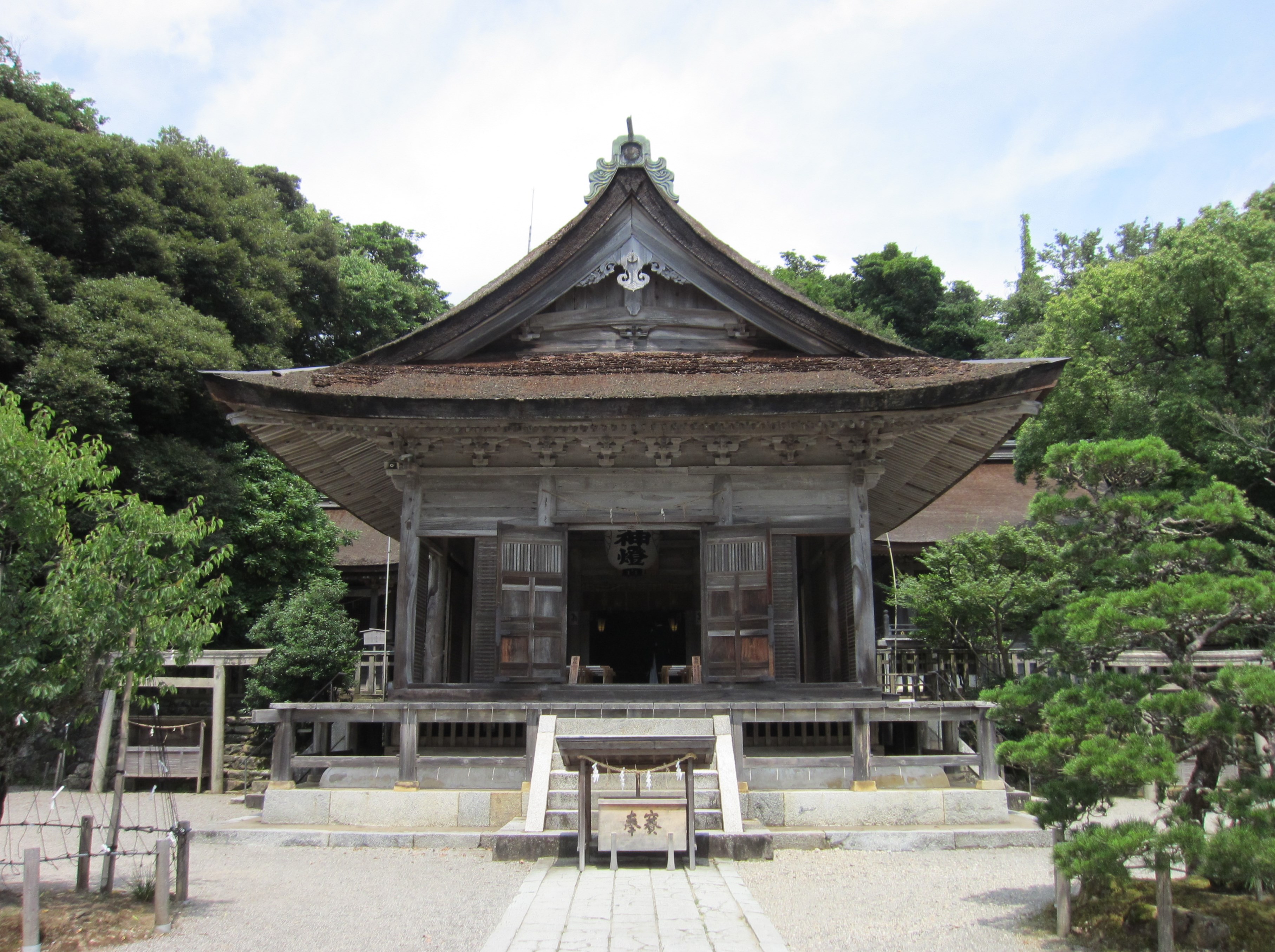
Keta Taisha
Every December 16 at three o'clock in the morning, a cormorant captured on a rocky island off Nanao City is released inside the grounds of Keta Taisha. In the darkness before dawn, village elders watch the bird's movements as it hops and flutters toward the offering table before the deity. The direction it turns, the ruffling of its feathers, the speed of its approach: each gesture is read as a sign foretelling whether the coming year will bring a good harvest or a poor one. The ritual, known as U-matsuri, is designated an Important Intangible Folk Cultural Property by the Japanese government. It has been performed at this Shinto shrine on the Noto Peninsula coast for so long that no one can say with certainty when it began.
Where a God Came Ashore
According to shrine tradition, Keta Taisha was built on the spot where Okuninushi, one of the great kami of Japanese mythology, landed on the Noto Peninsula with 300 followers from Izumo Province to bring the region under his authority. The legend places this event during the reign of either the semi-legendary eighth Emperor Kogen or the tenth Emperor Sujin, figures whose historical existence remains debated by scholars. What is certain is that the shrine is very old. Its earliest historical mention appears in a poem in the Man'yoshu, Japan's oldest anthology of poetry, composed by Otomo no Yakamochi in 748 AD while he was serving as governor of neighboring Etchu Province. The Shoku Nihongi, a chronicle completed in 797, references the shrine in a 768 AD entry. By the time the Nihon Sandai Jitsuroku was compiled around 901 AD, Keta Taisha had been accorded First Court Rank, the highest ritual standing a shrine could receive.
The Maeda Legacy in Wood and Stone
The shrine's current buildings owe much to the Maeda clan, the powerful daimyo family that controlled Kaga Domain and patronized Keta Taisha throughout the Edo period. The main hall, rebuilt in 1787, is a rare surviving example of the Ryonare-zukuri architectural style. It was designed by Shimizu Tashiro, the head carpenter of Kaga Domain, and is recognized as one of his masterpieces. Six structures at the shrine hold designation as National Important Cultural Properties: the main hall, the worship hall dating to 1653, the shrine gate, the auxiliary Hakusan Shrine hall, the Wakamiya Shrine hall from 1569, and another building from the late Muromachi period. Under the pre-World War II system of ranked Shinto shrines, Keta Taisha was classified as a kokuhei taisha, a national shrine of the first rank, placing it among the most prestigious in all of Japan.
Reading the Cormorant's Flight
The U-matsuri cormorant divination is the shrine's most extraordinary tradition. Each year, a cormorant is captured on Shikado Island off Nanao City and brought to the shrine grounds. Released in the pre-dawn darkness of December 16, the bird is observed by shrine priests and community elders as it moves across the sacred space. When the cormorant lands, it is captured again and carried to the coast, where it is released into the sky over the Sea of Japan. Every detail of the bird's behavior from the moment of release to the moment of landing is interpreted: the color shifts in its feathers, its hesitations and sudden movements, the path it traces through the cold morning air. The divination predicts not only the quality of the harvest but also the weather patterns for the year ahead. This living oracle connects the coastal communities of Noto to a tradition of animal augury that predates written records in the region.
First Shrine of Noto
Keta Taisha holds the designation of ichinomiya, the first shrine of its province, for old Noto Province. In the medieval system of shrine ranking, the ichinomiya was the most important shrine in each province, the first one a newly appointed governor was expected to visit upon taking office. That status endures today in the shrine's prominence within Ishikawa Prefecture. Keta Taisha sits in the city of Hakui, on the western coast of the Noto Peninsula, where the land faces the open Sea of Japan. The shrine's main festival is held annually on April 3, drawing visitors to honor Okuninushi, the kami of nation-building, medicine, and agriculture. Behind the main sanctuary, an ancient forest grows untended, a sacred grove that has been preserved as part of the shrine's spiritual landscape. The annual rhythm of festivals, the pre-dawn divination, the centuries of accumulated rank and reverence: all of it rests on this stretch of coastline where, legend says, a god once stepped from his boat onto the shore.
From the Air
Located at 36.926°N, 136.768°E on the western coast of the Noto Peninsula in Hakui, Ishikawa Prefecture. The shrine compound and its surrounding sacred forest are visible as a dense tree cluster near the coastline. Nearest airports include Noto Satoyama Airport (RJNW, ~40 nm northeast) and Komatsu Airport (RJNK, ~45 nm south-southwest). The coastal setting with the Sea of Japan to the west provides clear orientation. Best viewed at 2,000-3,000 ft AGL in clear conditions.