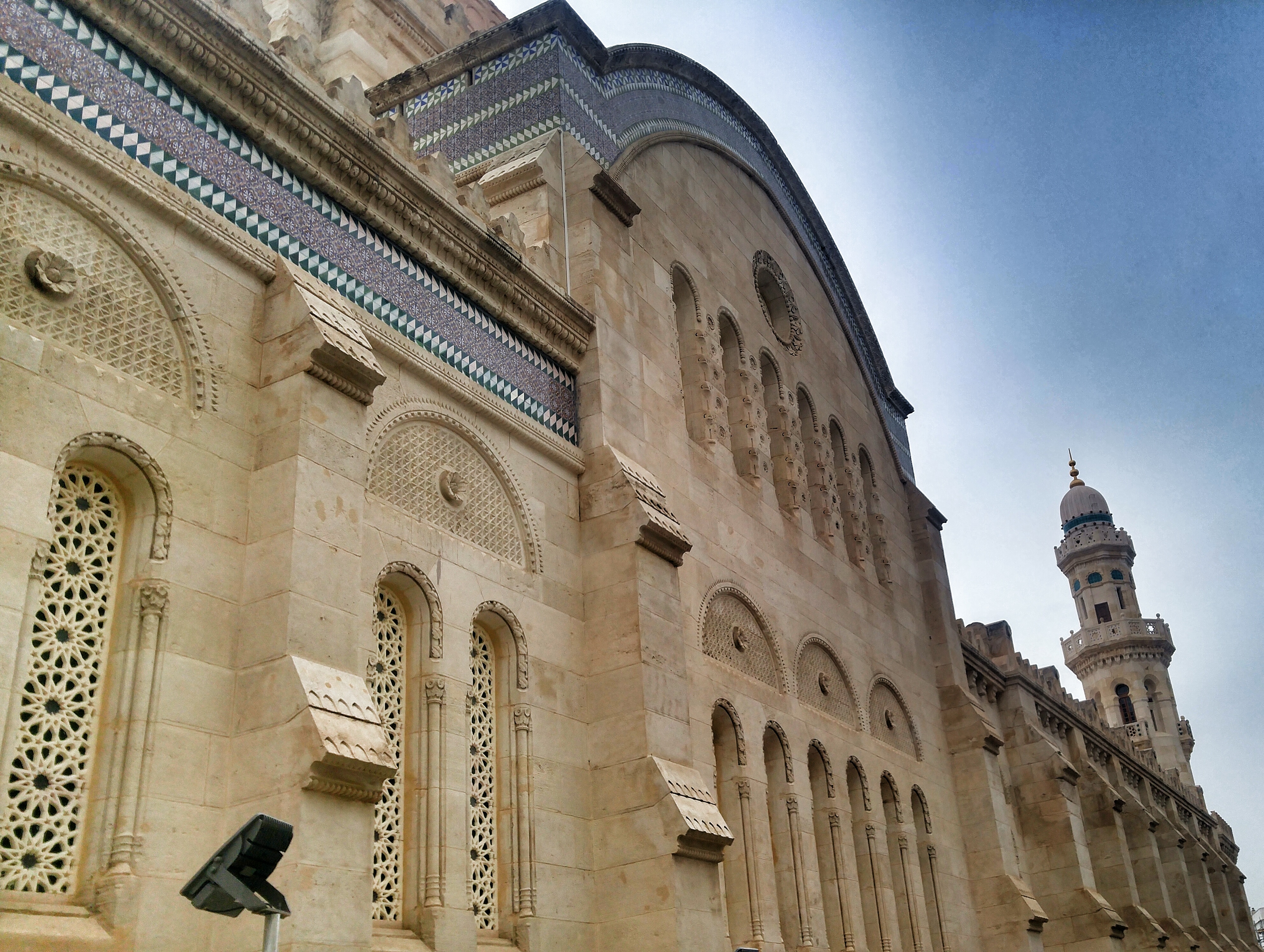
Ketchaoua Mosque
Few buildings in the world have been forced to change their identity as many times as the Ketchaoua Mosque. Built as a mosque in the heart of Ottoman Algiers, seized at bayonet-point and consecrated as a Catholic cathedral under French rule, then restored to Islamic worship upon Algerian independence -- it has been mosque, cathedral, and mosque again. Each transformation was an act of power. And each left its mark on a structure that now fuses Moorish, Byzantine, and Ottoman architectural traditions into something that belongs to no single era or faith.
At the Crossroads of Five Gates
The Ketchaoua Mosque stands at the foot of the Casbah of Algiers, on the first of the ancient medina's many steep stairways. Its position was not accidental. During the Ottoman period, this spot marked the intersection of roads leading from the lower Casbah to the city's five gates -- the strategic heart of Algiers. The aristocratic district surrounded it: the homes of Ottoman royal family members, political leaders, and wealthy merchants. An unconfirmed mention places a mosque here as early as the fourteenth century. The confirmed historical record dates the present structure to the seventeenth century, when it was glorified in a commemorative inscription as a building of "unparalleled beauty." The site itself reaches much deeper into history. It was built on the ground of Ikosim, a Phoenician settlement that predates the city of Algiers by more than a thousand years.
Bayonets on Christmas Day
In December 1831, at the orders of General Savary, several hundred Algerians who had gathered to protest were evicted at bayonet-point from the mosque. The protesters were outraged by the violation of guarantees given by General Bourmont, the commander who had captured Algiers the previous year. On Christmas Day 1832, the building was consecrated as the Cathedral of Saint Philippe. Between 1845 and 1860, the old mosque was demolished entirely and a new church was built on the site, incorporating European architectural elements alongside the surviving Ottoman foundations. The conversion of the Ketchaoua was not unique -- the French converted several mosques in Algiers into churches during the early decades of colonization -- but it was the most prominent, and it carried the deepest symbolic weight. The cathedral remained a Catholic place of worship for 130 years.
Restoration and Return
When Algeria won its independence in 1962, one of the first acts of cultural reclamation was the restoration of the Ketchaoua to Islamic worship. The reconversion carried, in the words of historians, "significant religious and cultural importance," and richly testified to the building's layered history as "this mosque-turned-cathedral-turned-mosque." But decades of use and modification had taken their toll. The minarets were near partial collapse. In September 2008, Algerian authorities launched a broader restoration plan covering the Ketchaoua and several other historic mosques, estimated at 300 million Algerian dinars. In April 2018, the mosque was reopened after a comprehensive restoration carried out by the Turkish International Cooperation and Development Agency, which worked to return the building to its original Ottoman architectural plan. Researchers from both Algeria and Turkey guided the restoration, attempting to honor the mosque's founding identity while acknowledging the centuries of change written into its walls.
A Building That Remembers Everything
Walk through the Ketchaoua today and you encounter the full sweep of Algiers' layered history compressed into a single structure. The architectural fusion of Moorish arches, Byzantine dome construction, and Ottoman spatial planning reflects centuries of cultural exchange across the Mediterranean. The mosque sits near the Djamaa el Kebir, the Great Mosque built in 1097, and close to what was once the Archbishop's Palace -- itself a repurposed Ottoman building. This density of sacred architecture, crammed into a few hundred meters at the base of the Casbah, makes the neighborhood a concentrated archive of power and belief. The Ketchaoua endures as a reminder that buildings, like nations, carry the scars of their transformations. Its beauty is inseparable from its history of violation and reclamation.
From the Air
Located at 36.785N, 3.061E at the foot of the Casbah of Algiers, near the waterfront. The mosque's twin minarets and dome are visible from low-altitude approaches. It sits adjacent to the Place des Martyrs, the large open square at the base of the old medina. Nearest airport: Houari Boumediene Airport (DAAG), approximately 16 km southeast. The dense white buildings of the Casbah rise steeply behind the mosque, creating a dramatic visual from the harbor or the air.