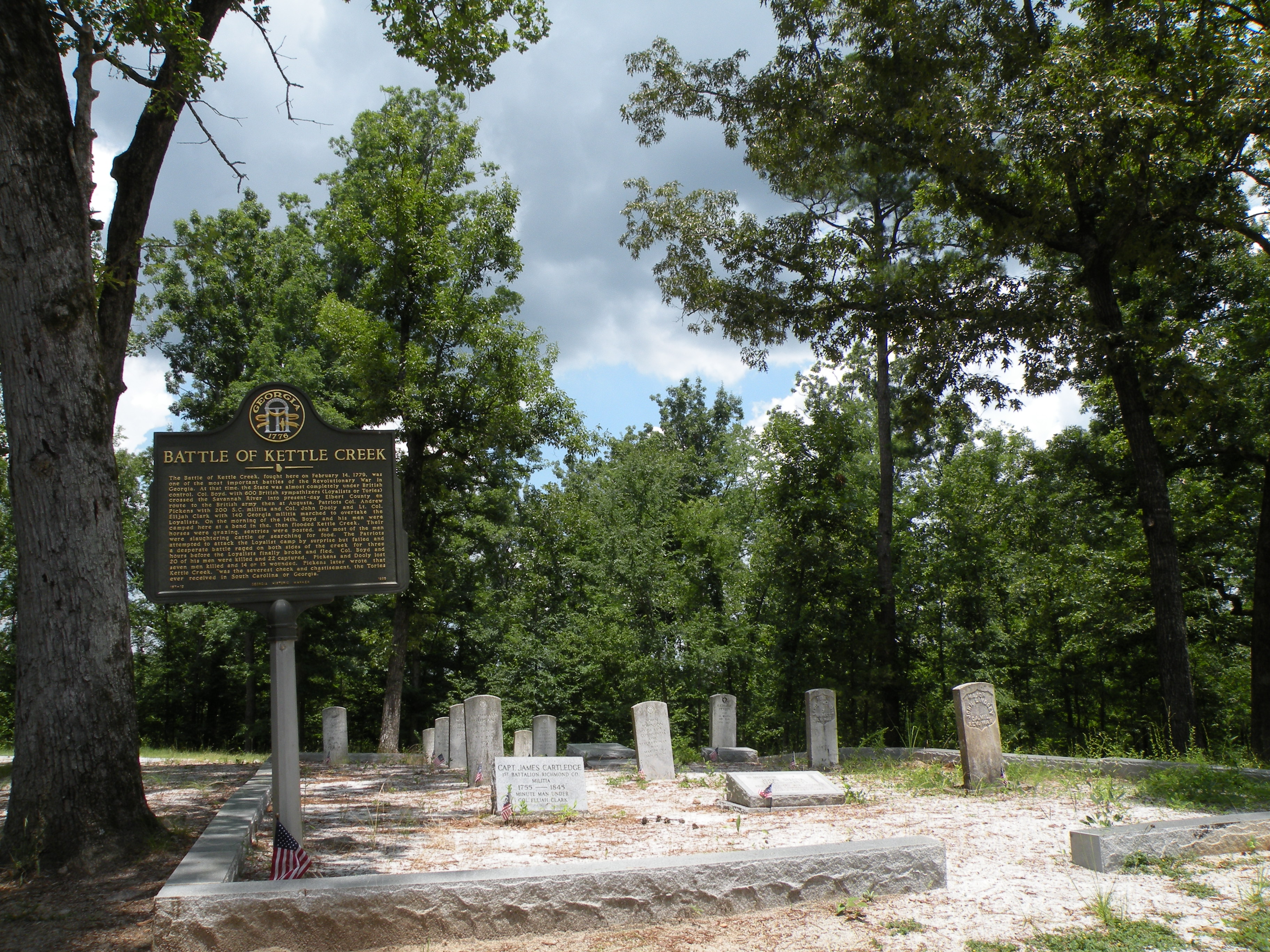
Kettle Creek Battlefield
Colonel James Boyd was butchering stolen cattle when the shooting started. It was February 14, 1779 -- Valentine's Day, though nobody in the Georgia backcountry was in a romantic mood. Boyd, an Irishman from South Carolina carrying a British commission to recruit Loyalists, had gathered roughly 600 men and was marching them toward the British garrison at Augusta. They stopped along Kettle Creek in Wilkes County to rest and slaughter livestock. Their horses were unsaddled and grazing. Their weapons were stacked. That was when 340 Patriot militiamen under Andrew Pickens, Elijah Clarke, and John Dooly crept through the winter woods and opened fire.
A War Between Neighbors
The Revolution in the Southern backcountry was less a war between nations than a civil war between neighbors. After the British captured Savannah in December 1778, they expected Georgia's interior Loyalists to rise up and join them. Boyd was the instrument of that strategy: travel behind rebel lines, recruit settlers loyal to the Crown, and march them to Augusta to bolster the garrison. He found willing recruits -- hundreds of frontier families had genuine grievances against the Patriot government and no love for the coastal elites who ran it. But the Patriot militia had its own fierce leaders. Elijah Clarke was an illiterate frontiersman who had arrived in Georgia's ceded lands only six years earlier. Andrew Pickens was a disciplined South Carolina Presbyterian. John Dooly commanded the Wilkes County militia. All three had scores to settle.
Thirty Yards and a Musket Ball
Pickens led the main assault up the center, with Clarke and Dooly flanking from the sides. A scout had reported the Loyalists' position along the creek, their guard down, their attention on the cattle. But Boyd was no fool. When the first shots rang out, he rallied about 100 men and charged directly at Pickens, climbing a hill to ambush the attackers at a range of just 30 yards. For a few chaotic minutes, the outcome hung in the balance. Then three Patriot muskets found Boyd. He fell mortally wounded, and without their commander the Loyalist line collapsed. Some fought on in scattered pockets; most fled into the surrounding woods. The entire battle lasted less than two hours. The Loyalists lost 70 killed and 70 captured. The Patriots suffered 9 dead and 23 wounded. Several Loyalist prisoners were subsequently tried and hanged for treason.
The Battle That Saved Georgia's Interior
Kettle Creek was not a large battle by the standards of the Revolution, but its consequences rippled far beyond the creek bank. The defeat shattered British confidence that Loyalist militias could hold the Georgia backcountry. Hundreds of potential Loyalist recruits, watching Boyd's force disintegrate, quietly reconsidered their allegiance. The British retained Savannah and eventually took Augusta, but their grip on the interior never solidified. For Clarke, the victory launched a legendary guerrilla career -- he would fight wounded in multiple engagements, lead Georgia refugees through the Carolina mountains, and become the most celebrated militia commander in the state's history. The county and the city of Athens would eventually bear variations of his name, though Clarke himself died nearly bankrupt in 1799, his later years marred by an ill-fated attempt to seize Creek lands and establish his own republic on the Oconee frontier.
War Hill and the Preservationists
The battlefield centers on War Hill, a prominent rise where some of the heaviest fighting occurred. In 1900, the Daughters of the American Revolution purchased 12 acres around the hill, beginning a preservation effort that continues today. The U.S. War Department erected the Kettle Creek Monument atop War Hill in 1930, and the Georgia Historical Commission added interpretive markers. The site was listed on the National Register of Historic Places on June 26, 1975. In 2013, the Kettle Creek Battlefield Association acquired an additional 60 acres, and by 2018 the American Battlefield Trust and its partners had preserved 180 acres of the field. In January 2021, the battlefield became affiliated with the National Park Service. The rolling Georgia piedmont that Boyd's men crossed with their stolen cattle now lies quiet, the creek still winding through hardwood bottomland, War Hill still commanding the landscape exactly as it did on that cold February morning when the muskets spoke.
From the Air
Located at 33.691N, 82.886W in Wilkes County, Georgia, approximately 11 miles southwest of Washington, Georgia, off Courtground Road. The battlefield is centered on War Hill, a prominent rise visible amid rolling piedmont terrain and hardwood forest along Kettle Creek. Nearest airports: Washington-Wilkes County Airport (KIIY) approximately 10nm northeast, Augusta Regional Airport (KAGS) approximately 40nm east. The terrain is gently rolling Georgia piedmont with mixed hardwood and pine forests. Best viewed at 1,500-2,500 feet AGL.