Kettle Falls Hotel
The price was one thousand dollars and four barrels of whiskey. That was the deal Robert Sloan Williams struck in 1918 to buy a remote hotel on the Canadian border, fifteen miles from the nearest road, reachable only by water. More than a century later the Kettle Falls Hotel still stands deep in what is now Voyageurs National Park, still accessible only by boat or floatplane, still serving drinks at a bar whose floor tilts so dramatically that first-time visitors grip their glasses and wonder if the whiskey has already gone to their heads. The locals call it the Tiltin' Hilton. The foundation settled unevenly years ago, and rather than fix it, the hotel leaned into the legend. Everything about this place resists the ordinary.
Timber, Homesteads, and a Surgeon's Detour
The story begins with Ida May Winslow, who patented the site as a homestead in 1910 at a portage point where Rainy Lake narrows toward Namakan Lake. The location had served travelers for centuries -- Indigenous peoples, voyageurs, and fur traders all recognized the strategic value of this pinch point between two great border lakes. The property passed to Frederick A. Dunsmoor, a Minneapolis surgeon, before landing in the hands of William E. Rose in 1913. Known as 'Big Ed,' Rose was a timberman who built the hotel's north-south wing to serve the lumberjacks, fishermen, and traders moving through the area. The timber industry was booming in northern Minnesota, and Kettle Falls sat at the crossroads of the water routes that carried logs to market.
Bootleggers and Border Country
When Robert Williams bought the hotel in 1918 -- for that memorable price of one thousand dollars and four barrels of whiskey -- he acquired more than a building. He acquired a location perfectly suited to the era about to arrive. With the Canadian border a stone's throw across the water, Kettle Falls became an ideal staging ground during Prohibition. Williams, who also operated a hotel and nightclub in Ranier, Minnesota, had repeated run-ins with the law. He was charged with selling illegal whiskey at both Ranier and Kettle Falls, and he eventually operated stills and a smuggling operation that moved Canadian liquor across the border lakes. The hotel's remoteness, which might have been a liability in another business, was a smuggler's greatest asset. There were no roads to patrol, no easy way for federal agents to arrive unannounced.
A Family Affair on the Water
Despite his legal troubles, Williams kept the hotel running for decades. The property was electrified by 1935 -- no small feat for a location with no road access. An annex called 'the big house' was added in 1946. When Bob Williams died in 1956, his widow Lil, stepson Charlie, and Charlie's wife Blanche continued the operation. Lil Williams ran the place until her own death in 1961. The National Park Service acquired the hotel from the Williams family in 1976, the same year it was listed on the National Register of Historic Places. The family continued to operate it even after the sale. A major renovation in 1986-87 updated the infrastructure while preserving the character -- including, wisely, that famously uneven bar floor.
Fifteen Miles from Anywhere
Today the Kettle Falls Hotel remains the only lodging within Voyageurs National Park, and its isolation is part of the draw. There is no road. You arrive by motorboat from one of the park's access points, or by floatplane if you prefer your entrances dramatic. The red-roofed hotel sits on a narrow strip of the Kabetogama Peninsula, surrounded by boreal forest and the vast interconnected waterways that French-Canadian voyageurs once paddled in birch bark canoes loaded with beaver pelts. The hotel's nomination to the National Register cited its significance in commerce, entertainment, industry, and transportation -- a fitting summary for a place that has served lumberjacks, bootleggers, fishermen, and families across three centuries of northern Minnesota life. The bar still tilts. The boats still dock at the same shore. And the border lakes still stretch to the horizon in every direction.
From the Air
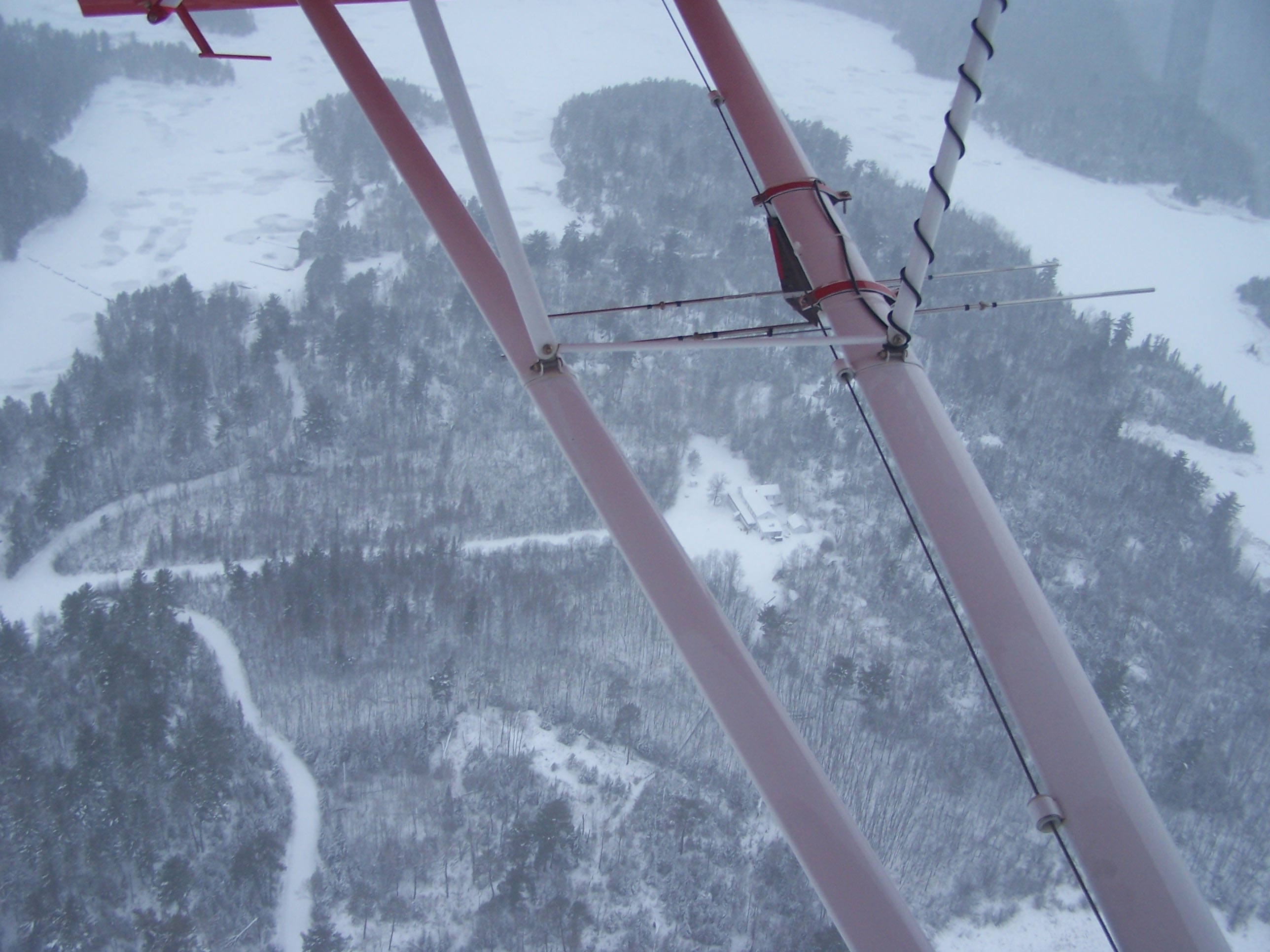
Located at 48.50°N, 92.64°W on the Kabetogama Peninsula within Voyageurs National Park, at the narrow channel between Rainy Lake and Namakan Lake near the Canadian border. The red-roofed hotel is visible from low altitude on the eastern shore of the peninsula. No road access -- the hotel is approximately 15 miles from the nearest road. Falls International Airport (KINL) at International Falls is the nearest airport with instrument approaches, roughly 25 nm to the west. Crane Lake seaplane base lies to the southeast. The Canadian border runs through the lakes immediately north. Best viewed at 1,500-3,000 feet AGL, where the hotel's red roof contrasts with the dark boreal forest and the sprawling lake system is visible in all directions.