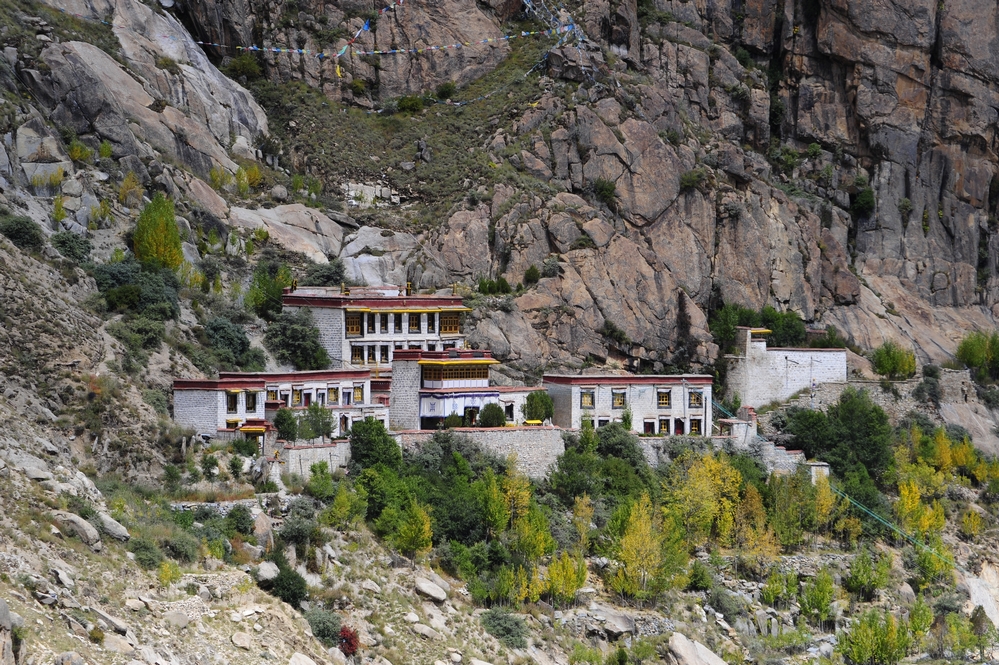
Keutsang Hermitage
The search party that found the future 14th Dalai Lama traveled from this hermitage. Perched on a hillside about 8 kilometers northwest of Lhasa, above the city's principal cemetery, Keutsang Hermitage belongs to Sera Monastery but has always cultivated its own identity - quieter, more austere, oriented toward ritual and retreat rather than the bustling monastic life of Sera's main campus below. The hermitage began as a cave. It grew into something far more consequential.
The Abbot Who Sought Solitude
Jampa Monlam, the first Keutsang incarnation and the seventeenth abbot of Sera Je College, did not set out to found an institution. He wanted penance and solitude. After leaving Sera Je, he moved into a cave on the hillside, a precarious perch once inhabited by the great Tibetan guru Tsongkhapa. He built a small hut for his retreat. But solitude proved elusive: students from Sera Je followed him up the hill, seeking his lectures. A small institution developed around his reluctant teaching. After his death, the second incarnation, Lozang Jamyang Monlam, came from a wealthy family and used those resources to construct buildings around the original cave site. The original cave eventually collapsed in a landslide, and the hermitage was rebuilt at a safer location adjoining the ruins of the older Keutsang West Hermitage, east of Sera on the hillside.
Finding the Dalai Lama
The fourth Keutsang incarnation was a close associate of the 13th Dalai Lama, Thubten Gyatso. When the 13th Dalai Lama died in 1933, the task of identifying his successor fell to search parties dispatched across Tibet. The fourth Keutsang incarnation played an instrumental role in this search, which eventually led to a two-year-old boy named Lhamo Thondup in Taktser, a village in northeastern Tibet. That boy became the 14th Dalai Lama, Tenzin Gyatso. The hermitage's association with this moment cemented its place in Tibetan history. From the early 19th century until 1959, Keutsang also owned the Drapchi Temple in the northern part of Lhasa, extending its influence well beyond the hillside. The fame and structural expansion of the hermitage trace directly to its connection with these successive Dalai Lamas.
Temples Stacked Three Stories High
The hermitage today centers on a main temple with a three-story secondary building behind it. The ground floor serves as a staircase and storage. The second floor houses the Scripture Temple, whose altar enshrines three protector deities: Palden Lhamo in the center, flanked by Dorje Yudrönma, the site deity of the monastery, and Nyang Dren Gyalchen. On the same floor, the Tengyur chapel holds a collection of translated Indian Buddhist treatises. Climb to the third floor and you find the Maitreya Chapel, dominated by a two-story-tall statue of the future Buddha that gazes out over the cemetery below. This floor also contains residential quarters reserved for the Dalai Lama and the Keutsang incarnation. In the northeast corner, a large Dharma enclosure built in 2004 provides space for younger monks to memorize scriptures, their chanting carrying across the hillside in the thin Lhasa air.
Rhythms of the Lunar Calendar
Keutsang operates on a ritual calendar that ties monastic life to the movements of the moon. Ceremonies mark the new moon, the full moon, and the tenth and twenty-fifth days of each lunar month. Local villagers invite the monks to their homes to perform rituals, a custom that sustains the hermitage financially while keeping it woven into the community. The annual cycle includes Tibetan New Year observances, eight sets of two-day Avalokiteshvara fasting rituals, and the chanting of rainy season precepts during summer. In the eighth Tibetan month, junior monks face a memorization examination administered by a senior scholar from Sera Monastery, testing their command of the ritual texts that are the hermitage's specialty. The hermitage sits along the Sera Mountain Circumambulation Circuit, a pilgrim path that comes alive during the "Sixth-Month Fourth-Day" celebrations, when devotees walk the route connecting the sacred sites above Lhasa.
From the Air
Keutsang Hermitage is located at 29.703N, 91.149E on a hillside about 8km northwest of central Lhasa at approximately 3,800m elevation. It sits east of and above Sera Monastery, overlooking Lhasa's principal cemetery. Lhasa Gonggar Airport (ZULS) is roughly 65km to the southwest. The hermitage is small and may be difficult to spot from altitude, but Sera Monastery below is a larger visual reference. High-altitude conditions and mountain terrain dominate the area.