KEXP
In 1988, a young Kurt Cobain walked up to the door of a tiny college radio station at the University of Washington and handed over a copy of his first single, 'Love Buzz.' The staff did not play it until Cobain called back from a gas station pay phone to request it himself. That station was KCMU, broadcasting at 90.3 FM with the power of a household light bulb. Today it is KEXP, headquartered at the Seattle Center with 4,700 watts of broadcast power, a YouTube channel with more than 3 million subscribers, and a reputation as one of the most important independent music platforms on Earth. The journey between those two moments is a story of student activists, grunge pioneers, corporate battles, and a city that kept insisting its music mattered.
Ten Watts and a Borrowed Transmitter
KEXP began in 1972 as KCMU, born out of the same restless energy that had swept American campuses during the Vietnam era. After a 1970 student strike at the University of Washington, four undergraduates -- John Kean, Cliff Noonan, Victoria Fiedler, and Brent Wilcox -- proposed a student-run radio station. The UW Board of Regents agreed to back them if they could secure FCC approval. They got it in October 1971, then scrounged old turntables from a rural Washington station and a discarded transmitter from Nathan Hale High School's KNHC. KCMU went on air May 10, 1972, from a retrofitted room in the Communications Building, transmitting at 10 watts. The signal barely reached University Avenue, the commercial strip a few blocks away. But the station was alive, splitting its time between folk-rock, blues, and student journalism, even sending reporters to both the Democratic and Republican national conventions that summer.
The Grunge Incubator
By the mid-1980s, KCMU had become ground zero for what the world would eventually call grunge. Music director Faith Henschel enforced a rule that a local band had to be played at least once every hour. Jonathan Poneman hosted a show called Audioasis; he met Bruce Pavitt at the station, and together they founded Sub Pop Records. Kim Thayil won a prize on KCMU, became a DJ, and got his band Soundgarden its first radio play there. Henschel assembled a two-cassette compilation titled 'Bands That Will Make You Money' and sent it to record labels, directly leading to Soundgarden's signing with A&M Records. As editor Charles R. Cross of The Rocket put it, 'virtually every volunteer who had an air shift in the late 80s ended up getting a job in the music industry or playing some role in the Seattle scene.' Mark Arm of Mudhoney and Green River passed through the UW. KCMU was not just playing the music; it was the social network that made the scene possible.
CURSE and the Fight for the Soul of College Radio
Success brought conflict. In November 1992, KCMU management fired nine volunteer DJs to make room for syndicated programs. Supporters organized under the name CURSE -- Censorship Undermines Radio Station Ethics -- and distributed flyers reading 'KCMU Is Dying.' Sub Pop, Capitol Records, and C/Z Records withheld records from the station. Billboard called KCMU 'one of the most influential commercial-free stations in the country' and put the dispute on its front page. The fight reached federal court in 1993 when fired staffers argued their First Amendment rights had been violated by a state-owned institution. In 1994, Judge Thomas Zilly ruled the station's no-criticism policy was unconstitutional. By then, tensions had cooled, and Rolling Stone declared the station was sounding 'more like the old KCMU.' The crisis mirrored struggles at college stations across the country, from WXPN in Philadelphia to KCRW in Santa Monica, as noncommercial radio grappled with professionalization.
Reborn at the Seattle Center
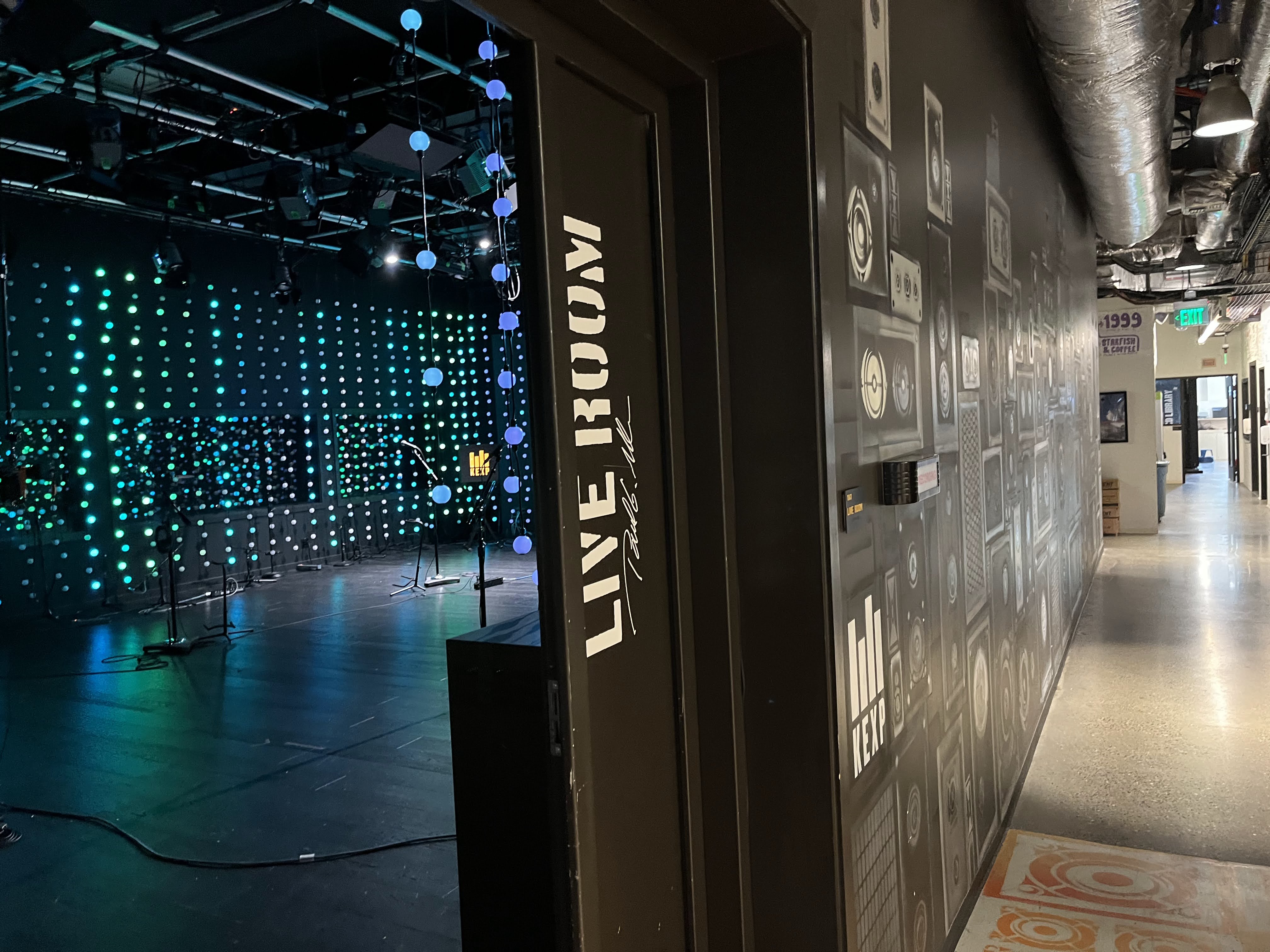
In 2001, a partnership with Paul Allen's Experience Music Project transformed KCMU into KEXP, relocating it to new studios and boosting its power to 720 watts. That same year, KEXP became the first station in the world to stream 128-kilobit-per-second MP3 audio online. Weekly online listeners jumped from 26,000 to 50,000 between 2004 and 2005, with pins on a studio map marking listeners from Tokyo to Antarctica. In 2014, the nonprofit Friends of KEXP purchased the station license from the university for $4 million. The following year, KEXP moved into a purpose-built facility at the Seattle Center, four times larger than the old studio, with a $15 million capital campaign chaired by Pearl Jam's Mike McCready. The Gathering Space, a public performance venue and cafe at the corner of Republican Street and 1st Avenue North, became the station's signature. Its live room, backed by motion-responsive festoon lights donated by Microsoft, provides the distinctive visual backdrop for KEXP's video performances.
A Signal That Circles the Globe
In 2018, an anonymous out-of-state listener known only as 'Suzanne' left KEXP a bequest of nearly $10 million. That gift funded the station's 2023 acquisition of KREV in the San Francisco Bay Area, relaunched as KEXC in March 2024. KEXP's YouTube channel now draws more than 3 million subscribers, with 75 percent of views coming from outside the United States. The station covers festivals from Iceland Airwaves to Rencontres Trans Musicales in France, and its in-studio sessions have become a global currency of musical credibility. From hip-hop on the long-running Street Sounds to Afrobeat on The Continent to Latin alternative on El Sonido, KEXP's programming reflects a world far broader than the alternative rock that made its name. What started as four students with a borrowed transmitter is now a listening community that spans continents, held together by a conviction that someone, somewhere, is about to play something you have never heard before.
From the Air
KEXP's studios are at the Seattle Center (47.616N, 122.309W), identifiable from the air by the distinctive Space Needle immediately adjacent. The station's transmitter is on Capitol Hill, visible as a tower cluster among midrise apartment buildings east of downtown. Nearest airports: Boeing Field/King County International (KBFI, 5nm south) and Renton Municipal (KRNT, 9nm south-southeast). The Seattle Center campus is easily identified from 2,000-4,000 feet AGL by the Space Needle, MoPOP's colorful architecture, and the Climate Pledge Arena.