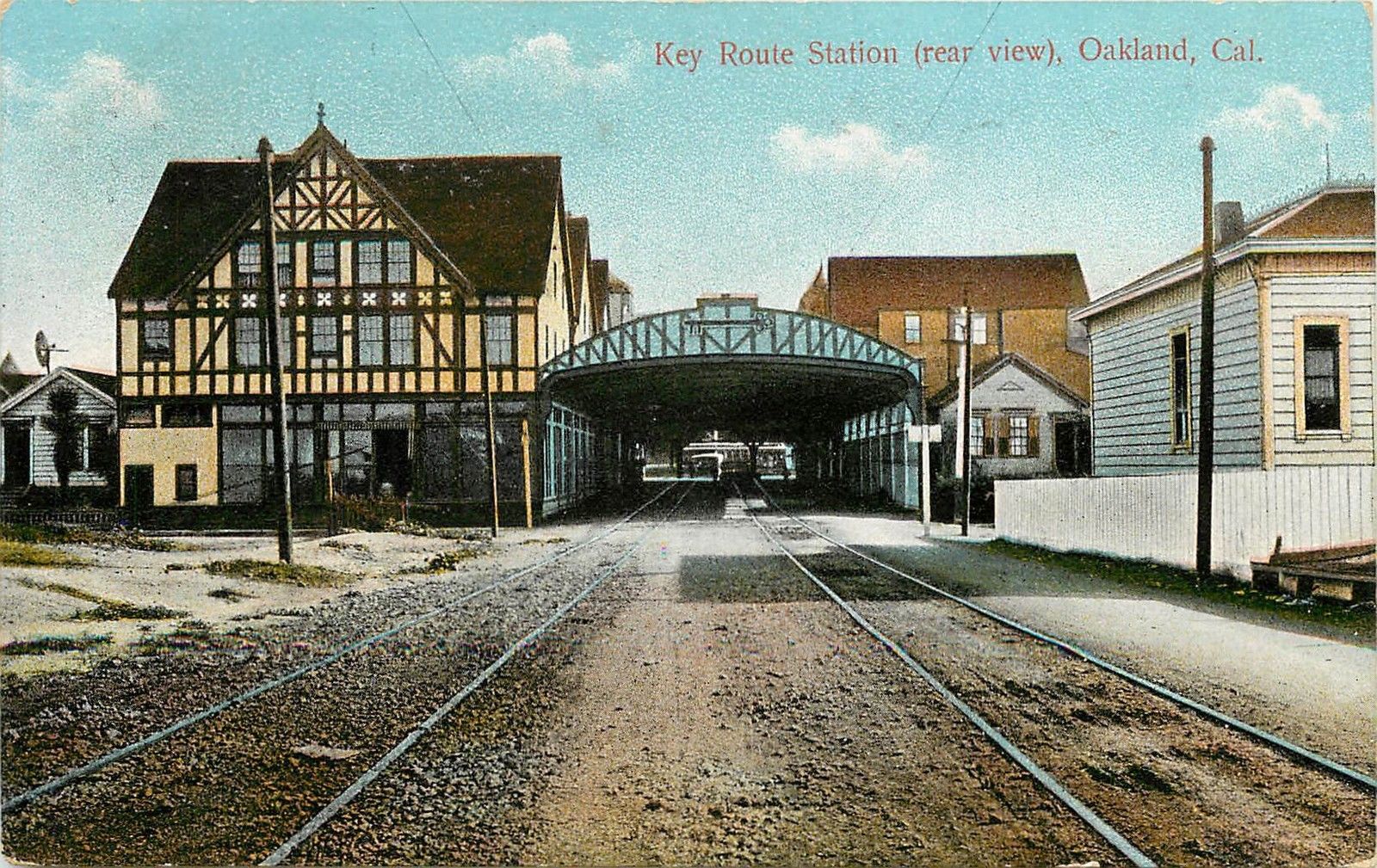
Key Route Inn
A streetcar once rolled through the lobby of a hotel. Not past it, not near it -- through it, on tracks that passed beneath a massive archway and into a corridor where guests could step off the train and directly into the reception hall. The Key Route Inn, which opened on May 7, 1907, on the west side of Broadway in what is now Uptown Oakland, was built around this audacious idea: that a hotel and a transit line could be fused into a single experience, one where arriving was as theatrical as the destination itself.
The Borax King's Grand Ambition
The men behind the Key Route Inn were not modest thinkers. Francis "Borax" Smith had made his fortune mining borax in Death Valley and hauling it out with the famous twenty-mule teams. His partner, Frank C. Havens, shared Smith's appetite for grand schemes. Together they operated the Realty Syndicate, a development empire that included the Key Route transit system -- a network of electric trains connecting Oakland's neighborhoods to a ferry pier, or "mole," that jutted into San Francisco Bay. The Inn was their crown jewel, a massive wood-framed structure dressed in Tudor-style open timbering, designed to look like an old English manor house. It straddled what is now West Grand Avenue, its bulk commanding the streetscape. President William Howard Taft stayed here with his party in 1909, lending the establishment the kind of prestige its builders craved.
Where the Tracks Met the Parlor
The hotel's defining feature was its integration with the Key Route's 22nd Street transbay line. Trains passed through a large archway and into an interior corridor, where a dedicated stop connected directly to the main lobby. For the traveler arriving by rail, the transition from transit to accommodation was seamless -- step off the platform, walk a few paces, and you were checking in. Initially this lobby stop served as the terminus of the line running to the Key ferry pier. But by 1919-1920, the route was extended across Broadway to reach the developing Trestle Glen neighborhood, transforming the hotel from a terminal point into a waystation. The Inn sat at the intersection of movement and rest, a building that embodied Oakland's ambition to be more than San Francisco's quieter neighbor across the bay.
Twenty-Five Years and a Match
The Key Route Inn lasted just a quarter century. On September 8, 1930, fire tore through the wood-framed structure, inflicting catastrophic damage. The timing could not have been worse. The Great Depression had arrived, hollowing out the hotel business. At the same time, Oakland's city planners wanted to connect Grand Avenue with 22nd Street, a road alignment that ran directly through the hotel's footprint. The combination of fire damage, economic collapse, and civic ambition sealed the Inn's fate. Demolition crews moved in during April and May of 1932. The building that had once hosted a sitting president was reduced to rubble and hauled away. Its sister property, the Claremont Hotel, which opened in 1915 in the Berkeley Hills, survived and still stands -- a reminder of what the Key Route Inn might have become with different luck and less combustible construction.
Ghost Lines
The hotel vanished, but the rail line through its bones did not -- at least not immediately. When the San Francisco-Oakland Bay Bridge opened in 1936 with its lower-deck railway, the old Key Route tracks became the "B" transbay line, carrying passengers across the water on steel and concrete rather than by ferry. That rail service lasted until April 1958, when buses replaced the trains. The route was folded into the publicly owned AC Transit system, and the modern Line B bypasses the former hotel site by nearly a mile. Today, nothing marks the spot where trains once glided through a hotel lobby. The intersection of Broadway and West Grand Avenue carries ordinary traffic past ordinary buildings, and the idea of embedding a transit stop inside a luxury hotel feels like something from a more imaginative age -- or perhaps from a future that hasn't arrived yet.
From the Air
Located at 37.81°N, 122.27°W in Uptown Oakland along Broadway near West Grand Avenue. Best viewed from 2,000-3,000 feet AGL. The site sits roughly midway between Oakland's Jack London Square waterfront and the hills to the east. Metropolitan Oakland International Airport (KOAK) lies 5 miles to the south. The Bay Bridge is clearly visible to the west, and the distinctive Fox Oakland Theatre tower is a useful landmark a few blocks south on Telegraph Avenue.