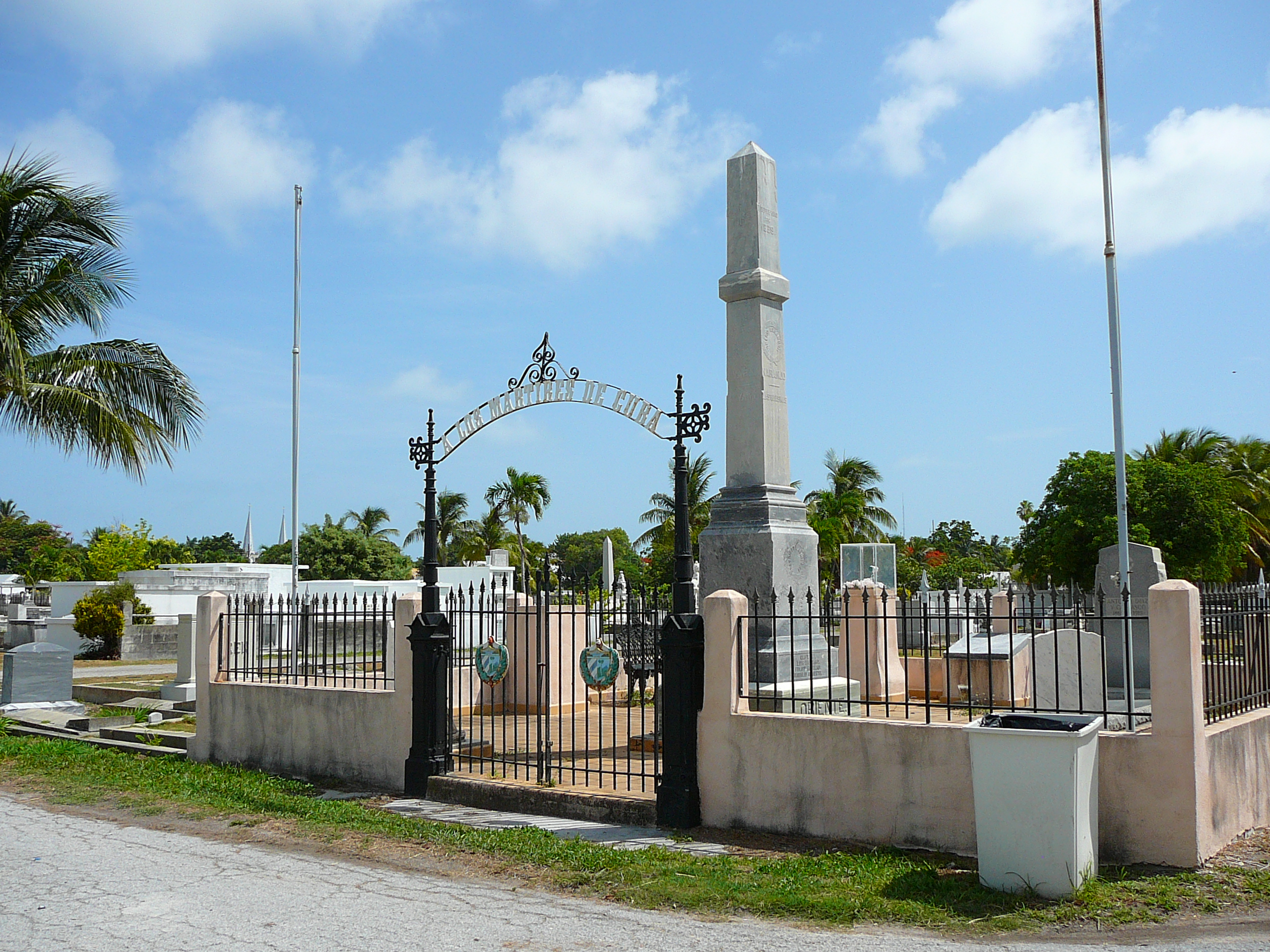
Key West Cemetery: I Told You I Was Sick
"I Told You I Was Sick." The epitaph on B.P. "Pearl" Roberts's headstone is the most famous line in Key West Cemetery, and it captures everything about this place: the dark humor, the defiance, the refusal to take even death entirely seriously. Spread across 19 acres at the foot of Solares Hill -- the highest point on an island that barely rises above sea level -- the cemetery holds an estimated 100,000 burials, more than three times the living population of Key West. The dead outnumber the living here, and they have better stories. The cemetery exists at this location because a hurricane in 1846 washed the bodies out of the original burial ground on the coastal sand dunes, and the city decided higher ground might be prudent. They have been stacking the dead here ever since.
Built on Borrowed Ground
The original Key West cemetery sat on Whitehead Point near the West Martello Towers, where the coastal sand dunes seemed like a reasonable place to bury the dead on a small island. Then the hurricane of 1846 arrived and proved otherwise, washing bodies from their graves and scattering them across the island. In 1847, the city established a new cemetery at the foot of Solares Hill, the highest natural point in Key West. Because the island's water table sits just a few feet below the surface, most graves are above-ground vaults -- limestone and concrete crypts stacked like a smaller, more eccentric version of the cemeteries in New Orleans. Newer burials push upward for the same reason: dig down more than a few feet and you hit water. The result is a landscape of weathered stone rising from tropical vegetation, some markers dating to the 1840s, many cracked, broken, and slowly yielding to the salt air.
Sailors, Soldiers, and Freedom Fighters
The cemetery carries the weight of Key West's military history. A dedicated section honors the sailors killed aboard the USS Maine, which exploded in Havana Harbor on February 15, 1898 -- the event that triggered the Spanish-American War. Two dozen of those sailors are buried here beneath a memorial that still draws visitors. Nearby, a section marked "A los martires de Cuba" holds the graves of Cuban independence fighters from the Ten Years' War against Spain, a reminder of Key West's deep ties to Cuba, just ninety miles across the strait. Confederate Navy sailors rest here as well, along with veterans of both World Wars. The cemetery is a layered record of every conflict that has touched this island, from the Civil War to the wars that made and remade the Caribbean.
The Grave Robber and the Beauty
Among the cemetery's most unsettling stories is the tale of Maria Elena Milagro de Hoyos, a young Cuban-American woman considered a local beauty in the 1920s. She died of tuberculosis in 1931 at age 22. Carl Tanzler, a German-born radiology technician at the local Marine Hospital, had developed an obsession with her during her treatment. He paid for her funeral and commissioned an above-ground mausoleum in the cemetery, which he visited almost every night. In April 1933, Tanzler removed her body from the tomb under cover of darkness, transporting it home on a toy wagon. He lived with the corpse for seven years, using piano wire, wax, silk, and plaster to preserve it, until Elena's family discovered what he had done in 1940. Her grave in the cemetery is now unmarked, a quiet ending to one of Key West's most macabre chapters.
Epitaphs with Attitude
Key West Cemetery is famous for its irreverent headstone inscriptions, a tradition that reflects the island's defiant spirit. Beyond Pearl Roberts's classic "I Told You I Was Sick," Gloria M. Russell's stone reads "I'm Just Resting My Eyes" -- the excuse of every person who has ever fallen asleep in front of a television. The grave of Miriam Albury, who died in 1933, has had a stuffed bunny placed on it for over fourteen years by an unknown visitor. The Secretary General of the Conch Republic, Sir Peter Anderson, rests here, his title a reminder of Key West's mock secession from the United States in 1982. "Sloppy Joe" Russell, Ernest Hemingway's fishing guide and the bartender whose name still adorns Key West's most famous bar, lies here too, having died in 1941. Even a deer belonging to a Key West family has its own grave marker. In Key West, apparently, everyone gets the last word.
From the Air
Located at 24.556°N, 81.796°W at the foot of Solares Hill in Old Town Key West. From the air, the cemetery is identifiable as a large open rectangular area in the northwest section of Old Town, its above-ground vaults and paths creating a distinctive pattern among the surrounding residential neighborhood. The cemetery covers approximately 19 acres, making it one of the larger open spaces on the island. Nearest airport is Key West International (KEYW), approximately 1.5 miles east. The cemetery sits between Angela Street to the south and Passover Lane to the north, with Frances Street forming the eastern boundary. Best viewed at lower altitudes where the individual monuments and sections become visible.