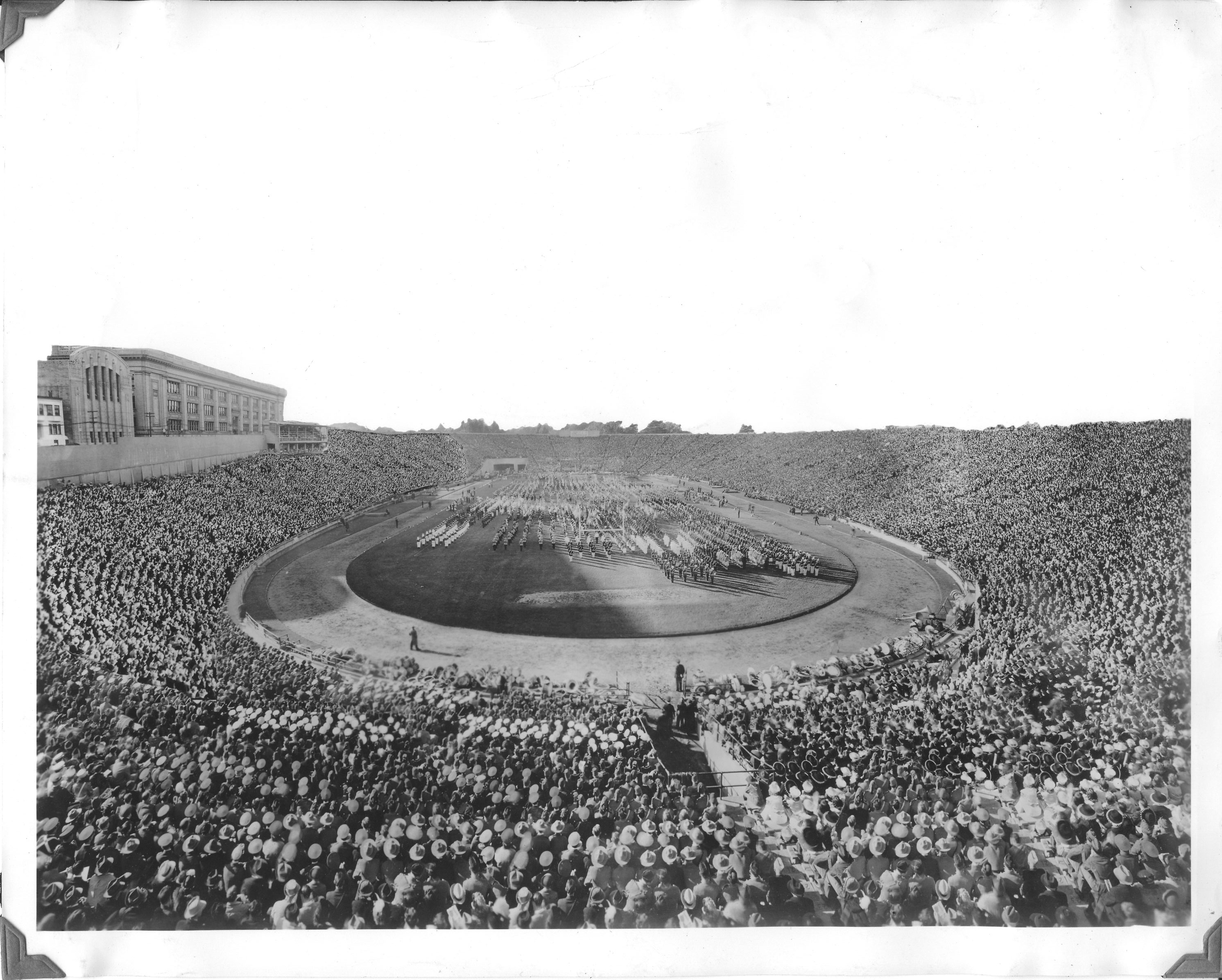
Kezar Stadium
Hall of Fame defensive tackle Art Donovan remembered the "look of dread" on visiting players' faces as they arrived at Kezar Stadium. The dressing rooms were inadequate, the tunnel to the field long and dusty, the turf shredded by rain and overuse, and, as Donovan recalled in his 1987 memoir, the seagulls would arrive in the fourth quarter and "start shitting on you like they were aiming." Kezar was never a luxury venue. It was something better: a stadium with character, tucked into the southeastern corner of Golden Gate Park, where the roar of 59,000 fans once rattled the eucalyptus trees.
A Pioneer's Memorial Becomes a Gridiron
The stadium exists because of a woman who never saw a football game. In 1922, the San Francisco Park Commission accepted $100,000 from the estate of Mary Kezar to build a memorial honoring her mother and uncles, pioneers in the area. The city added $200,000, and the stadium was built in a single year. Dedication ceremonies on May 2, 1925, featured a two-mile footrace between Finnish running legends Ville Ritola and Paavo Nurmi. A month later, the new venue hosted the USA Outdoor Track and Field Championships. Through the 1930s, Kezar hosted everything from motorcycle racing to cricket. In 1928, a high school championship game between San Francisco Polytechnic and Lowell drew more than 50,000 spectators, a record for a high school football game in Northern California that still stands.
The 49ers' Rowdy Home
Kezar became the first home of the San Francisco 49ers and, briefly, the Oakland Raiders, who played their first four home games there in 1960. The stadium witnessed the first alley-oop pass in NFL history and, in 1964, Jim Marshall's infamous wrong-way run, when the Minnesota Vikings defensive end scooped up a fumble and ran the wrong direction for a safety against his own team. The 49ers played their final game at Kezar on January 3, 1971, losing the NFC Championship Game to the Dallas Cowboys 17-10. It was a fitting end for a venue that had always been more gritty than glamorous. The team moved to the more modern Candlestick Park, leaving Kezar to the fog, the seagulls, and history.
Scorpio's Lair
Months after the 49ers departed, Hollywood arrived. Several scenes from the 1971 film Dirty Harry were shot at and above Kezar. The fictional serial killer Scorpio, played by Andrew Robinson, worked as the stadium caretaker and lived beneath the grandstand. The location was perfect: a cavernous, aging stadium in a park, equal parts civic pride and urban decay. Shortly after filming, the original structure was demolished and rebuilt at a fraction of its former size, shrinking from 59,000 seats to 10,000. The new version included an eight-lane all-weather track and a grass athletic infield. A replica of the original concrete arch bearing the Kezar Stadium name was built on the west side as tribute, with a plaque honoring Bob St. Clair, the Hall of Fame tackle who played his high school, college, and pro careers all at Kezar.
Still in the Game
The smaller Kezar reinvented itself as a community stadium. Sacred Heart Cathedral Preparatory and Mission High School play home football games on its field. The annual Bruce-Mahoney rivalry game between St. Ignatius and Sacred Heart draws fans who remember when the stadium held six times as many. In 2014, a $3.2 million renovation added a new running track surface and installed 1,000 historic Candlestick Park seats, an echo of the 49ers' second home returning to their first. San Francisco City FC, a supporter-owned soccer club, has called Kezar home since 2001. Professional teams have come and gone: the San Francisco Dragons in lacrosse, the San Francisco Deltas in soccer, each contributing renovations before folding. Kezar endures. It is not grand, not modern, not famous the way it once was. But on a Friday night under the lights, with the park dark and quiet beyond the bleachers, you can still hear what Mary Kezar's memorial became.
From the Air
Located at 37.77°N, 122.46°W in the southeastern corner of Golden Gate Park. The stadium's oval track and green infield are visible from altitude within the park's tree canopy. Nearest airports: SFO (KSFO, 11 nm south), Oakland (KOAK, 14 nm east). The stadium sits adjacent to Kezar Pavilion, near the Haight-Ashbury neighborhood.