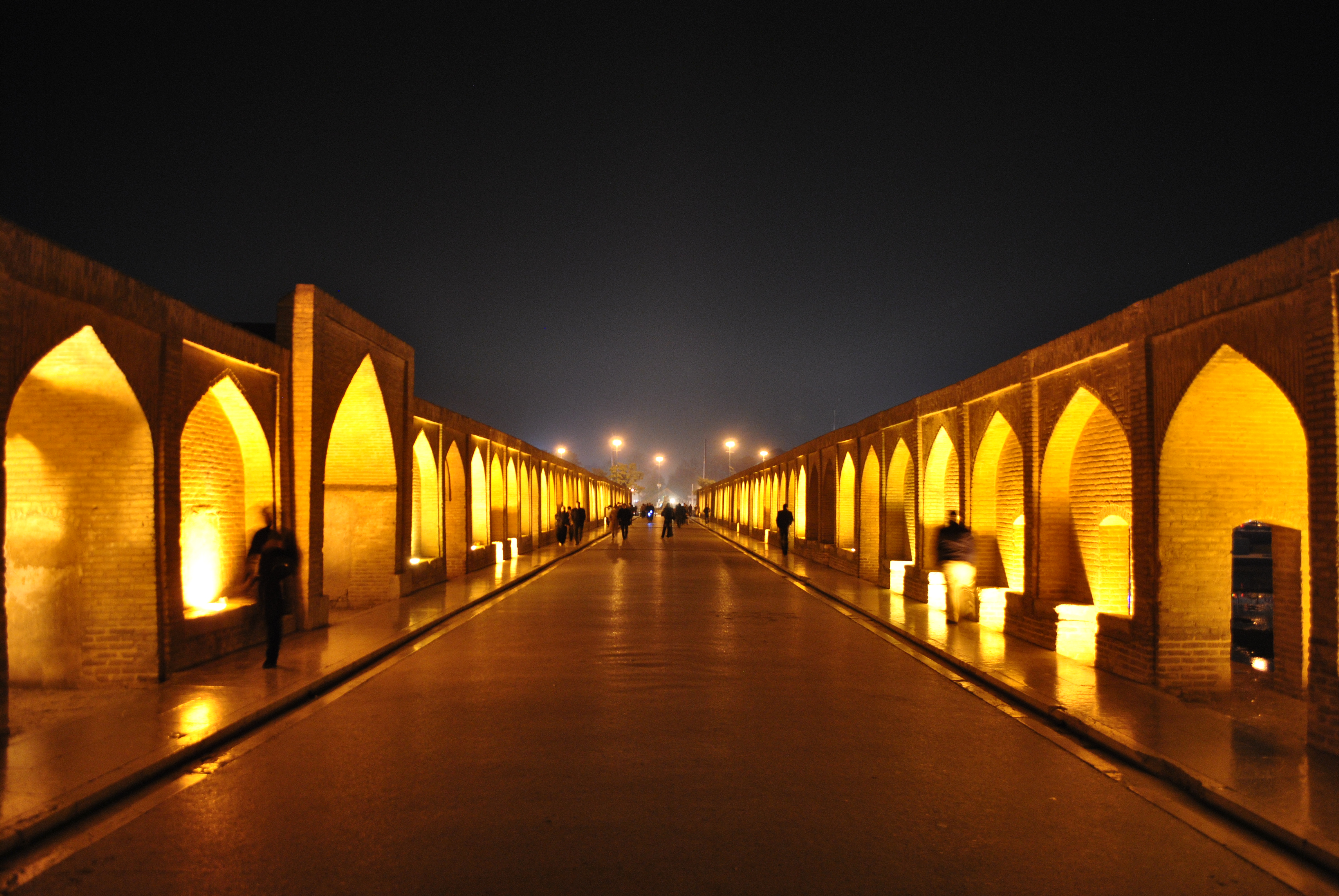
Khaju Bridge
Most bridges carry traffic. The Khaju Bridge carries a civilization's idea of what a bridge should be. Built around 1650 under Shah Abbas II, the seventh ruler of Safavid Iran, it stretches 133 meters across the Zayanderud -- the largest river of the Iranian Plateau -- on 23 stone arches. But calling it a bridge understates the ambition. It is also a dam, a public meeting hall, a gallery of tilework and painting, and, according to the art historian Arthur Upham Pope, "the culminating monument of Persian bridge architecture." Two stone lions guard its eastern approach, carved symbols of the Bakhtiari troops who once garrisoned Isfahan.
Engineering in Disguise
Beneath the tilework and the pavilions, the Khaju Bridge is a sophisticated piece of hydraulic engineering. Sluice gates built into the archways allow the water level upstream to be raised by as much as six meters, creating a reservoir that feeds irrigation channels for the gardens and farms lining the Zayanderud's banks. When the gates open, excess flow passes downstream to prevent flooding. The bridge functions as a weir, regulating the river for agriculture in a region where every drop matters. This dual purpose -- beauty above, infrastructure below -- is characteristic of Safavid design, which treated utility and aesthetics as inseparable rather than competing goals.
A Shah's Viewing Platform
Shah Abbas II did not build the Khaju Bridge from scratch. It rises on the foundations of an older crossing, its exact age unknown. What Abbas II added was grandeur. A pavilion sits at the center of the structure where the shah himself once sat to admire the view -- the river below, the Zoroastrian quarter on one bank, the Khaju quarter on the other. His goal was strategic as well as scenic: the bridge connected the Khaju district and the Hassanabad Gate with Takht-e Folad and the road south to Shiraz, knitting together neighborhoods that the river had kept apart. Inscriptions on the bridge record a repair in 1873, confirming that later dynasties valued the crossing enough to maintain it.
Where Poets Gathered
The bridge was never merely functional. Its arched lower level, with alcoves recessed into the piers, served as a public gathering place -- a covered promenade where Isfahanis came to talk, debate, and listen. The poet Saeb Tabrizi composed a long poem describing a night of celebration and illumination beside the bridge, and he was not the only writer the Khaju inspired. For centuries, Isfahan's poets praised the bridge as one of the city's defining works. Today, musicians still gather in the alcoves beneath the arches, their voices amplified by the vaulted stone. The acoustics are not accidental. The spaces were designed for human voices as much as for water flow.
A Masterpiece Under Pressure
The French artist Eugene Flandin painted the bridge in 1840, and early 20th-century photographs show it largely unchanged from his depiction. But recent decades have brought threats. Iranian architects have raised alarms about damage caused by modern renovation programs, citing the destruction of the original stepped base, alterations to the riverbed, and the removal of Safavid-era inscribed stone blocks. The Zayanderud itself has become intermittent, its flow diminished by upstream dams and agricultural extraction. When the river dries, the bridge loses its context -- a weir with nothing to weigh, arches framing empty sand. The bridge endures, but the landscape it was designed to govern is changing around it.
From the Air
Located at 32.637N, 51.683E spanning the Zayanderud River in Isfahan. The bridge's 133-meter length and distinctive arched profile are visible from low altitude. Isfahan Shahid Beheshti International Airport (OIFM) lies approximately 19 km to the east. The Si-o-se-pol bridge is visible about 1 km upstream to the west. Best viewed below 3,000 feet AGL in clear conditions for architectural detail.