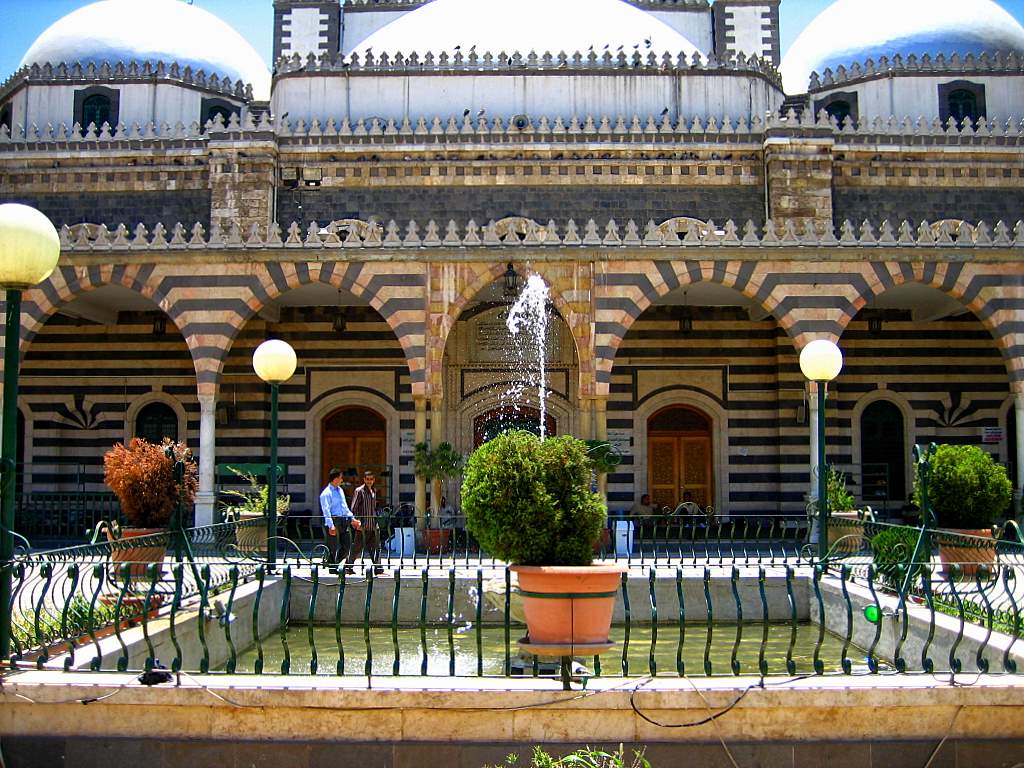
Khalid ibn al-Walid Mosque
Khalid ibn al-Walid never lost a battle. The 7th-century Arab commander who broke Byzantine rule in Syria and led the Muslim conquest of the Levant earned the title "Sword of God," and his tomb in Homs has drawn pilgrims for more than a thousand years. The mosque built around that tomb -- rebuilt, expanded, damaged, and restored across the centuries -- sits in a park along Hama Street in ash-Shuhada Square, its silver central dome catching the light above two black-and-white striped minarets. It is at once a place of worship, a pilgrimage center, and an involuntary monument to the cycles of destruction and repair that define Syrian history.
The Sword of God's Resting Place
A small mosque reportedly stood adjacent to Khalid's mausoleum as early as the 7th century, though the interior shrine containing the tomb dates to the 11th century. The structure that pilgrims came to know was built during the reign of Mamluk sultan al-Zahir Baybars in 1265 and restored under al-Ashraf Khalil in 1291. Inside the mausoleum, ornate decorations depict more than 50 victorious battles that Khalid commanded -- a visual catalog of conquest that transformed the boundaries of the ancient world. His son is buried beside him. A wooden sarcophagus carved with Kufic inscriptions quoting the Quran once covered the grave, though it was eventually moved to the National Museum in Damascus during renovations.
Bands of Black and White
The present-day mosque was built in the early 20th century in Ottoman style, replacing the Mamluk-era structure. Its architecture speaks the visual language of the Levant: ablaq masonry, the technique of alternating horizontal bands of black basalt and white limestone, runs across the courtyard and minarets. The central dome, metallic and silver, sits atop four massive columns built in Mamluk ablaq style. Nine smaller domes surround it. The minarets at the northwestern and northeastern corners rise with narrow galleries, their striped stonework visible from across the city. Inside, the prayer hall's walls are constructed of basalt, a building material abundant in the volcanic landscape around Homs. The old cemetery that once encircled the mosque has been replaced by gardens, softening the transition between sacred architecture and the modern city.
Symbol of Defiance
When Syria's civil war reached Homs, the Khalid ibn al-Walid Mosque became a focal point of resistance. On 18 July 2011, according to The New York Times, Syrian security forces killed ten protesters leaving a funeral procession from the mosque -- an event that transformed the building from a place of prayer into a symbol of anti-government rebellion. Rebels took shelter inside its walls. The government declared the mosque had been turned into "an arms and ammunition depot." By 27 July 2013, the rebels had abandoned the building, but not before government shelling had damaged Khalid's tomb and left parts of the interior charred. State media footage showed the burned prayer hall, the shattered door to the mausoleum, and rubble where ablaq columns had stood for a century.
Restoration and Return
The mosque's repair came from an unexpected direction. Chechen leader Ramzan Kadyrov funded and oversaw the restoration, reopening the mosque in a ceremony that underscored the tangled international dimensions of Syria's conflict. The reconstruction returned the building to its Ottoman-era appearance, though the damage that preceded it left psychological scars no renovation could address. For the Sunni community of Homs, the mosque's destruction during the civil war echoed centuries of earlier violence: Mamluk restorations after medieval wars, Ottoman repairs after earthquakes. Stamps depicting the mosque have been issued by the Syrian government in several denominations over the years -- small pieces of paper asserting the permanence of a building that history has repeatedly tried to erase.
Pilgrimage Persists
Pilgrims still come to Homs to visit the tomb of the undefeated general. The shrine is considered a significant pilgrimage center, drawing visitors who trace the same path that Muslims have followed since the mausoleum was first established. They come to stand beside the grave of a man who fought at the Battle of Yarmouk in 636, the engagement that ended Byzantine control of Syria and opened the region to Islamic civilization. The mosque that houses him has been Mamluk, Ottoman, a rebel stronghold, and a war ruin. Each incarnation has been folded into its walls. Walking through the restored courtyard, past the ablaq stonework and beneath the silver dome, visitors encounter not just the memory of a warrior from fourteen centuries ago, but the layered testimony of every conflict that has washed through Homs since.
From the Air
Located at 34.74N, 36.72E in the Khaldiya district of Homs, Syria. The mosque's silver central dome and twin black-and-white minarets are identifiable from moderate altitude. Homs sits in the Orontes River valley at approximately 500 meters elevation. Nearest major airport is Homs Military Airport. Bassel Al-Assad International Airport (OSLK) in Latakia is approximately 150 km northwest. The city is a major crossroads between Damascus, Aleppo, and the Mediterranean coast.