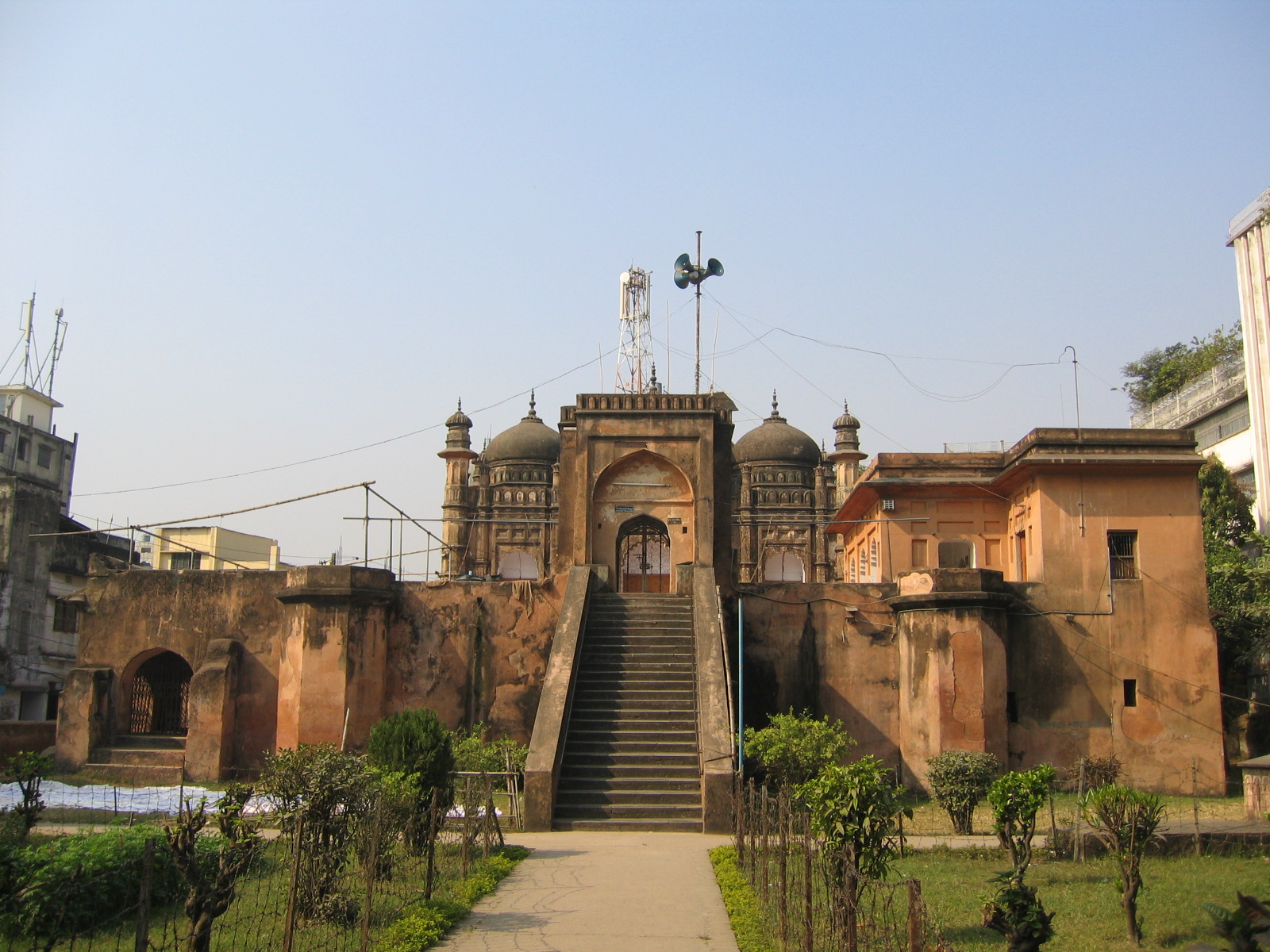
Khan Mohammad Mridha Mosque
Twenty-five steps lead up from the street. That is the first thing visitors notice about the Khan Mohammad Mridha Mosque, and it is the detail that defines the entire building. While most mosques in Old Dhaka sit at ground level, pressed into the dense urban fabric, this one rises on a platform 16 feet and 6 inches above its surroundings. The elevation is not decorative. Beneath the prayer platform lies a tahkhana, a series of vaulted underground rooms originally built for living quarters, whose roof forms the terrace on which the mosque sits. The effect, climbing those steps from the narrow lanes near Lalbagh Fort, is of leaving the crowded city behind and arriving somewhere the air can move.
Built by Order, Named by Mystery
The mosque was constructed in 1706 in the Atish Khan Mahalla neighborhood under the instruction of Qadi Ibadullah, a religious judge whose authority carried the weight of the Mughal state. The man who built it, Khan Mohammad Mridha, gave the mosque its common name, but a Persian inscription found on the central archway refers to the builder as Khan Muhammad Mirza, suggesting he may have been the architect as well as the patron. The construction took place during the rule of Farrukhsiyar, the deputy governor of Dhaka, placing the mosque squarely in the late Mughal period when Bengal's provincial capitals were producing ambitious religious architecture. Northwest of the mosque, a madrasa was established whose founding teacher, Mawlana Asadullah, taught fiqh, philosophy, and logic in Arabic and Persian until his death in 1709. The school was funded by the Nawabs of Bengal.
Three Domes Above the City
The prayer hall measures 48 by 24 feet, capped by three domes in the standard Mughal arrangement: a larger central dome flanked by two smaller ones achieved through intermediary pendentives. Corner minarets rise just above the parapet, slender and short, topped with ribbed cupolas. The facade carries paneling and ornamental merlons along the roofline, while multi-cusped arches frame the entrances, flanked by engaged columns. Inside, two lateral arches divide the hall into three bays, each containing a mihrab marked by a multi-cusped arch within a rectangular panel. The annex to the north serves as a madrasa with a hujra, an arcaded hall that doubles as shelter for travelers. Seasonal flowers bloom in the eastern garden, tended by a gardener from the Department of Archaeology. An abandoned well in the northern garden once supplied water for wudu, the ablution before prayer.
A Monument Besieged
In 1913, the Archaeological Survey of India listed the mosque as a historic monument, but by then alterations had already accumulated. The earliest known photograph shows a ruined structure at the turn of the 19th century. Subsequent repairs by both the Department of Archaeology and the mosque committee sometimes ignored the building's architectural and historic significance, replacing friezes and ornamental features with dissimilar substitutes. Encroachments steadily constricted the compound's boundaries, a problem serious enough to make the mosque a case study at a 1989 architectural conservation workshop in Dhaka, sponsored by the Aga Khan Trust for Culture and the United Nations Development Programme. The site's mutawalli has been blunt about the state of affairs: the mosque is government-owned and supervised by the Department of Archaeology, but the government intervention lacks both sincerity and transparency.
Where Worship Meets Weathering
The Khan Mohammad Mridha Mosque occupies a peculiar position in Dhaka's heritage landscape. It is simultaneously a protected archaeological site and an active place of worship, two roles that have often worked at cross purposes. Conservation rules have restricted the mosque committee's ability to make necessary repairs, while government agencies have not filled the gap with adequate funding or attention. Despite the Bangladesh National Building Code, the Metropolitan Building Rules of 2006, and the Antiquities Act of 1968, all of which require protection of heritage sites, enforcement has been minimal. The mosque stands 150 meters west of Lalbagh Fort, one of Dhaka's most visited Mughal monuments. Visitors who climb those 25 steps today find a building that is diminished but not defeated, its three domes and open terrace still offering what they were designed to provide three centuries ago: a place to pray above the noise of the city.
From the Air
Located at 23.721°N, 90.385°E in Old Dhaka, approximately 150 meters west of Lalbagh Fort. The elevated platform and three domes are visible from low altitude near the fort complex. Nearest major airport is Hazrat Shahjalal International Airport (VGHS), approximately 13 km north. The Buriganga River runs roughly 1 km to the south. Best viewed in conjunction with Lalbagh Fort, which provides a clear landmark for orientation.