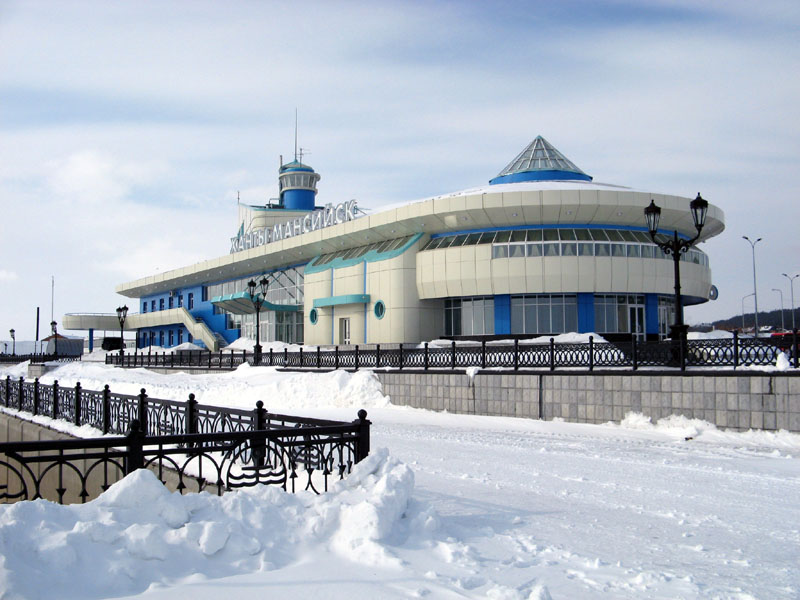
Khanty-Mansiysk
Most regional capitals are the largest cities in their regions. Khanty-Mansiysk is not even close. With roughly 101,000 inhabitants, it is dwarfed by Surgut, Nizhnevartovsk, and Nefteyugansk -- all oil boomtowns that grew fat on the petroleum beneath Western Siberia's frozen marshes. Yet Khanty-Mansiysk is the capital, the administrative heart of Khanty-Mansi Autonomous Okrug-Yugra, and it has leveraged that status into something unexpected: a subarctic city that hosts world-class sporting events, international chess tournaments, and cultural institutions that would be ambitious for a city ten times its size.
Names Beneath the Name
The city sits on the eastern bank of the Irtysh River, 15 kilometers from its confluence with the Ob, two of Siberia's great waterways meeting in the taiga. Before 1940, this place was called Ostyako-Vogulsk, combining the older Russian names for the indigenous Khanty and Mansi peoples -- the Ostyaks and the Voguls. The renaming honored the peoples themselves rather than the Russian labels applied to them, though by the 2010 census, Khanty made up only 3.9% of the population and Mansi just 1.6%. Russians comprised 73%. The city was founded in 1930 as a work settlement around an existing village, one of many Soviet-era administrative centers planted across Siberia to organize territories that had previously organized themselves. The Khanty and Mansi languages, both Uralic tongues and the closest living relatives of Hungarian, still hold official status alongside Russian, though they are not widely spoken.
Chess Capital of the Frozen North
What Khanty-Mansiysk lacks in population, it compensates for in ambition. The Ugra Chess Academy has hosted an astonishing roster of international events: the 2010 Chess Olympiad, for which the Olympic Hotel was purpose-built to house players; the Women's World Chess Championship in 2012; Chess World Cups in 2005, 2007, 2009, and 2011; the World Rapid and Blitz Championship in 2013; and the 2014 Candidates Tournament. In 2015, the FIDE Grand Prix came to town, and in 2018, 64 women chess players from 28 countries competed here for the FIDE Women's World Championship, won by Ju Wenjun of China. For a city above the 60th parallel, where subarctic winters plunge temperatures to extremes and the average annual temperature hovers well below freezing, this concentration of elite intellectual competition is remarkable -- though perhaps the long, dark winters explain the appeal of a game played indoors.
Biathlon Trails and Ice Palaces
Chess is not the only sport that thrives here. The snow and cold that define Khanty-Mansiysk's subarctic climate make it a natural venue for winter sports. Biathlon World Cup competitions are held annually in the city, which hosted the full Biathlon World Championships in both 2003 and 2011. The first Mixed Biathlon Relay Championships took place here in 2005. In 2011, the IPC Biathlon and Cross-Country Skiing World Championships brought para-athletes to compete on the same trails. The city also hosted the 2015 Winter Deaflympics, and its Ice Palace has served as home to HC Yugra of the Supreme Hockey League. The infrastructure built for these events -- hotels, sports complexes, a river port, an airport serving Utair Aviation -- has transformed what was once a remote administrative outpost into a small city with outsized facilities, all of it underwritten by the oil revenues that flow through the autonomous okrug.
Sacred Ground, Ancient and Modern
Beneath the modern sports venues and chess academies, older stories persist. The Church of the Intercession of the Theotokos in Samarovo traces its origins to the aftermath of Cossack Yermak's defeat of Khan Kuchum's army near Tobolsk in the late 16th century. A stone structure was built on the site in 1816, designed by an architect named Shangin. The Soviet regime plundered the church, and its ruins lay buried for decades until excavations in 1994 uncovered the original foundation. Restoration began in 1996, and by 2001 the church was consecrated anew. Patriarch Alexy II of Moscow visited that same year. The church's resurrection mirrors the city's own trajectory: something dormant for decades, then rebuilt with resources that earlier generations could not have imagined. At 61 degrees north, where the Irtysh slides toward its meeting with the Ob and winter lasts half the year, Khanty-Mansiysk keeps building.
From the Air
Located at 61.0N, 69.0E on the eastern bank of the Irtysh River, near its confluence with the Ob River. Khanty-Mansiysk Airport (USHH) is located just outside the city center and serves as the primary regional hub. The city is visible from altitude as a compact urban area surrounded by taiga forest and river floodplains. Best viewed at 3,000-6,000 ft AGL. The convergence of the Irtysh and Ob rivers is a major visual landmark. The Ice Palace and sports facilities are distinctive structures on the city's periphery.