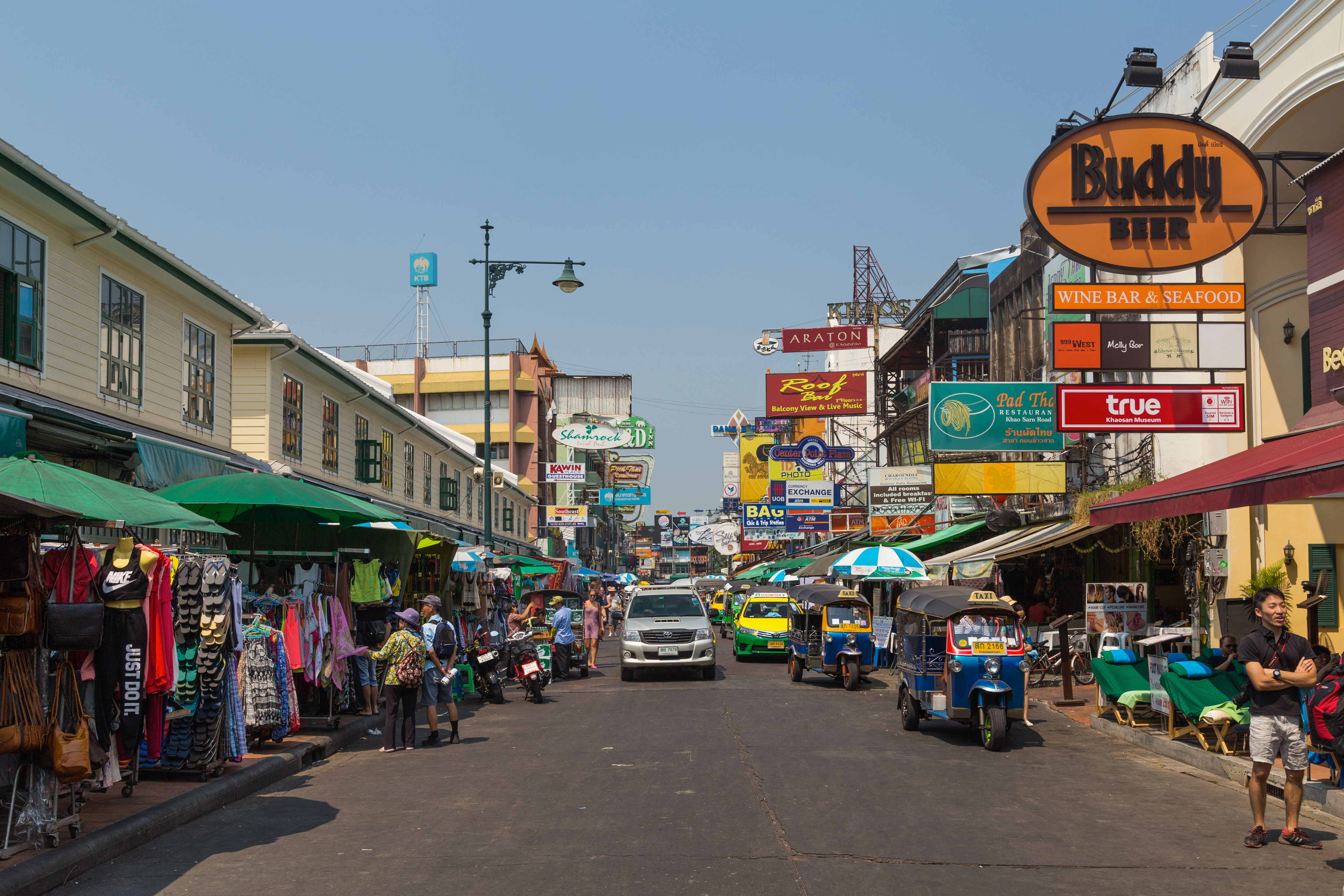
Khaosan Road
One Thai writer called it 'a short road that has the longest dream in the world.' At 410 meters, Khaosan Road barely qualifies as a proper street. You can walk its full length in five minutes -- assuming you can push through the crowd, which during high season numbers 40,000 to 50,000 people per day on a strip narrower than a two-lane highway. The name translates as 'milled rice,' a reminder that this was once a Bangkok rice market, unremarkable and functional. Sometime around 1982, a guesthouse opened in a narrow alley connecting to Ratchadamnoen Avenue, and the transformation began. Within a generation, Khaosan Road became the global nerve center of backpacker culture -- the place where gap-year travelers landed, budget itineraries were hatched, and the boundary between tourism and disappearance blurred into something Susan Orlean once described as 'the place to disappear.'
Before the Backpackers
In the early 1980s, Khaosan Road was a quiet residential and commercial street in Bang Lamphu, one of Bangkok's oldest neighborhoods, about a kilometer north of the Grand Palace. Small shophouses lined both sides: beef noodle stalls, grocery stores, Thai fabric shops, and a few illegal snooker clubs frequented by teenagers. Some old houses belonging to local gentry remained. The area's character was shaped by its neighbors -- Wat Chana Songkram, a centuries-old Buddhist temple under royal patronage, sits directly opposite the road to the west, while a small Islamic community with several mosques occupies the area to the northwest. Khaosan Road was built in 1892 during the reign of Rama V, part of the modernization of Bangkok's road network. For nearly a century, nothing about it suggested it would become internationally famous.
The Backpacker Ecosystem
What drew the first travelers was proximity to the Grand Palace and cheap rent. What kept them was each other. Backpacker economies are self-reinforcing: one guesthouse attracts travelers, travelers attract vendors, vendors attract more travelers, and soon the street develops its own gravitational pull. By the 1990s, Khaosan had evolved a complete ecosystem. Shops sold handicrafts, pirated CDs and DVDs, used books in a dozen languages, and -- notoriously -- fake student IDs and press credentials. Food hawkers offered barbecued insects and exotic snacks calibrated to the adventurous tourist palate. After dark, the road became a block party: bars opened their fronts onto the street, music competed from every direction, and touts promoted entertainment of varying legality. The road also became a staging ground for onward travel -- bus tickets to Chiang Mai, boat trips to the southern islands, visa runs to Cambodia -- making Khaosan not just a destination but a hub.
Songkran and the Water Wars
Khaosan Road's most famous annual spectacle coincides with Songkran, the traditional Thai New Year celebrated from 13 to 15 April. What begins as a Buddhist ritual of water blessing escalates, on Khaosan Road, into one of the largest water fights on Earth. Thousands of people armed with water guns, buckets, and garden hoses drench every person on the street without exception. The event draws visitors specifically for the chaos -- tourists who fly to Bangkok for three days of sanctioned mayhem in tropical heat. The water fight has become so central to Khaosan's identity that it eclipses everything else the road does during the rest of the year. It is, in a sense, the purest expression of what the street represents: a place where the normal rules of public behavior are suspended by mutual consent, and where the line between participant and spectator does not exist.
Cleaning Up the Dream
Bangkok's authorities have spent years trying to impose order on a street that thrives on its absence. In July 2018, the Bangkok Metropolitan Administration announced that street vendors would be removed from Khaosan Road, relocated to a nearby area, and restricted to evening hours. The Khaosan Street Vendors Association, representing some 300 vendors, refused. On the first day of the ban, roughly 70 percent of vendors opened as usual in defiance of police. Neither side blinked. The following year, the BMA committed 48.8 million baht to transform the road into an 'international walking street,' installing proper drainage, designated vendor stalls, scheduled shifts, and emergency vehicle access. The facelift was completed in 2019. Whether it tamed Khaosan Road is a different question. The street has survived every attempt at regulation the way it has survived every other disruption -- by absorbing it, adapting, and continuing to draw the people who come looking for whatever it is that a 410-meter strip of pavement in Bangkok can offer that nowhere else quite can.
From the Air
Located at 13.7589N, 100.4972E in the Bang Lamphu area of Phra Nakhon District, approximately 1 km north of the Grand Palace. The short street is not individually visible from altitude but sits within the dense historic district near the Chao Phraya River. Nearest airports: Don Mueang (VTBD) approximately 15 nm north; Suvarnabhumi (VTBS) approximately 18 nm east-southeast.