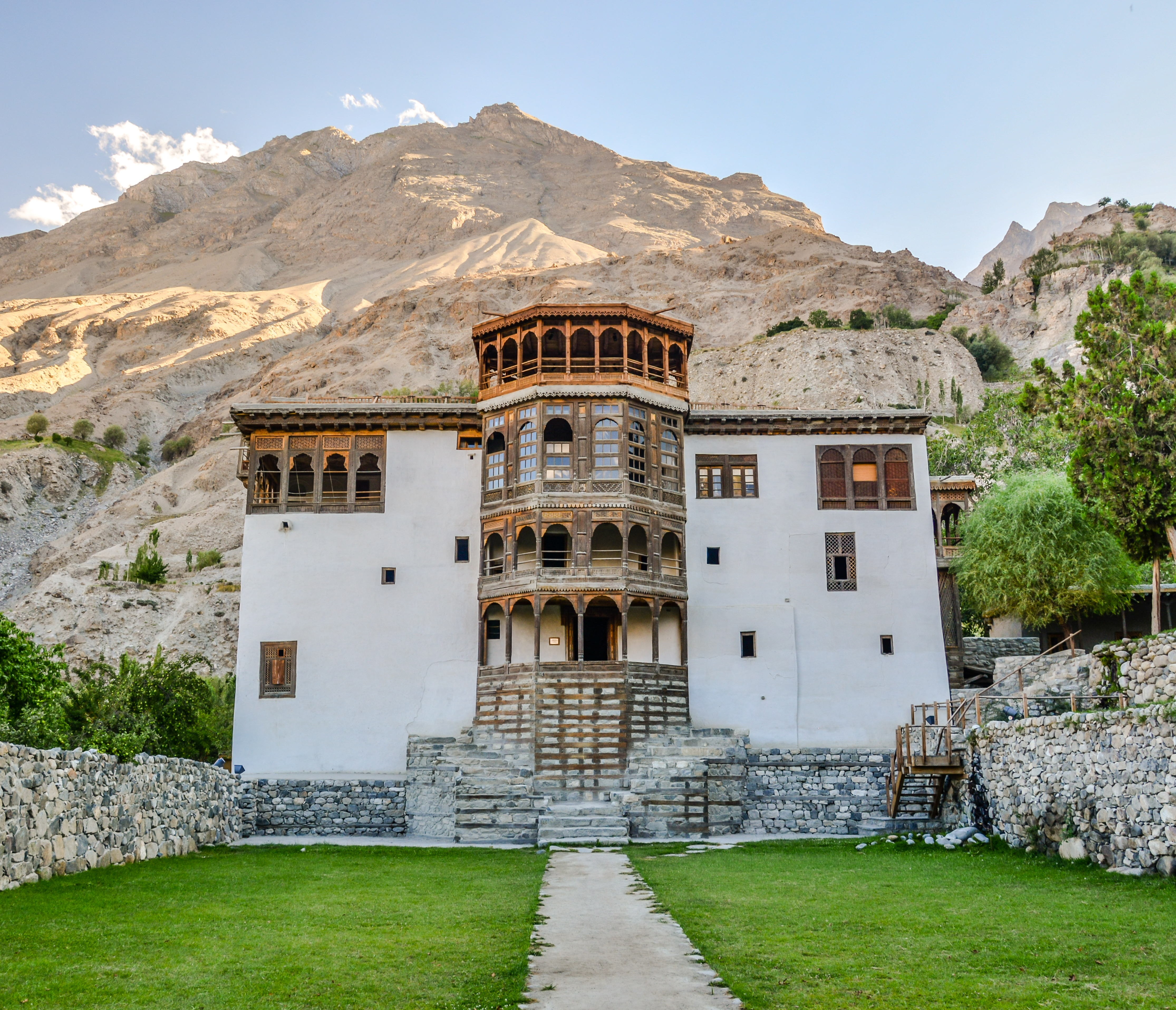
Khaplu Palace
The method for choosing where to build was simple and irreversible: roll a large stone from the cliff above, and wherever it stops, lay the foundation. In 1840, Yabgo Raja Daulat Ali Khan of Khaplu did exactly that. The boulder came to rest at Doqsai village, and the palace -- known locally as Yabgo Khar -- rose on that spot, replacing an older fort that had already weathered centuries of siege and conquest. Today, at 2,600 meters above sea level in eastern Baltistan, Pakistan, Khaplu Palace stands as both a museum of regional history and a functioning luxury hotel, its wooden ceilings still bearing the chisel-and-paint designs of Kashmiri and Balti craftsmen who used not a single nail in their construction.
A Fort Before the Palace
The palace was not Khaplu's first seat of power. An earlier fort, located near the present-day palace site, had served the Yabgo dynasty for generations before it fell to outside forces. In the 1590s, Murad Khan of the Maqpon Dynasty -- rulers of all Baltistan -- besieged the fort for three months, cutting off water and supplies until the 62nd Yabgo ruler, Rahim Khan, surrendered. The fort changed hands again in the 1660s and 1674. By the time the Dogra of Jammu captured the wider region in the 19th century, the old fort had served its purpose. The Dogra moved the seat of government, and Daulat Ali Khan seized the opportunity to build something grander -- a palace rather than a fortress, designed for ceremony and residence rather than war.
Craftsmanship Without Nails
The palace was constructed by Kashmiri and Balti artisans whose techniques favored precision over hardware. The wooden ceilings are covered in intricate designs executed entirely with chisel and paint -- no nails hold them together. Beyond the main gate, which once housed a stable, a passage opens onto a front lawn where musicians performed during the festivities of the Yabgo Rajas. Inside, the rooms carry names that describe their function and their grandeur: the Chogoraftal, the royal meeting room; the Chogojarokh, the royal balcony; the Lainakhang, the princess's dressing room. The River Shyok, a tributary of the Indus, flows past the town below, following the ancient trade route that once connected Baltistan to Ladakh. That proximity to the Silk Road shaped Khaplu's prosperity and its architecture -- a blend of Tibetan, Central Asian, and Kashmiri influences converging in a single building.
Rescue and Revival
By the early 2000s, Khaplu Palace was deteriorating. In 2005, the Aga Khan Trust for Culture launched a restoration under the Aga Khan Historic Cities Programme, funded by the Norwegian Ministry of Foreign Affairs and guided by the Venice Charter's standards for heritage conservation. The project lasted six years, with material costs reaching 30 million rupees and labor costs totaling another 25 million. USAID contributed funding for an exhibition centre dedicated to Balti culture, which now occupies two-thirds of the site. The remaining portion operates as a heritage hotel managed by Serena Hotels, where guests sleep in the same rooms that once housed royalty. The restoration earned the Virgin Holidays Responsible Tourism Award in 2012 for poverty reduction, and in 2013, UNESCO honored the project with its Asia Pacific Heritage Award for Distinction.
Baltistan's Crossroads
Khaplu sits at the administrative heart of Ghanche District, but its significance has always exceeded its official status. The town occupies a position on the Shyok River where trade routes from Ladakh, Central Asia, and the Indus Valley once converged. A trek behind the palace leads through a ravine to the village of Pari in Skardu District, one of many footpaths that predate roads by centuries. The Yabgo dynasty that built the palace ruled Khaplu for at least 62 generations before Rahim Khan's surrender in the 1590s -- a lineage that stretches back to a time when Buddhism, not Islam, dominated the region. Today the palace museum traces that arc, from the earliest Yabgo rulers through the Maqpon conquests, the Dogra occupation, and the eventual absorption of Baltistan into Pakistan. The drama serial Dayar-e-Dil, one of Pakistan's most-watched television productions, was filmed here -- a testament to the palace's cinematic quality and its hold on the national imagination.
From the Air
Located at 35.15°N, 76.34°E in the Ghanche District of Gilgit-Baltistan, Pakistan, at an altitude of approximately 2,600 m (8,530 ft). The River Shyok is visible threading through the valley below. The nearest major airport is Skardu Airport (OPSD), approximately 100 km to the west. The Karakoram Range dominates the northern and eastern horizons. Best viewed in clear weather; the palace compound is visible as a cluster of traditional architecture on the valley floor. The Line of Control with India lies to the east.