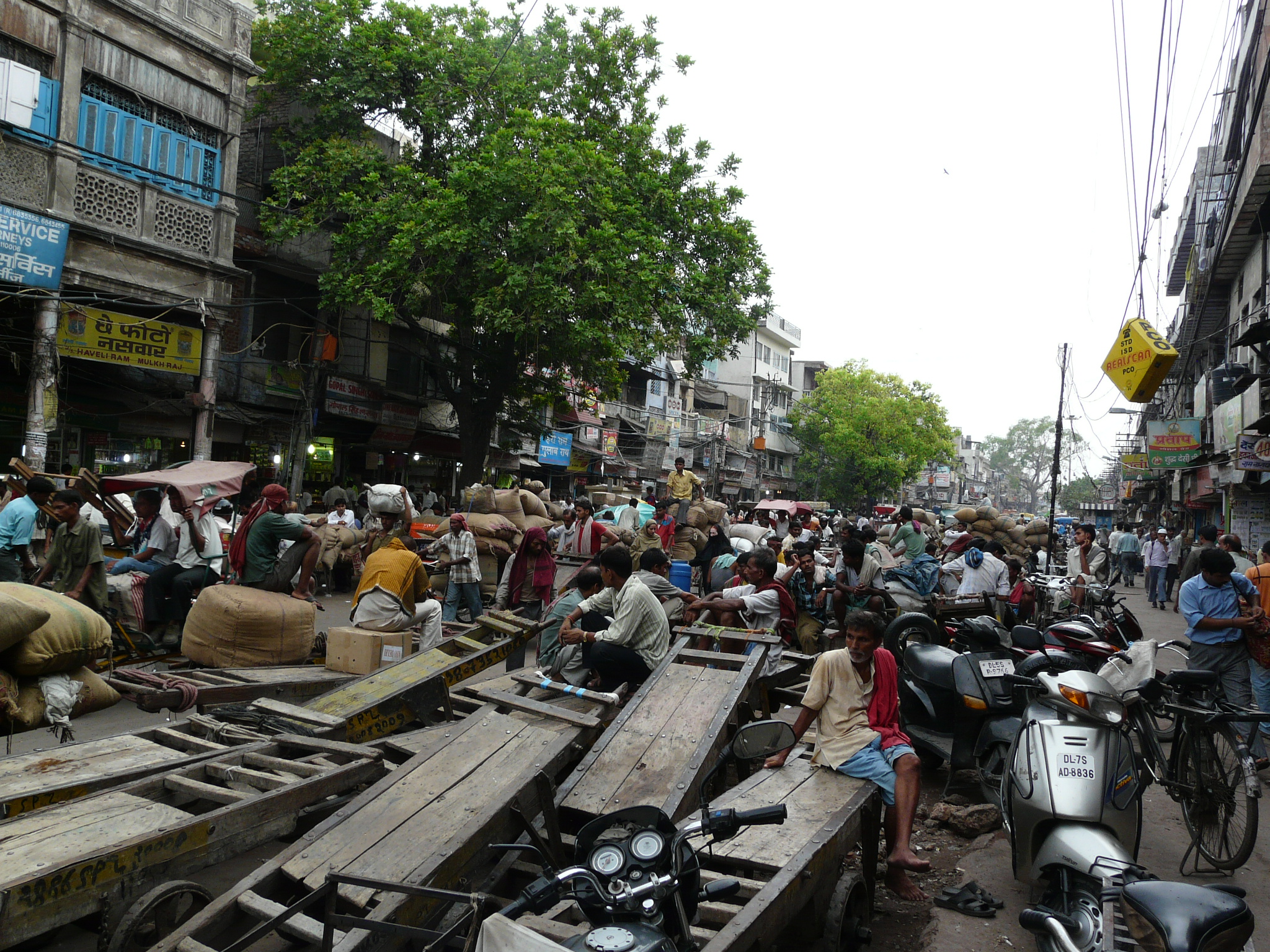
Khari Baoli
The smell hits before anything else. Turmeric, cumin, dried chili, cardamom -- arriving at Khari Baoli is less like entering a market and more like walking into a cloud of concentrated flavor. This narrow street in Old Delhi, wedged between the Fatehpuri Masjid and the western end of Chandni Chowk, has been trading spices since the reign of Shah Jahan in the 17th century. It is Asia's largest wholesale spice market. Somewhere beneath the asphalt and the handcarts and the burlap sacks stacked head-high, a saline stepwell lies buried -- the brackish water source that gave this place its name. Khari means salty. Baoli means stepwell. The well is gone, but the market it spawned has never stopped.
A Well Before the Spices
Khari Baoli's origins predate the spice trade by a century. In 1551, during the reign of Islam Shah -- son of the Afghan conqueror Sher Shah Suri -- a nobleman named Khwaja Abdullah Laazar Qureshi commissioned a stepwell on this site. Persian inscriptions once marked the structure, carved near the eleventh step on the southern wall and above the entrance, invoking blessings in the name of Allah and the Prophet. Nothing remains of the well itself today; the inscriptions survive only as copies preserved in 19th-century texts like Sir Syed Ahmad Khan's Aasar Us Sanadeed. The stepwell's saline water was used for animals and bathing, never for drinking -- a practical distinction that shaped the neighborhood's character long before the first sack of pepper changed hands here.
Shah Jahan's Market Takes Root
The market grew up around the Fatehpuri Masjid, built in 1650 by Fatehpuri Begum, one of Shah Jahan's wives. During Shah Jahan's reign, the street acquired its name from the existing stepwell, and a fortified gateway known as the Lahori Gate was constructed at its western end -- one of fourteen gates ringing the walled city of Shahjahanabad. The Lahori Gate pointed toward Lahore, now across the border in Pakistan. Like the stepwell, both the gate and well have vanished beneath the modern road. But the commercial energy they anchored has proved far more durable than stone. Many shops here are still identified by their original serial numbers -- "Chawal Wale 13" or "21 Number Ki Dookan" -- and some are run by the ninth or tenth generation of families who founded them in the 17th and 18th centuries.
Traders, Migrations, and Pickles
Khari Baoli's merchant community expanded dramatically in the 1930s. In 1936, Chowdhary Chhotu Ram, a minister in the Punjab Government, issued a law canceling village debts. The policy devastated Agrawal trading families, who lost their businesses overnight and migrated to Delhi in large numbers. They settled in neighborhoods like Kamla Nagar and Shakti Nagar, but they brought their trade to the old walled city -- to Chandni Chowk, Dariba Kalan, and above all to Khari Baoli. These families layered new commercial energy onto an already centuries-old market. One institution that predates even this migration is the pickle shop Harnarains, established in the 1860s and now operating as Harnarains International. Its products have reportedly graced the tables of Jawaharlal Nehru and Indira Gandhi -- a claim the shop's owners wear as a badge of honor spanning more than a century and a half of continuous operation.
Gadodia Market and the Scale of the Trade
On the south side of Khari Baoli sits Gadodia Market, built by wealthy merchants in the 1920s and today the beating heart of Asia's largest wholesale spice exchange. The scale is staggering. Traders arrive from Jammu and Kashmir, Rajasthan, and as far as Madhya Pradesh, all funneling through these cramped lanes where handcarts jostle for space and negotiations happen at shouting volume. Spices are only part of the inventory: dried fruits, nuts, herbs, rice, and tea all move through Khari Baoli in bulk quantities that supply much of North India. The margins are thin and the competition fierce, which keeps prices low and the crowd perpetual. At the market's far end, the street connects to the wholesale herb market at Katara Tambaku, where importers and exporters conduct cross-border trade in medicinal plants.
Sensory Overload, Century After Century
Visiting Khari Baoli is an exercise in sensory endurance. The lanes are barely wide enough for two people to pass, yet they carry a river of commerce that has flowed without interruption since the Mughal era. Sacks of red chili powder lean against walls that have absorbed centuries of turmeric dust, staining the stone a permanent gold. Porters balance impossible loads on their heads, threading through gaps that seem to exist only for them. The air is so thick with ground spice that first-time visitors often sneeze uncontrollably, a reaction the shopkeepers find endlessly amusing. There is no sanitized heritage experience here, no interpretive signage or curated walkway. Khari Baoli is a living market that happens to be four centuries old -- and it has no intention of becoming a museum.
From the Air
Khari Baoli is located at 28.658N, 77.221E in Old Delhi, at the western end of Chandni Chowk near the Fatehpuri Masjid. From the air, the dense, irregular rooftop fabric of Old Delhi is clearly distinguishable from the planned grid of New Delhi to the south. The Red Fort complex lies approximately 1.5 km to the east. Nearest major airport is Indira Gandhi International (VIDP/DEL), about 19 km southwest. Best viewed below 2,000 feet to appreciate the narrow street pattern. The Jama Masjid's large domes and minarets serve as a useful visual reference point nearby.